A reel-fed line that takes paper straight from the reel, prints or rules it, collates, stitches, folds, trims and stacks books with a few operators is priced per configuration, and is what high-volume tender supply usually needs. The machine is the smaller part of the business: paper is most of the cost, and school demand is seasonal, peaking before the school year. The Department of Basic Education and the provincial departments deliver workbooks, stationery and textbooks to public schools in all 75 education districts every year, and provinces buy through their own procurement.
Exercise book machine prices, 2026
| What you buy | What it does | Indicative price (2026) | Fits |
|---|---|---|---|
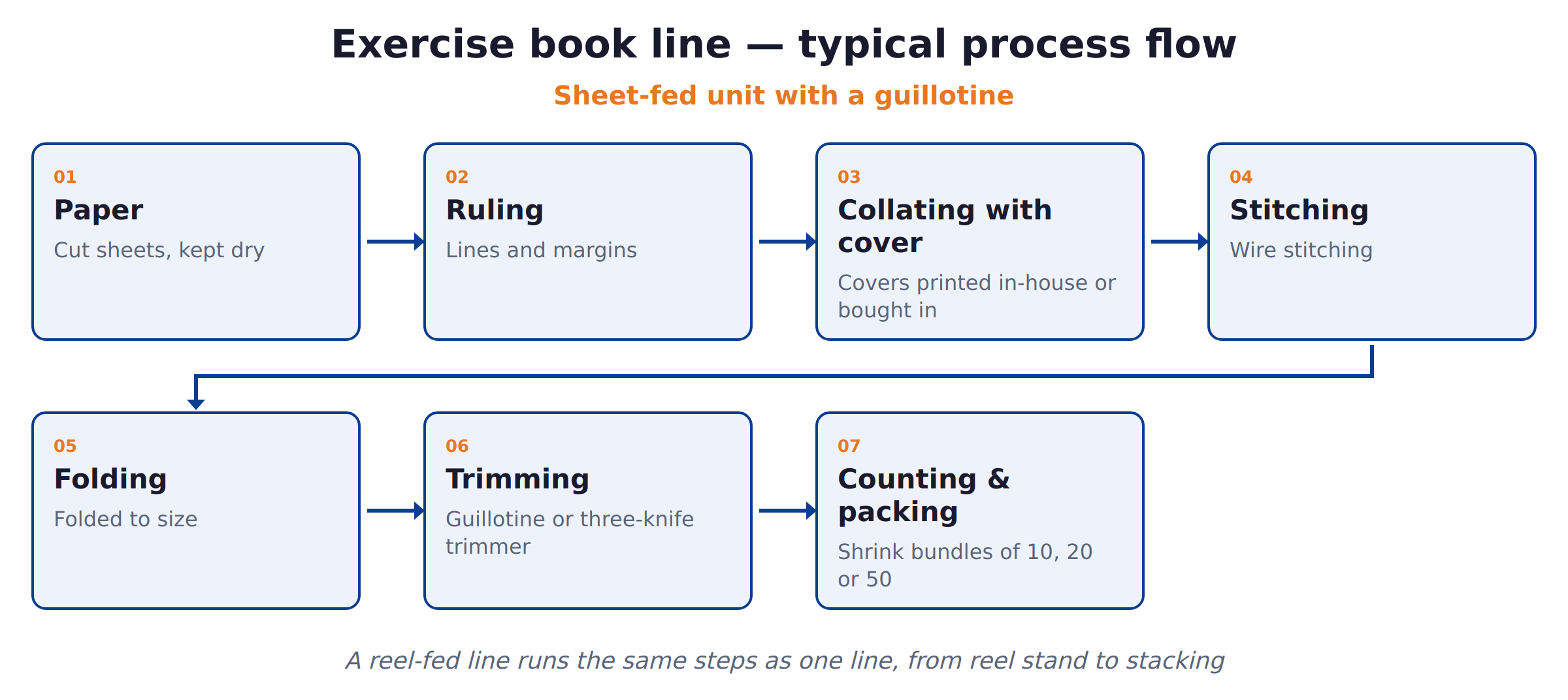
| Sheet-fed exercise book unit | Ruling, collating with cover, stitching and folding of sheets | About US$17,000–30,000 ex-works | Regional converters, stationers |
| Guillotine or three-knife trimmer | Trims books to final size | Priced per machine | Needed with sheet-fed units |
| Reel-fed exercise book line | Reel stand, printing or ruling, sheeting, collating, stitching, folding, trimming, stacking | Quoted per configuration | Tender suppliers, national volumes |
| Cover printing | Printed covers with grids, timetables or school branding | Printed in-house or bought in | All |
| Counting and shrink packing | Bundles of 10, 20 or 50 books | Priced per configuration | Volume supply |
Landed and installed through Durban, budget about 1.25–1.45 times the ex-works price. Paper converting machines under heading 8441 enter South Africa duty-free; VAT applies.
Sheet-fed or reel-fed?
| Sheet-fed unit | Reel-fed line | |
|---|---|---|
| Paper | Cut sheets | Paper reels |
| Steps | Several machines, more handling | One line, little handling |
| Labour | More operators | Fewer operators per book |
| Output | Lower | Much higher |
| Investment | Low | High |
| Change-overs | Simple | Longer, but runs long batches |
| Fits | Regional, mixed orders | Tender volumes, few book types |
Most new businesses start sheet-fed. A reel-fed line makes sense only with volume you can sell every year, such as a multi-year supply contract.
What drives the cost of a book
As an example, an A4 book of 72 pages on paper of about 60 g/m² uses roughly 0.13 kg of paper before the cover. At volume, paper is the largest cost, followed by the cover board, staples or wire, labour, power and packing. A converter that buys paper reels at a good price, keeps waste low and runs long batches makes the margin. Price paper from local mills and importers before you price the machine.
School and LTSM demand
The Department of Basic Education's 2026 readiness update describes how the DBE and provincial education departments deliver consignments of workbooks, school stationery and textbooks to public schools in all 75 education districts each year, guided by a national LTSM sector plan. Provinces run their own procurement, and some schools buy directly. Tenders are published on the National Treasury eTenders portal and provincial portals; suppliers must be registered on the Central Supplier Database, and the Preferential Procurement Regulations 2022 set out how preference points are applied. Read each tender: some require bidders to be manufacturers or authorised distributors, set paper weights and page counts, and fix delivery dates before the school year.
Seasonality
Exercise book sales peak in the months before schools open and in the first term. Plan production through the year and storage for finished books, or combine exercise books with other paper products, such as notebooks, counter books, writing pads or paper bags, to keep the line busy.
How to compare quotes
- Book sizes: A4, A5 and others, with page counts.
- Output: books per hour for your book, not the brochure figure.
- Ruling or printing: number of colours and patterns.
- Binding: wire stitching, sewing or glue, and staple counts.
- Trimming: included or separate.
- Paper range: grammage and reel sizes.
- Counting and packing.
- Installation, commissioning on your paper, and training.
- Spares: stitching heads, knives, belts.
- References of lines running in Africa.
Choose by situation
- Stationer or printer adding books: a sheet-fed unit and a guillotine.
- Regional converter supplying schools: sheet-fed units with cover printing and packing.
- Tender supplier at national volume: a reel-fed line with trimming and counting.
- Mixed paper products: a sheet-fed unit next to other converting machines.
Worked example: a regional exercise book converter
A printer in the Eastern Cape supplies stationers and some schools with bought-in books. It installs a sheet-fed ruling, stitching and folding unit and a guillotine, prints covers on its existing press, and bundles books in shrink film. It registers on the Central Supplier Database and bids for a share of a provincial stationery tender in its second year, building stock from mid-year to deliver before the school year. The figures are illustrative.
Space, staff and power
A sheet-fed unit with a guillotine and a packing table fits in a small industrial unit, but paper and finished books need much more space than the machines: a season's stock of books can fill a warehouse. Keep paper dry and off the floor, because damp paper curls and jams machines. A sheet-fed operation typically needs a few operators per shift for feeding, stitching, trimming and packing; a reel-fed line fewer per book but more skilled people to set it up. Both need three-phase power, and the guillotine needs trained operators and safe guarding under the OHS Act.
Quality buyers check
Schools and retailers look at paper brightness and opacity, whether ink bleeds through, ruling that is straight and evenly spaced, staples that hold, square trimmed edges and the correct page count. Tender specifications often fix paper weight, page count, ruling type and cover details, and inspectors may count pages and weigh samples on delivery. Keep samples from every batch and a record of the paper used, so that you can answer a complaint with evidence.
Mistakes we see
- Buying a reel-fed line without a contract.
- No paper plan: reels bought at spot prices when the season starts.
- No storage: finished books damaged by damp.
- Ignoring tender specifications: page counts and paper weights that do not match.
- No trimming: books with uneven edges that buyers reject.
What we see in South Africa
- Schools are the main market, supplied through provincial procurement and retailers.
- Demand is seasonal, peaking before the school year.
- Paper is the main cost.
- Paper converting machines enter duty-free under heading 8441.
- Tenders require CSD registration and follow the preferential procurement rules.
- Local converters compete with imports on price and delivery time.
Covers
Covers are often printed in-house on an offset or digital press, or bought from a printer. School books usually carry a grid for the learner's name, subject and class; retail books carry designs and brands. Board weight, lamination and print quality affect the price per book more than most converters expect, so cost the cover separately from the inside pages.
Where CISH fits
We supply complete exercise book lines, from sheet-fed units with trimming and packing to reel-fed lines, from audited factories in China, sized to your books and volumes. CISH ships to Durban, clears and delivers the line, installs and commissions it on your paper, and trains your operators. For a single used stitching machine, a local seller is usually the better choice.
Frequently asked questions
How much is an exercise book making machine?
As an indication for 2026, a sheet-fed ruling, stitching and folding unit costs about US$17,000–30,000 ex-works. Reel-fed lines are quoted per configuration.
What machines are needed to make exercise books?
Ruling or printing, collating with covers, stitching, folding, trimming, and counting and packing.
What is the main cost in making exercise books?
Paper, followed by covers, staples, labour, power and packing.
How do I supply exercise books to schools?
Through provincial education department tenders, school purchases and retailers. Register on the Central Supplier Database and read each tender's specification.
Is there import duty on exercise book machines?
Paper converting machines under heading 8441 enter South Africa duty-free; VAT applies.
Does CISH supply exercise book lines?
Yes, complete lines with commissioning and training.