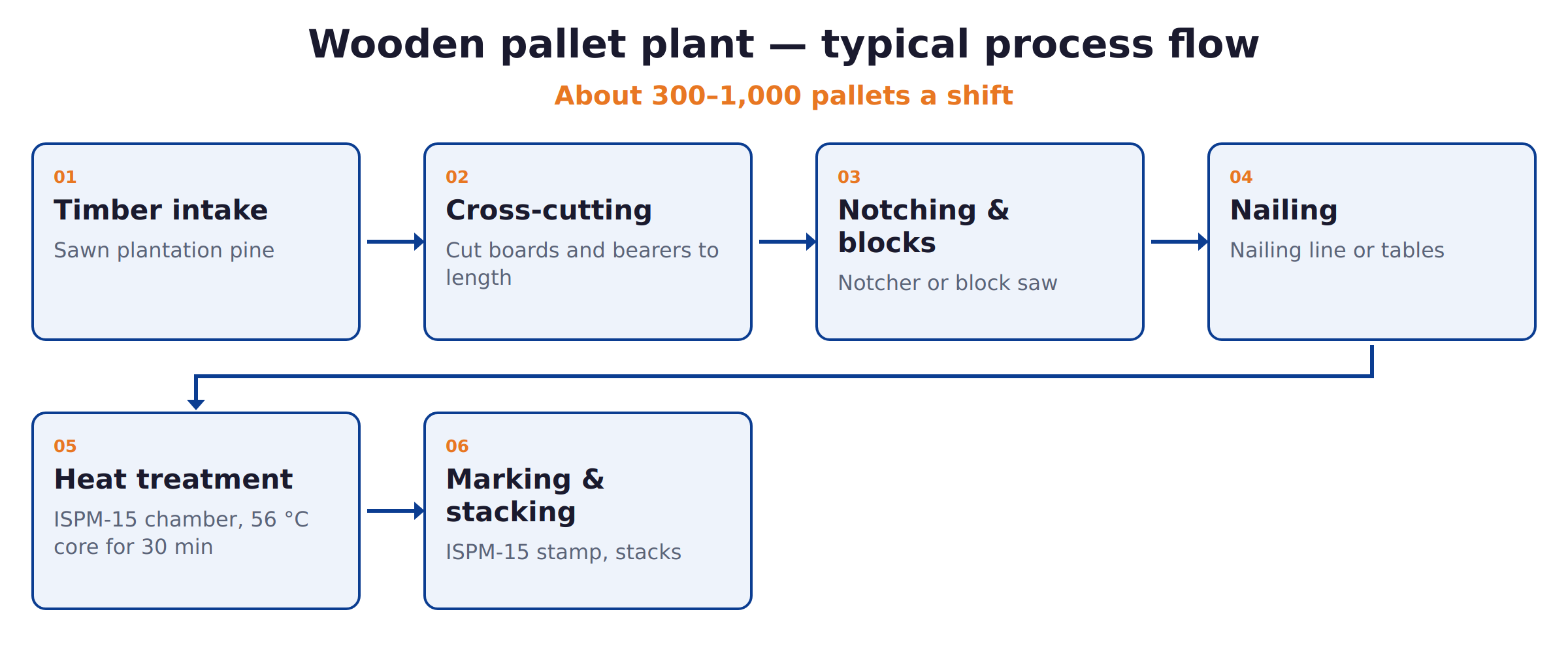
New pallets are cut from timber, mostly plantation pine from sawmills, and nailed together by hand with pneumatic nailers or on a nailing line; refurbishing buys broken pallets, repairs them and resells them at lower prices. Pallets used for export must be heat-treated and marked to ISPM 15, and in South Africa only service providers registered with the Department of Agriculture may treat and mark wood packaging. Timber is most of the cost, and buyers such as fruit packers, manufacturers, retailers' distribution centres and logistics companies buy on price, strength and delivery.
Step 1: new, refurbished or both?
| New pallets | Refurbished pallets | |
|---|---|---|
| Raw material | Sawn timber or logs | Used, broken pallets plus some new timber |
| Equipment | Saws, notchers, nailing tables or line, stacker | Dismantling and repair stations, nailers, sorting |
| Price to customer | Higher | Lower |
| Quality | Consistent, to specification | Variable; graded |
| Buyers | Exporters, manufacturers, customers with specifications | Local logistics, warehouses, one-way shipments |
| ISPM 15 | Required for export pallets | Required for export use, with rules for repaired pallets |
Many businesses do both: refurbishment brings steady volume, new pallets bring margin and export customers.
Step 2: know the pallet types your buyers use
The common local types are stringer pallets and block pallets in sizes such as 1,200 × 1,000 mm, with Euro pallets of 1,200 × 800 mm for some exports. Fruit exporters, beverage companies, cement and building materials makers, retailers and logistics companies each have their own specifications for timber size, nails and load. Get a drawing and specification from each customer and make samples for approval.
Step 3: timber supply
Timber is the largest cost. Buy sawn timber from sawmills that process plantation pine, or buy offcuts and lower grades at a discount for pallet components. Check moisture: wet timber shrinks, nails loosen and pallets grow mould. Agree prices and volumes, and keep stock for at least a few weeks.
Step 4: ISPM 15 for export
Wood packaging used in international trade must be treated and marked to ISPM 15: the mark shows the IPPC symbol, the country code, the producer or treatment provider code and the treatment code, such as HT for heat treatment. In South Africa, wood packaging may only be treated and marked by service providers registered with the Department of Agriculture to the ISPM 15 standard. Some export markets add their own conditions; the department's 2025 briefing on citrus exports to special markets sets out requirements for wood packaging on those consignments. If you supply exporters, either register as a treatment provider with your own heat-treatment chamber or use a registered provider.
Step 5: equipment and costs
| Purchase | Use | Indicative price (2026) |
|---|---|---|
| Single machines | Cross-cut and rip saws, notchers, nailing tables, stackers | About US$2,000–25,000 each |
| Automatic nailing line | About 250–1,200 pallets per 8-hour shift | About US$30,000–105,000 |
| ISPM 15 heat-treatment chamber | Batch heat treatment | About US$6,000–60,000 |
| Small pallet plant, landed | About 300–1,000 pallets per shift, with cutting, nailing and treatment | About US$100,000–250,000 |
| High-speed Euro or block lines | Several pallets a minute | Quoted per configuration |
Our pallet plant cost guide shows the bands. Woodworking machinery under heading 8465 and drying chambers under 8419.35 enter duty-free.
Step 6: premises and safety
A pallet yard needs covered space for timber and finished pallets, a workshop with three-phase power, compressed air for nailers, a heat-treatment chamber with its fuel or power supply, and space for trucks to load. Saws, nailers and conveyors are driven machinery: guard them, train operators, and provide hearing and eye protection under the Driven Machinery Regulations. Sawdust and offcuts are a fire risk; clean up daily and plan their sale or use, for example as fuel for the heat-treatment chamber.
Step 7: sell and deliver
Pallets are bulky and cheap to move only by the truckload, so most sales are within a few hundred kilometres. Win customers with consistent quality, quick turnaround on orders, and delivery when they need it. Offer collection of broken pallets for refurbishment; it gives you raw material and keeps the customer.
Worked example: a pallet yard for fruit exporters
A sawmill worker in Mpumalanga starts a pallet business near fruit packhouses. She leases a yard, buys a cross-cut saw, a notcher, two nailing tables and pneumatic nailers, and makes stringer pallets to the packhouses' drawings. Because the pallets are exported, she uses a registered heat-treatment provider in the first season, then installs her own chamber and registers with the Department of Agriculture as an ISPM 15 treatment provider. She adds a refurbishment section for local customers in the off-season. The figures are illustrative.
Common mistakes
- Wet timber.
- Marking ISPM 15 without registration.
- No customer specification.
- No plan for sawdust and offcuts.
- No delivery truck.
Quality checks
Check timber moisture with a moisture meter before nailing, measure finished pallets against the customer's drawing, and inspect nail heads, cracks and splits. Load-test a sample pallet when you start a new design. For ISPM 15 pallets, keep heat-treatment records for each batch and make sure the mark is clear and permanent on two opposite sides.
Pooling, returns and repairs
Many large users rent pallets from pooling companies or run their own return systems, so not every customer buys new pallets. A pallet business can work alongside these systems by repairing and sorting pallets, or by supplying one-way export pallets that never come back. Ask each customer how they manage pallets before you quote.
Working capital and timber stock
Timber is bought in loads and paid for before pallets are sold, and many buyers pay on 30-day terms. Plan working capital for several weeks of timber, nails and finished pallets, and for customer credit. Buying timber well, in sizes that suit your pallet designs with little waste, is where much of the margin is made.
Fire risk
Timber, sawdust and pallets are a large fire load. Keep stacks away from buildings and boundaries, clear sawdust daily, and keep extinguishers and a water supply on site.
Where CISH fits
We supply complete pallet plants, cutting, notching, nailing, stacking and ISPM 15 heat treatment, from audited factories in China, sized to your pallets a day. CISH ships, clears, installs and commissions the plant, and trains your operators. Registration as an ISPM 15 treatment provider is done by the pallet business with the Department of Agriculture. For a single saw or nailing table, a local supplier is usually the better buy.
Frequently asked questions
How much does it cost to start a pallet business?
Hand nailing can start with a few single machines at about US$2,000–25,000 each. A small landed pallet plant for 300–1,000 pallets a shift costs about US$100,000–250,000 as an indication for 2026.
Do pallets need ISPM 15 treatment?
Pallets used for export must be treated and marked to ISPM 15 by a service provider registered with the Department of Agriculture.
Where do pallet makers get timber?
Mostly from sawmills that process plantation pine, including lower grades and offcuts for components.
Is pallet refurbishment profitable?
It can be, because broken pallets are cheap. Refurbished pallets sell at lower prices, mostly for local use.
Who buys pallets?
Fruit packers and exporters, manufacturers, retailers' distribution centres, logistics companies and building materials makers.
Does CISH supply pallet plants?
Yes, complete plants with heat treatment, commissioning and training.