The supplier to choose commits to extraction rate and output of super or special maize meal at your grade, includes cleaning, degerming, fortification and bagging, and supports rollers and sifters locally.
Four kinds of maize mill supplier
Farmers milling for the community, service millers and commercial millers supplying retailers all search for maize milling machines. The suppliers are different businesses.
| Supplier type | What they sell | Price | Who answers for output and extraction | Best fit |
|---|---|---|---|---|
| Local mill builder | Hammer mills, compact roller mills, sifters, local service | Moderate; strong value at small scale | The builder, with local technicians | Service milling, farm and community mills |
| Agent of an imported milling brand | Engineered roller mills, sifters, purifiers, mill design | Highest | The agent and the brand's engineers | Large commercial mills |
| Chinese factory, direct | Complete roller-mill plants by tonnes per day, often in a steel frame | Lowest on the quote | You, after delivery | Millers with their own milling engineer |
| Turnkey mill company | Intake, cleaning, conditioning, degerming, milling, sifting, fortification, packing and storage, installed and commissioned | Between direct and imported | The turnkey company, at agreed t/day and extraction | New commercial mills and millers adding capacity |
Hammer mill or roller mill?
The first choice decides the supplier. A hammer mill grinds whole or degermed maize into meal in one pass; it is cheap, robust and suits service milling and unsifted meal. A roller mill plant separates the germ and bran and produces the graded products retailers sell: super, special and sifted maize meal, plus samp, grits and bran. If you want to sell super maize meal to a supermarket, you are buying a roller-mill plant. Our maize mill sizing guide compares the two in detail.
What to test in a maize mill supplier
Extraction rate at your grade
Extraction rate, the share of maize that becomes saleable meal of a given grade, decides a mill's profit more than its tonnes per day. Ask for the guaranteed extraction for super and special meal, measured on your maize, and for a sample run before acceptance.
Degerming and cleaning
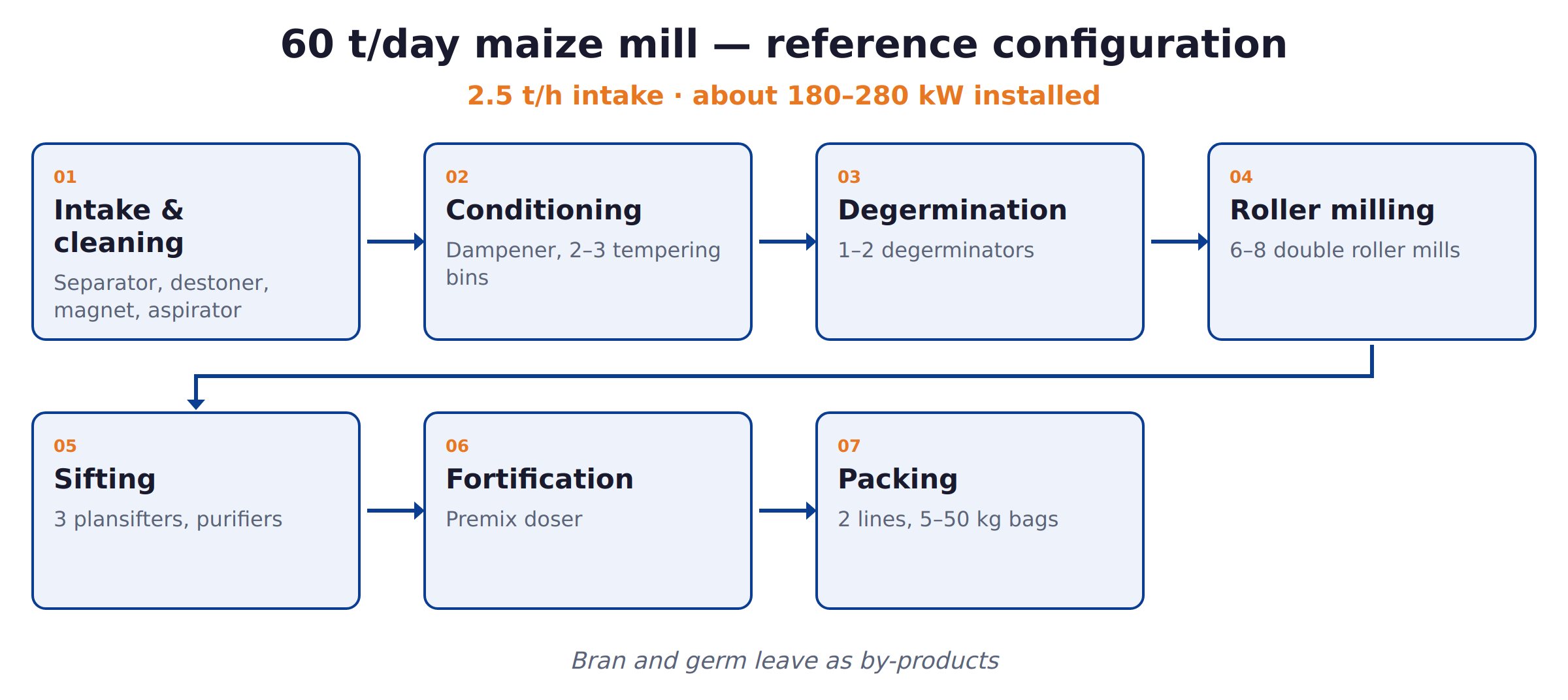
Good meal starts with clean maize. A complete mill needs pre-cleaning, destoning, magnets, conditioning with water and degerming. A quote that starts at the first roller has left out the part that decides colour, shelf life and extraction.
Fortification and packing
Maize meal sold in South Africa must be fortified. The mill needs a dosing system for the premix, sized to the flow, and a packing line for the bag sizes you sell, typically 1 kg to 80 kg.
Where to find maize mill suppliers
- The National Chamber of Milling represents South Africa's wheat and white maize millers; its associate members include equipment manufacturers, fortification mix suppliers and packaging suppliers. The IAOM Middle East and Africa conference and expo, with the Chamber as local host, runs at the CTICC in Cape Town on 23–26 November 2026.
- Grain SA publishes crop and market reports that every mill business plan should use.
- Other millers: visit a mill of the size you want, and ask about extraction, roll changes and downtime.
- China: many roller-mill plants of 30–100 t/day sold in Africa are built in China. Use our supplier audit checklist before paying.
We do not name or rate individual suppliers.
How to choose: a 10-point checklist
- Product mix stated: super, special, sifted, unsifted, samp, grits.
- Capacity in tonnes of maize per day, at a stated running time.
- Extraction rate guaranteed for each grade, on your maize.
- Cleaning and degerming included: pre-cleaner, destoner, magnet, conditioning, degermer.
- Milling and sifting: number of roller mills, sifter area, purification.
- Fortification: premix dosing sized to flow, with records.
- Packing: bag sizes, weighing accuracy, sealing or stitching, palletising.
- Dust and explosion safety: aspiration, filters, explosion venting where needed.
- Installation, commissioning and training in the price.
- Support: roll fluting and grinding, sifter screens, local service.
Ten questions to ask
- What extraction rate will you guarantee for super and special meal on my maize?
- How many tonnes per day, at how many hours a day?
- What cleaning and degerming does the mill include?
- How is fortification premix dosed and recorded?
- What bag sizes does the packing line handle, and how accurate is it?
- What does the mill use in electricity per tonne?
- How often do rollers need re-fluting, and who does it?
- Is installation, commissioning and training included?
- What does the warranty cover?
- Which mill in South Africa runs this plant, and may I visit?
Comparing maize mill quotes
| Section | What each quote should state |
|---|---|
| Intake and storage | Intake pit, elevators, silos or bins |
| Cleaning | Pre-cleaner, destoner, magnets, aspiration |
| Conditioning and degerming | Dampening, tempering bins, degermer |
| Milling | Roller mills, number and size, roll specification |
| Sifting and purification | Plansifters, purifiers, product streams |
| Fortification | Dosing feeder, premix storage |
| Packing | Bagging scales, sizes, sealing, palletising |
| Dust control and safety | Aspiration, filters, explosion protection |
| Freight, installation, commissioning | Incoterm, clearance, steel structure, engineer days, sample runs |
| Owner's scope | Building or foundations, power connection, water, roads |
Compare totals with what each quote leaves out; our same-scope comparison explains the method.
From a delivered project: On a delivered 60 t/day super-fine maize mill more than six hours from the nearest engineering hub, the mill itself was the easy part: extra pre-cleaning for maize at 11–16% moisture, an on-site critical-spares buffer and a year of support took the plant to about 85% of nameplate by month four. Read the maize mill case study.
Common mistakes
- Buying a hammer mill for a super meal market. Retailers buy graded, sifted meal.
- Comparing tonnes per day without extraction. A cheaper mill that extracts less loses money on every bag.
- Skipping cleaning. Dirty maize damages rollers and the product.
- Forgetting fortification. Unfortified meal cannot be sold.
- No grain storage plan. A mill without enough storage buys maize at the wrong time of year.
Maize mill prices in 2026
Indicative, in USD, from our maize mill sizing guide:
| Mill size | Indicative price (2026) | Usual supplier type |
|---|---|---|
| 30 t/day complete mill with packing | US$250,000–400,000 | Turnkey company or direct import |
| 60 t/day | US$700,000–1.1 million | Turnkey company or agent |
| 240 t/day | US$2.0–3.5 million | Agent or turnkey company |
South African facts that shape the decision
- A large crop. The Crop Estimates Committee's seventh forecast for 2025/26 (26 August 2026) put the commercial maize crop at about 17.4 million tonnes: about 9.49 million tonnes of white maize and 7.91 million tonnes of yellow. White maize traded around R3,900 a tonne at the time.
- Meal prices are falling. In July 2026 the average price of a 5 kg bag of maize meal was R65.09, about 12.4% lower than a year earlier, so new mills must compete on cost per bag.
- Zero-rated product. Maize meal of the specified grades is zero-rated for VAT under item 2 of Part B of Schedule 2 to the VAT Act, which keeps the retail price sensitive to milling cost.
- Grading rules. Maize products sold in South Africa are graded, packed and marked under the regulations published as GN R.63 of 2016, which define classes such as super, special, sifted and unsifted maize meal.
- Fortification. Maize meal must be fortified under the fortification regulations (R504 of 2003, amended by R.900 of 2005).
- Import duty. Milling machinery for cereals (8437.80) is free of general duty in SARS's 2026 tariff. Import VAT of 15% applies and is claimable by VAT vendors; see our import duty guide.
Where CISH fits
CISH is a turnkey mill company. We specify roller-mill plants from audited factories in China against your maize, product mix and extraction target, ship and clear them, and install and commission the mill from intake to bagged, fortified meal, with sample runs on your maize and your team trained. We suit commercial mills of about 30 t/day and more, and millers adding a roller-mill line beside hammer mills. For a single hammer mill, a local builder is usually the better buy.
Frequently asked questions
Who sells maize milling machines in South Africa?
Local mill builders supplying hammer mills and compact roller mills, agents of imported milling brands, Chinese factories selling complete roller-mill plants direct, and turnkey mill companies. Service and community mills are usually equipped locally; commercial roller mills are often imported.
How much does a maize milling plant cost?
As an indication for 2026, a complete 30 t/day maize mill lands at about US$250,000–400,000, a 60 t/day mill about US$700,000–1.1 million, and a 240 t/day mill about US$2.0–3.5 million.
What is the difference between super and special maize meal?
They are grades defined in the maize products regulations (GN R.63 of 2016), set mainly by fat and fibre content, which depends on how much germ and bran the mill removes. Super is the most refined. Making them needs a roller-mill plant with degerming and sifting.
Does maize meal have to be fortified?
Yes. The fortification regulations (R504 of 2003, amended in 2005) require maize meal to be fortified, so the mill needs a premix dosing system.
What is a good extraction rate?
It depends on the grade and the maize. Ask each supplier to guarantee extraction for super and special meal on your maize, and to demonstrate it at commissioning; it is the number that decides the mill's margin.
Is there import duty on maize milling machines?
Milling machinery for cereals (8437.80) is free of general duty in SARS's 2026 tariff. Import VAT of 15% applies.
Does CISH sell single hammer mills?
No. We supply, install and commission complete maize mills. For a single hammer mill, a local builder or dealer is the better route.