A tissue paper mill, which makes the jumbo rolls from pulp or recovered paper, is an investment of a different order, with water, energy, effluent and permits to match. SARS's tariff supports converting: jumbo tissue rolls carry 5% general duty against 20% on finished toilet paper.
Two businesses, not two machine sizes
| Converting jumbo rolls | Running a tissue paper mill | |
|---|---|---|
| What you make | Toilet rolls, kitchen towels, serviettes from bought-in tissue | The tissue itself, in jumbo rolls, from pulp or recovered paper |
| Main equipment | Unwind stands, embosser, rewinder-perforator, log saw, wrapper, bundler | Stock preparation, tissue machine with dryer and reel, rewinder, boiler, water and effluent treatment |
| Capital | US$10,000–50,000 basic; up to about US$1 million fully automatic | A different order of magnitude; quoted per configuration |
| Main raw material | Jumbo rolls | Pulp or recovered paper |
| Utilities | Electricity, compressed air | Large volumes of water, steam and electricity |
| Permits | Business, food-unrelated workplace rules | Water use, effluent, and air emission permits for some activities |
| Time to start | Months | Years |
| Best for | New and growing toilet paper brands | Established producers with assured volume and fibre |
Why converting wins for most buyers
- Capital. You can start with a basic line and grow to an automatic one as sales grow.
- Duty structure. In SARS's 2026 tariff, toilet or facial tissue stock in jumbo rolls (4803.00) carries 5% general duty, finished toilet paper (4818.10) 20%. Importing jumbo rolls and converting locally keeps the duty gap on your side.
- Flexibility. You can buy different grades from different mills, run one-ply and two-ply, and change suppliers if paper prices move.
- Speed. A converting line can be installed in weeks once it arrives.
When a mill starts to make sense
Consider papermaking only when most of these are true:
- You already convert and sell enough tissue every month to keep a tissue machine running full time.
- You have a long-term supply of pulp or sorted recovered paper at a known cost.
- Your site has the water, power and steam a mill needs, and an effluent route.
- You can obtain water use authorisation and, where applicable, environmental and air emission permits.
- You have, or can hire, papermakers and maintenance engineers.
Otherwise, the money is better spent on a faster converting line and on securing paper supply.
Buying jumbo rolls: what to compare
Jumbo rolls are priced per tonne by grammage, ply, fibre (virgin or recycled), softness and width. Compare offers on:
- Grammage and ply, which decide how many sheets and rolls you get per tonne.
- Fibre and softness, which decide the retail grade you can sell.
- Roll width and diameter, which must fit your unwind stands.
- Delivery and duty: local mills, SADC and EU or UK origin enter free of duty; others carry 5%.
- Consistency: variation between rolls causes breaks on the rewinder.
Ask suppliers for a price per tonne and a sample roll to run on your line before you commit.
How many rolls does a tonne of jumbo roll make?
The arithmetic decides your paper budget, so do it before you buy. Take a common two-ply roll as a worked example (your own specification will differ):
| Item | Example value |
|---|---|
| Paper per ply | 17 g/m² |
| Plies | 2, so 34 g/m² |
| Sheet size | 10 cm × 10 cm, so 0.01 m² per sheet |
| Sheets per roll | 200, so 2 m² of paper per roll |
| Paper per roll | 2 m² × 34 g/m² = 68 g |
| Rolls per tonne, before trim and breaks | 1,000,000 g ÷ 68 g ≈ 14,700 |
Allow for trim, tail and core waste, and for rolls lost when the paper breaks, and the usable figure is lower. Two consequences follow. First, every gram per square metre matters: the same tonne at 15 g/m² per ply makes noticeably more rolls than at 17 g/m². Second, your price per roll is mostly paper, so negotiating jumbo roll price, grade and consistency does more for your margin than shaving the machine price.
Choose by scenario
| Situation | Route |
|---|---|
| New toilet paper brand, local market | Basic or semi-automatic converting line, bought-in jumbo rolls |
| Growing converter supplying retailers | Automatic converting line with wrapping and bundling |
| Converter with steady volume and a fibre source | Feasibility study for a tissue mill |
| Waste paper collector wanting to add value | Usually sell to mills; a mill needs far more than collection |
What choosing wrong costs
- A mill without the market. A tissue machine running part-time loses money every hour.
- A converting line without assured paper. The machine stands when jumbo rolls are short.
- An automatic line too early. The capital outruns sales; start basic and upgrade.
- Ignoring roll quality. Loose rolls and poor perforation lose retail buyers.
Chinese, European and local equipment
- Converting lines from Chinese factories cover most small and mid-sized needs at the lowest price; European lines lead at very high speeds.
- Tissue machines from European builders dominate large mills; Chinese builders offer smaller crescent-former and cylinder machines at lower cost.
- Local suppliers sell and service smaller converting machines and used equipment.
Five things to confirm before deciding
- Your sales today and in three years, in rolls per month.
- Your jumbo roll suppliers, grades and price per tonne.
- Your site: power, compressed air, space for rolls and finished stock.
- Your packaging and labelling for retail buyers.
- For a mill: fibre supply, water, steam, effluent and permits.
The South African context
- The duty gap. Jumbo rolls (4803.00) carry 5% and finished toilet paper (4818.10) and tissues and towels (4818.20) 20% general duty in SARS's 2026 tariff; all are free from the EU and UK, EFTA and SADC.
- Machinery is duty-free. Papermaking (8439.20), pulp-making (8439.10) and paper converting machinery (8441.10, 8441.80) are free of general duty; VAT vendors reclaim the 15% import VAT. See the import duty guide.
- Mill permits. A paper mill needs water use authorisation under the National Water Act, and pulp and paper activities such as chemical recovery are listed activities under the Air Quality Act (GN 893, category 9).
- The sector. PAMSA represents the pulp, paper and tissue industry, which reports keeping about 1.2 million tonnes of paper and paper packaging out of landfill each year.
- Packaging obligations. Paper packaging falls under the extended producer responsibility regulations (GN 1184 of 2020).
Where CISH fits
CISH supplies, installs and commissions complete toilet paper converting lines from audited factories in China, from basic lines to automatic lines with wrapping and bundling, tested on your jumbo rolls. We do not build tissue mills. For who sells converting lines and how to judge them, see our toilet paper machine suppliers guide.
Frequently asked questions
What is a toilet paper jumbo roll?
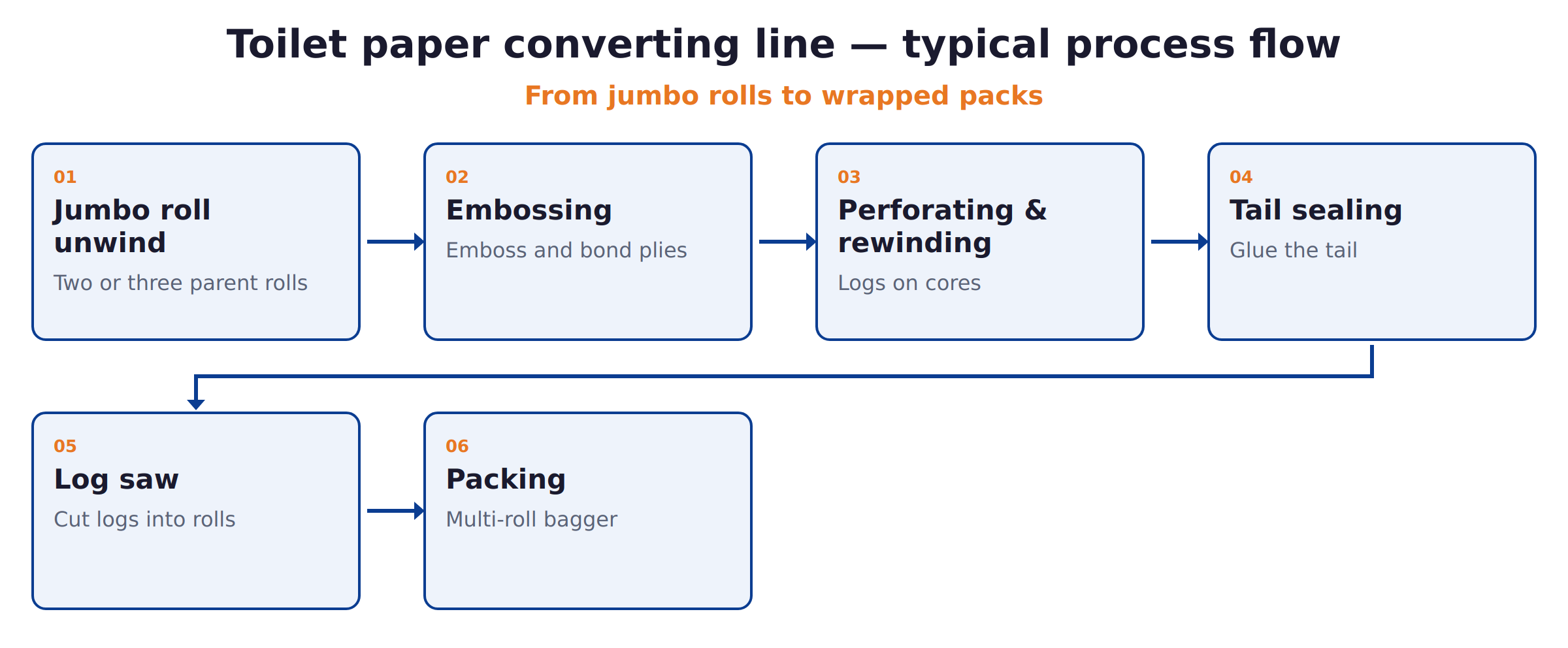
A large parent roll of tissue paper made by a paper mill. Converters unwind it, emboss, perforate and rewind it into logs, then cut and pack the rolls.
Is it better to buy jumbo rolls or make paper?
For almost every new business, buying jumbo rolls and converting them is better: far lower capital, faster start and flexibility. A mill makes sense only with assured volume, fibre, water and power.
What is the import duty on jumbo rolls?
Tissue stock in jumbo rolls (4803.00) carries 5% general duty in SARS's 2026 tariff; finished toilet paper (4818.10) carries 20%. Both are free from the EU and UK, EFTA and SADC.
How much does a toilet paper converting line cost?
As an indication for 2026, a manual or basic line costs about US$10,000–50,000 and a fully automatic high-capacity line up to about US$1 million.
What permits does a tissue mill need?
Water use authorisation under the National Water Act, effluent approval, and, for some pulp and paper activities, an atmospheric emission licence under the Air Quality Act.
Does CISH build tissue paper mills?
No. We supply complete converting lines that turn jumbo rolls into packed toilet paper.