A plant bakery buying a semi-automatic bread line (from about USD 80,000) or a continuous plant (USD 250,000–800,000+) needs a supplier who will put in writing the loaves per hour on your dough, who installs and commissions the line, and who keeps it running.
The four kinds of bakery equipment supplier
Most searches for bakery equipment suppliers in Johannesburg, Cape Town or Durban return the same mix of companies, and they are not selling the same thing. The useful first step is to work out which kind of supplier you are talking to, because each one is built for a different purchase. The table compares them on the points that decide whether a bakery actually produces bread on the date in your business plan.
| Supplier type | What they usually sell | Price level | Lead time | Who installs and commissions | Training and after-sales | Best fit |
|---|---|---|---|---|---|---|
| Catering and retail-bakery dealer | Single machines from stock or catalogue: deck and convection ovens, spiral mixers, provers, slicers; often used equipment too | Lowest per machine | Days to a few weeks for stock items | Delivery and connection; rarely responsible for output | Local technicians for the brands they carry | In-store, artisan and retail bakeries up to a few hundred loaves a day |
| Local agent for an imported brand | One or two European or Asian equipment brands, sometimes a full line from that brand | High, especially for European lines | Typically several months for a line built to order | The agent or the factory's engineer, depending on the contract | Good on their own brand; machines from other brands in the same line are your problem | Plant bakeries standardising on one brand and willing to pay for it |
| Chinese factory, bought direct | Single machines or "complete lines" quoted ex-works or FOB | Lowest for a line on the quote | Build time plus about six to ten weeks of shipping and clearance | You, unless you pay for a factory engineer's visit | Remote, in Chinese time; parts by courier from China | Buyers who have specified, imported and commissioned a line before |
| Turnkey line company | The whole line from flour silo or mixer to bagger, plus installation, commissioning and training under one contract | Between the direct quote and the European agent | Build, ship and commission as one schedule | The turnkey company, against an agreed output on your product | Contracted; covers every machine in the line, whatever the brand | First plant bakeries and bakeries adding a second line |
None of these is the "right" supplier in general. A dealer is the correct choice for a retail bakery, and paying a turnkey company to manage a three-machine purchase wastes money. The mistakes happen at the boundary, when a bakery that needs a line buys it the way a retail bakery buys an oven.
Catering dealer or industrial line supplier: where the line starts
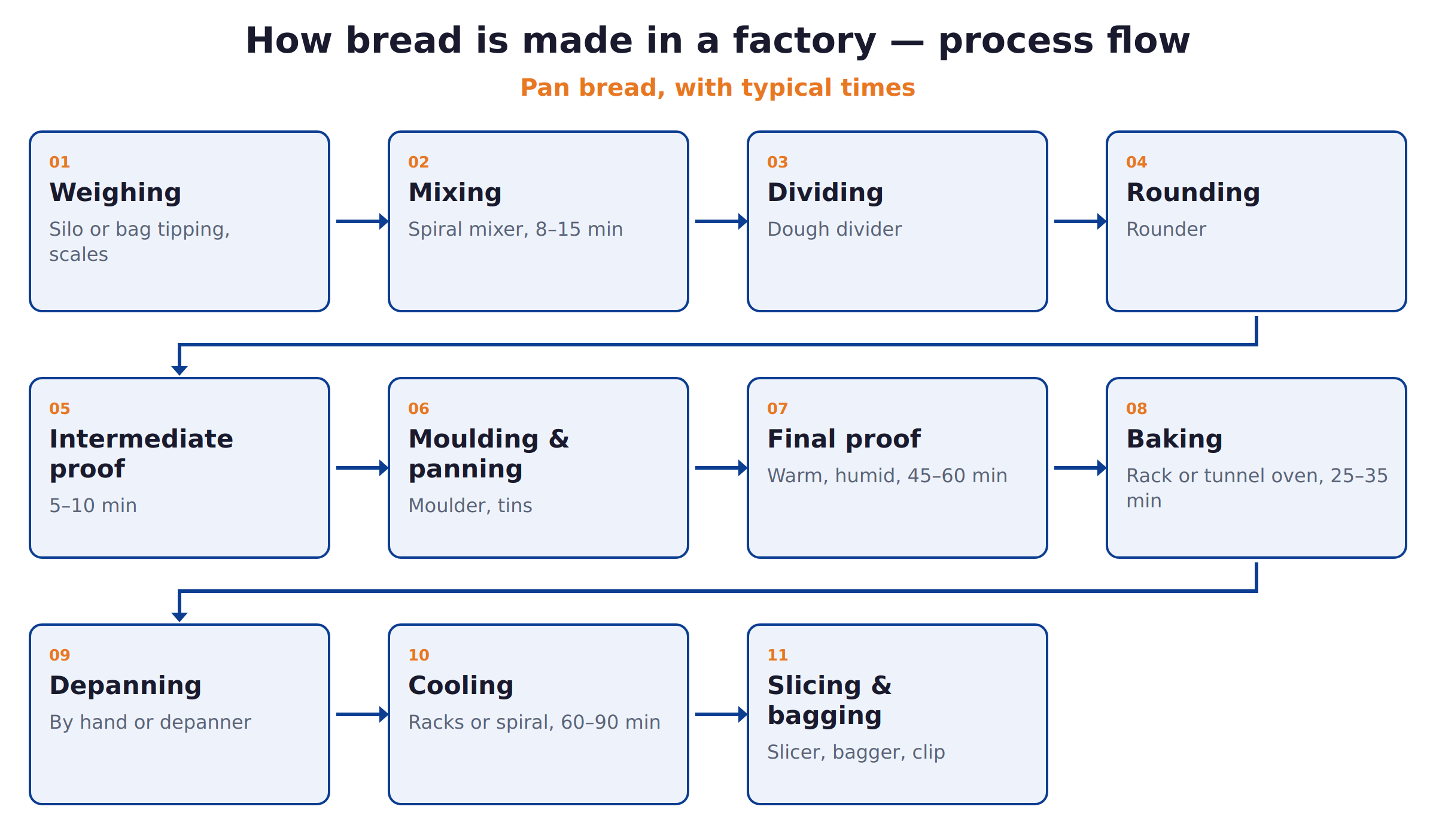
The dividing line is not the size of the oven. It is whether the machines must work as one flow. A retail bakery mixes a batch, divides by hand or with a table-top divider, proves on racks and bakes in a deck or rack oven; each machine is independent, and if one stops the others carry on. A plant bakery runs divider, rounder, intermediate prover, moulder, final prover, oven, cooler, slicer and bagger at one rate. If the prover cannot hold what the divider sends, the dough over-proves. If the cooler is short, the slicer tears warm bread. At that point you are no longer buying machines; you are buying a rate, and somebody has to be responsible for it.
A useful test: ask the supplier what output they will commit to, in loaves per hour at your loaf weight and your dough. A dealer will usually quote each machine's nameplate capacity. A line supplier should give you a single number for the line and agree to demonstrate it at handover. If nobody will commit to the line rate, you are buying a collection of machines and doing the integration yourself.
Two more questions sort suppliers quickly. Does one company supply the oven, the provers and the slicing and bagging end, or are you assembling them from three sources? And can the supplier show you a working line of the same type, ideally in a South African bakery running a similar product? A supplier with nothing running locally is not disqualified, but you should then expect a stronger acceptance test and a longer warranty.
Where to find bakery equipment suppliers in South Africa
- The South African Chamber of Baking. The industry body for plant, independent and retail bakers has represented the sector since 1938 and lists supplier members, including equipment and ingredient companies, alongside its bakery members. It also runs the Certificate in the Basics of Breadmaking and the Certificate in the Theory of Breadmaking, useful for the people who will run your line.
- Trade shows. Propak Africa, with FoodPro for food and beverage processing, runs every three years at the Johannesburg Expo Centre, Nasrec. The next edition is 7–10 March 2028. It is the one place in the country where several line suppliers show running equipment in the same hall.
- Industrial areas. Dealers and agents cluster in the industrial parts of Gauteng, the Western Cape and KwaZulu-Natal. Visit the showroom and the workshop: a supplier that repairs and rebuilds ovens on site is a different business from one that only imports boxes.
- Other bakers. The best reference is a bakery running the equipment you are considering. Ask the supplier for one you can visit, and ask the baker what broke in year one and how long the fix took.
- China, directly. Factories in China build most of the world's mid-priced bread lines and sell through online platforms and trade fairs. Our guides on auditing a Chinese supplier and paying one safely cover that route.
We do not list or rate individual companies on this page. Any list goes out of date, and a supplier that suits a 400-loaf retail bakery may be the wrong choice for a 3,000-loaf-an-hour line. Use the checklist below on every company you shortlist.
How to choose: a 10-point checklist
- Committed output. One number for the line in loaves or kilograms per hour, at your loaf weight, on your recipe, demonstrated at handover.
- Reference you can visit. A running line of the same type, preferably in South Africa, with a baker willing to talk to you.
- One supplier for the flow. Who supplies the dough handling, provers, oven, cooling, slicing and bagging, and who answers if they do not work together.
- Installation and commissioning in the price. Named in the quote, with engineer days and travel, not "available on request".
- Electrical and gas standard. Machines built for South African supply, with the motors, drives and controls named; gas trains suitable for local gas supply where the oven is gas-fired.
- Hygiene design. Food-contact materials, washdown and access for cleaning that an environmental health practitioner will accept under R638.
- Training. Operators and maintenance staff trained on the line, with the number of days stated.
- Warranty terms. Length, what is excluded, and who pays to bring an engineer if a fault is under warranty.
- Support after year one. Who services the oven burners, the prover climate control and the slicer; how parts are sourced and how long they take.
- Who you contract with. The company you sign with, where it is registered, and whether the account you pay belongs to that company.
If you are weighing where the equipment is made rather than who sells it, see European, Chinese or local bakery equipment compared by oven, mixer and product.
Ten questions to ask any bakery equipment supplier
- What output will you guarantee in writing, on my dough, at my loaf weight?
- Which bakery in South Africa is running this line, and may I visit?
- Which machines in the line are your own, and which do you buy in?
- Who installs and commissions, how many days does that take, and is it in this price?
- What electrical supply and gas supply does the line need, and who confirms my site has it?
- How is the oven heated, and what does it use per hour at full output?
- What is excluded from this quote?
- What training is included, and for how many people?
- What does the warranty cover, for how long, and who pays for the engineer's visit?
- If something fails in year two, who do I call, and how are parts supplied?
Watch the answers to questions 3 and 7. A "complete bread line" that stops at the oven, with slicing and bagging "available separately", is common. So is a quote that excludes the cooling conveyor, the one machine that decides whether the slicer works.
How to compare quotes: what a complete line quote lists
Bakery quotes are hard to compare because each supplier draws the boundary in a different place. Before you compare prices, put every quote on the same list:
| Item | What to check in each quote |
|---|---|
| Dough preparation | Mixers, bowl hoists or flour handling, water chiller or metering if needed |
| Make-up | Divider, rounder, intermediate prover, moulder, panning; the rate of each against the line rate |
| Proving and baking | Final prover with climate control; oven type, baking area, heating, and fuel use per hour |
| Cooling, slicing, bagging | Cooling conveyor or spiral length and time; slicer, bagger, closure and coding |
| Pans and trays | Quantity and size; often left out |
| Freight and import | Incoterm, insurance, clearance, transport to site, offloading and rigging |
| Installation and commissioning | Engineer days, travel, what "commissioned" means (power-on or demonstrated output) |
| Training and documents | Days, people, manuals, electrical drawings, parts list |
| Warranty and support | Length, exclusions, response arrangement, first-year consumables |
| Owner's scope | Building, electrical supply, gas, water, drainage and extraction: listed so nobody assumes the other side pays |
The comparable price of a quote is its total plus everything on this list it leaves out. Our page on putting a direct offer and a turnkey proposal on the same scope walks through the method in more detail.
Common mistakes when buying bakery equipment
- Comparing machine prices, not line totals. On most lines the equipment is 35–55% of the project once freight, installation, utilities and building work are added.
- A line sized to the brochure. Buy for the bread you can sell. An oven running at half its rating costs nearly as much to heat as one running full.
- Leaving out the cold end. Short cooling means torn slices, condensation in the bag and mould complaints.
- No-one responsible for the flow. Three suppliers, three warranties, and a line that does not reach rate because nobody owns the whole of it.
- Discovering the site late. Electrical capacity, gas supply and drainage decide what you can install; check them before you order, not when the containers arrive.
What bakery equipment costs in 2026
Indicative equipment prices in USD, before freight and installation. Plan on roughly 25–45% more for a landed and installed line. Detail by scale is in our bakery equipment prices guide.
| Purchase | Typical buyer | Indicative equipment price (2026) | Usual supplier type |
|---|---|---|---|
| Single-machine setup: mixer, prover, deck or rack oven | Retail, in-store and artisan bakeries | USD 15,000–45,000 | Catering and retail-bakery dealer |
| Semi-automatic bread line | Independent plant bakery, first line | From about USD 80,000 | Agent, direct import or turnkey company |
| Continuous automatic plant, tunnel oven | Plant bakery supplying retail chains | USD 250,000–800,000+ (capacity 200–9,000 kg/h) | Agent or turnkey company |
South African rules that affect your choice of supplier
None of these is something a supplier can do for you, but each one changes what you should ask the supplier to provide.
- R638 of 2018 and the Certificate of Acceptability. Food premises need a Certificate of Acceptability from the municipal environmental health service under the hygiene regulations. Layout, finishes, hand-wash points and cleanability of equipment are all inspected, so ask for a layout drawing that shows them.
- Every loaf must be marked. Under R.405 of 5 May 2017, wheat bread other than speciality bread must show its class, the producer's name and physical address, and its mass. Packed bread carries these on the bag. Unwrapped bread needs a sign at the point of sale in lettering at least 30 mm high. Your bagging and coding equipment must handle this from day one.
- Packed bread is a prepacked foodstuff. Bagged bread also falls under the labelling regulations, R146 of 2010, so the bag printing and the coder have to produce compliant labels.
- Brown bread is zero-rated for VAT; white bread is not. Item 1 of Part B of Schedule 2 to the VAT Act zero-rates brown bread and whole wheat brown bread as defined in R.405. White bread carries 15% VAT. That affects your product mix and pricing, and therefore the line you need.
- The flour arrives fortified. Wheat flour sold in South Africa is fortified at the mill under R504 of 2003, so a bakery buys fortified flour and does not dose premix itself. Your flour supply contract matters more than a dosing system.
- The bread price your line has to beat. In July 2026 the average urban price of a 700 g loaf was R17.72 for brown bread and R19.61 for white (NAMC, from Stats SA data). Work back from those prices to the cost per loaf your line must achieve before you choose a scale.
- Import duty on the equipment is usually nil. SARS's tariff lists bakery machinery (8438.10) and bakery ovens (8417.20) as free of general duty. Import VAT of 15% is charged on the customs value plus a 10% uplift and any duty, and a VAT-registered business can claim it back. Our import duty guide has the calculation.
Where CISH fits
CISH is a turnkey line company. We source bread lines from audited factories in China, check the specification against your product and site, ship and clear them, and install and commission them in South Africa against an agreed output on your dough, with operators trained on the line. We fit bakeries buying a semi-automatic or continuous line, a first plant line or a second line beside an existing one. If you need a deck oven and a mixer for a retail bakery, a local dealer will serve you better and faster, and we will tell you so.
Frequently asked questions
Who sells bakery equipment in South Africa?
Four kinds of company: catering and retail-bakery dealers selling single machines, local agents for imported European or Asian brands, Chinese factories selling direct, and turnkey companies that supply and commission complete lines. Which one suits you depends on whether you are equipping a retail bakery or a plant bakery with a single line rate.
Is it better to buy bakery equipment locally or import it?
For single machines in a retail bakery, buying locally is usually better: stock is available, a technician is nearby and the saving from importing one oven is small. For a full line, importing is often much cheaper on the equipment, but you need someone to specify, install and commission it, and a plan for support after the first year.
How much does a bakery production line cost in South Africa?
As an indication for 2026: about USD 15,000–45,000 for a single-machine retail setup, from about USD 80,000 for a semi-automatic bread line, and USD 250,000–800,000+ for a continuous plant. Add roughly 25–45% for freight, installation and commissioning. The bakery equipment prices guide breaks this down.
Should one supplier provide the oven, provers and slicer?
On a line, yes, or at least one company should be contractually responsible for the line reaching its rate. Machines from different suppliers can work well together, but if nobody owns the whole flow, a shortfall becomes an argument between three warranties.
Do I need a Certificate of Acceptability for a bakery?
Yes. Under R638 of 2018, food premises need a Certificate of Acceptability issued by the municipal environmental health service. The inspection covers the building, layout and cleanability of equipment, so plan the layout with the line supplier before construction.
Is there import duty on bakery ovens?
Bakery ovens (tariff heading 8417.20) and bakery machinery (8438.10) are listed as free of general duty in SARS's 2026 tariff. Import VAT of 15% still applies on the customs value plus a 10% uplift, and VAT-registered businesses can claim it back. Confirm the heading for your exact machines with your clearing agent.
How long does it take to get a bread line running?
For a line built to order in China, allow for the build time, about six to ten weeks of shipping and clearance, and a few weeks of installation and commissioning. The site work, especially electrical supply and gas, often decides the date more than the equipment does, so start it early.
Does CISH supply single bakery machines?
No. We supply, install and commission complete bread lines. For a single oven or mixer, a local catering or bakery equipment dealer is usually the better choice.