European equipment is typically the most precise, longest-lived and most expensive, with high-end controls and a strong resale value, and suits industrial bakeries that run every day for decades. Chinese equipment covers everything from single mixers and ovens to complete automatic lines at a fraction of the European price; quality varies more between factories, so checking the factory, materials and spares matters. Locally made or locally assembled equipment, mainly ovens, racks, troughs and some mixers, is quick to deliver and easy to repair, and suits small bakeries and add-ons.
The short answer: compare by origin, not by name
| European equipment | Chinese equipment | Local equipment | |
|---|---|---|---|
| Price | Highest | Low to moderate | Low to moderate |
| Build and precision | Very high | Varies by factory; good factories are close to European on many machines | Good for ovens, racks, troughs |
| Expected life | Longest | Good with maintenance; check bearings, gearboxes, motors | Good for simple equipment |
| Controls | Advanced, often proprietary | Simple to advanced; common PLCs available | Simple |
| Spares | Through agents, can be costly | Must be planned; stock wear parts | Quick and local |
| Lead time | Longest | Short to moderate | Short |
| Best fit | Industrial bakeries, 24-hour lines | Township to factory scale, complete lines | Small bakeries, ovens and add-ons |
We do not name or rate brands. Within every origin there are good and poor products; the checks below matter more than the logo.
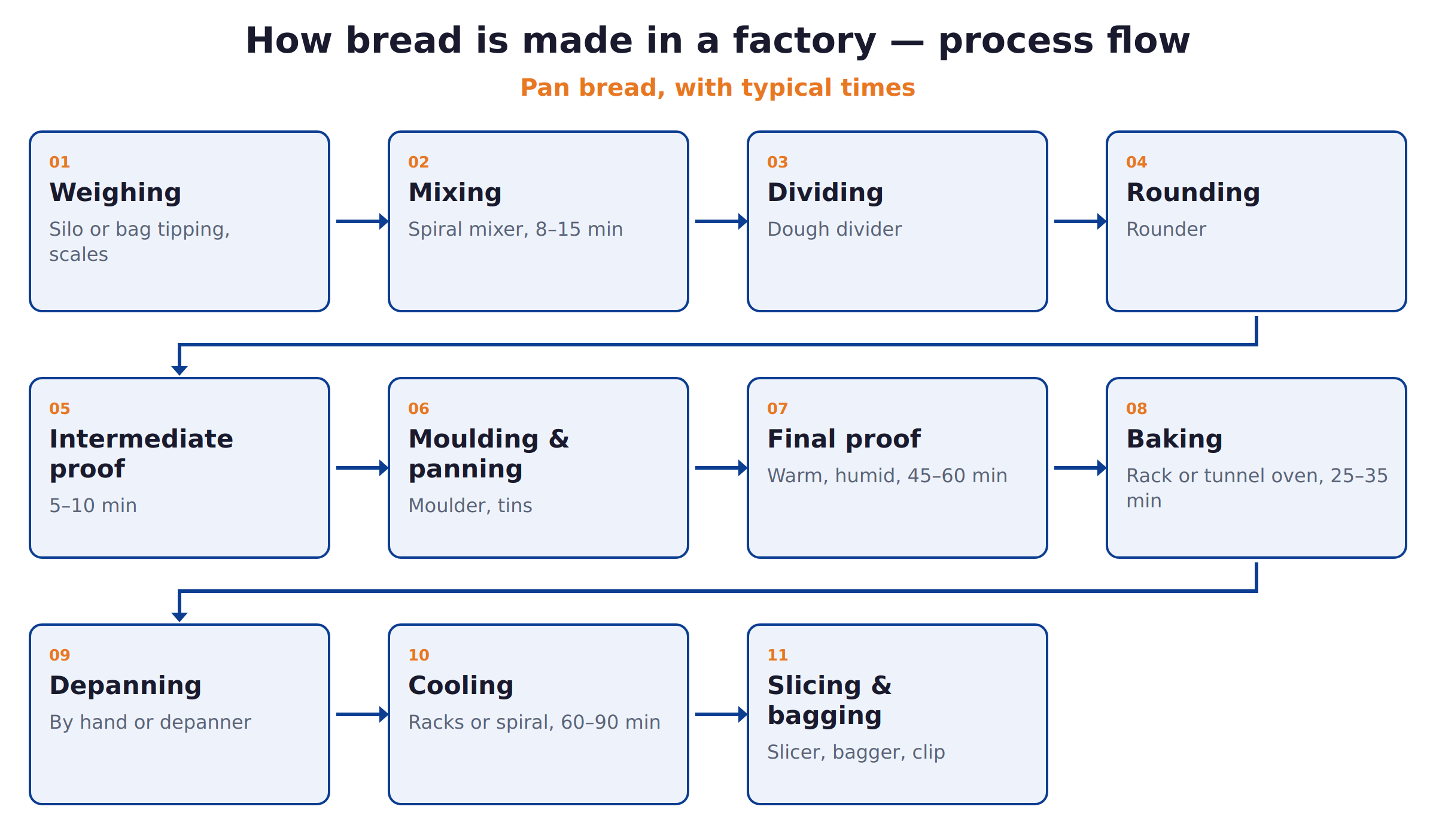
Match the origin to your bakery
Township or neighbourhood bakery
A spiral mixer, dough divider or dough brake, moulder, prover and a deck or rack oven. A machine set of about US$15,000–45,000 covers it. Local ovens and racks with an imported mixer and divider are common and sensible. Choose machines your technician can fix.
Growing bakery supplying shops
A semi-automatic line from about US$80,000: divider-rounder, intermediate prover, moulder, final prover, rack ovens, cooling, slicing and bagging. Well-specified Chinese lines are usually the best value here, if the supplier commissions the line and you hold spares.
Bread factory supplying retailers
Fully automatic lines at about US$250,000–800,000 or more, running two or three shifts. European lines and the better Chinese lines both compete here; compare total cost over ten years, not only purchase price, and visit a running line of the make you are considering.
What to check, whatever the origin
- Food contact materials: stainless steel bowls, hoppers and belts that meet food standards.
- Drive components: motor, gearbox and bearing makes; these decide life and repair cost.
- Controls: a common PLC and drives with local support, and access to the programme.
- Oven heat source and insulation: gas, diesel or electric, burner make, and heat loss.
- Spares list: what fails first, what it costs and whether it is in South Africa.
- References: a bakery running the same model that you can visit and phone.
- Commissioning and training: who comes, for how long, and what output they guarantee.
Ovens: the biggest running cost
The oven uses most of the energy in a bakery. Eskom's standard tariff rose 8.76% for 2026/27, and many bakeries use LPG or diesel ovens to control costs and bake through power cuts. LPG installations must follow SANS 10087 and be installed and certified by a practitioner registered with SAQCC Gas. Ask every supplier for energy per bake for your products, and compare that over five years. Our guide to deck, rotary and tunnel ovens explains which oven suits which bakery.
Duty and landed cost
Bakery ovens under 8417.20 enter South Africa duty-free; check the tariff line for each other machine at quotation, and remember that VAT applies. Imported equipment adds freight, clearing, installation and commissioning to the purchase price, so compare landed, installed prices, not ex-works quotes against local delivered prices.
Mixing origins in one bakery
Many bakeries combine origins sensibly: a European or high-end divider for accurate loaf weights, Chinese provers and rack ovens, and local racks, trolleys and tables. That can work well if the machines are sized to the same output and someone takes responsibility for the whole line. The risk is that each seller blames another when the line does not reach its rate.
Worked example: three quotes for a growing bakery
A bakery in Polokwane needs to go from 3,000 to 8,000 loaves a day. Quote A is a European semi-automatic line, the highest price, with long lead time. Quote B is a Chinese line at well under half the price, with a commissioning engineer, a spares kit and two reference bakeries in Africa. Quote C is a mix of local ovens and second-hand imported dividers. The owner visits a bakery running quote B's line, checks the divider accuracy and oven energy use, and chooses B with an added spares package, keeping one local oven for cakes. The figures are illustrative.
Service and spares in practice
Whatever you buy, a bakery cannot stop for weeks. Keep the parts that wear fastest on the shelf: mixer belts and bearings, divider knives and seals, oven burner parts, fan motors and thermostats, slicer blades. Agree with the supplier which spares are held in South Africa and which must be shipped, and how long that takes. Train one person in your bakery to do basic maintenance every week.
Five questions to ask before you buy
- Which bakeries in South Africa run this model, and can I visit one?
- What does a complete spares kit cost, and what is in it?
- Who commissions the line, and what output is guaranteed?
- What is the energy use per bake for my products?
- Can a local technician access and change the controls?
Common mistakes
- Choosing on brand reputation alone.
- Comparing ex-works prices with local delivered prices.
- No spares plan for imported machines.
- A fast divider feeding a slow oven.
- Buying an industrial line for a neighbourhood bakery.
Questions to ask before you sign
Ask each seller for the oven's heat-up time from cold and its temperature spread across the deck or rack, measured with a probe at several points. Ask for the mixer's bowl capacity in kilograms of dough, not litres of bowl, and the motor rating on both speeds. Ask how dividers handle your dough's water content, because a machine tuned for dry dough tears soft rolls. Find out which parts wear, how long each lasts in a bakery your size, and whether they can be bought in South Africa. Finally, ask for a test bake on your own recipe before shipping, filmed if you cannot attend.
Where CISH fits
We supply complete bakery lines from audited factories in China, sized to your loaves a day and fuel, with controls your technicians can support. CISH ships, clears, installs and commissions the line with output demonstrated, supplies a spares package, and trains your bakers. For a single oven or mixer, a local supplier is often the better buy, and we will say so.
Frequently asked questions
Is European, Chinese or local bakery equipment better?
It depends on the bakery, so compare by origin and support rather than name: European for industrial precision and long life, Chinese for value across all sizes, local for ovens, racks and quick service.
Is Chinese bakery equipment reliable?
It varies by factory. Good factories make reliable machines; check materials, drive components, controls, spares and references.
How much does bakery equipment cost?
As an indication for 2026, a machine set costs about US$15,000–45,000, a semi-automatic line from about US$80,000 and an automatic line about US$250,000–800,000 or more.
Is there import duty on bakery ovens?
Bakery ovens under 8417.20 enter duty-free; VAT applies.
Should I buy all equipment from one supplier?
Buying a matched line from one supplier puts responsibility for output in one place; mixing origins can work if someone owns the whole line.
Does CISH supply bakery lines?
Yes, complete lines with commissioning, spares and training.