Start from litres a month: a 1,000 litre (10 hL) brewhouse brewing a few times a week makes enough for a taproom and local restaurants; larger outputs need either more brews per day or a bigger brewhouse. Two-vessel brewhouses (mash-lauter tun and kettle-whirlpool) suit most craft breweries; three or four vessels allow more brews per day. Steam heating gives the best control and suits larger systems, electric heating is clean and simple for small brewhouses, and direct fire is cheapest but harder to control. Fermenters, not the brewhouse, usually limit output, because each batch spends one to three weeks in a tank.
The short answer: size, vessels and heating
| Decision | Options | Choose by |
|---|---|---|
| Brewhouse size | 500 L, 1,000 L, 2,000 L, 3,000 L and up | Litres a month you can sell and brews per week you will run |
| Vessels | 2-vessel, 3-vessel, 4-vessel | Brews per day you need |
| Heating | Electric, steam, direct fire | Power supply, gas or boiler, control you want |
| Fermenters | Number and size of unitanks | Weeks in tank per beer style |
| Packaging | Kegs, cans, bottles | Your sales channels |
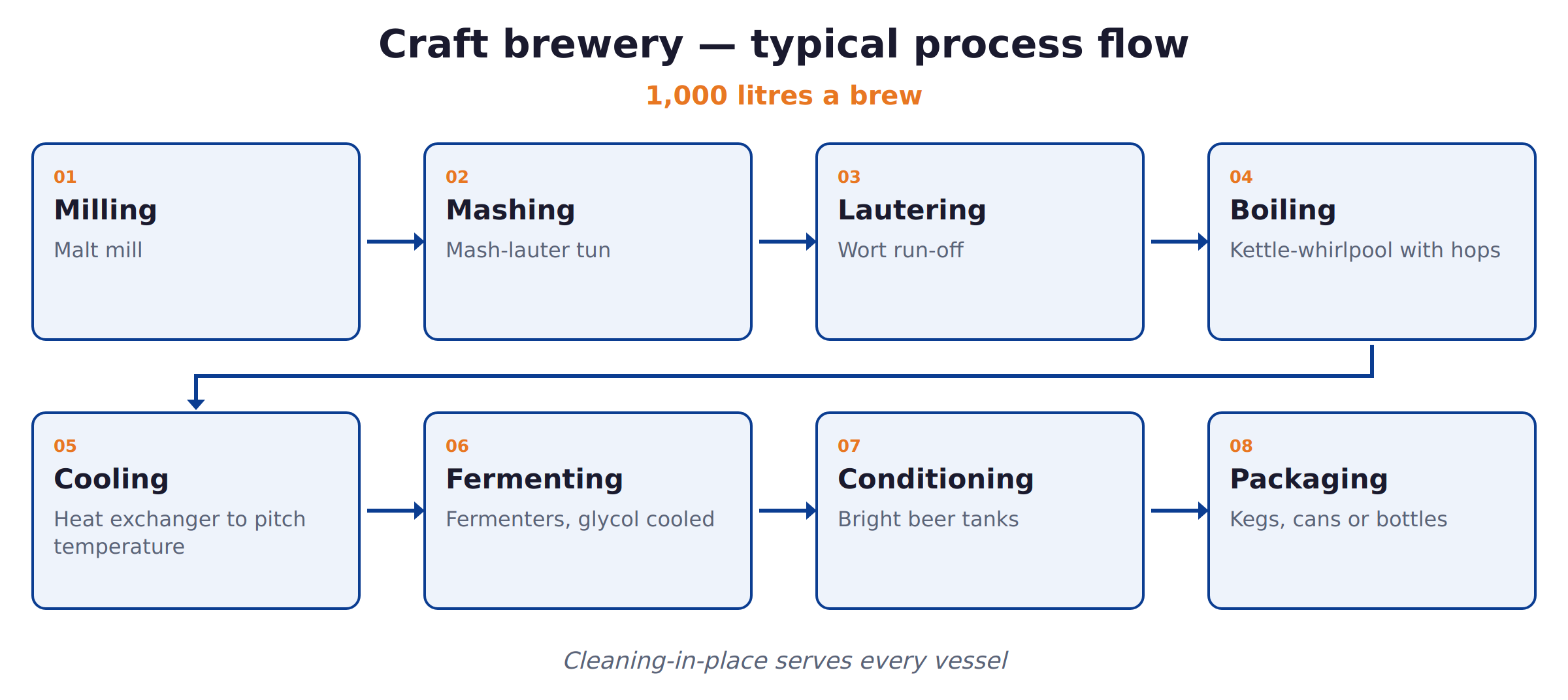
Size the brewhouse from sales, not ambition
Work out litres a month in year two, divide by brews you can run per week, and size the brewhouse for that, leaving room for one extra brew day. As an example, a taproom and a dozen outlets selling about 8,000 litres a month need roughly two 1,000 litre brews a week, allowing for losses. A brewhouse that is too large wastes energy and malt on half-filled brews; one that is too small means brewing every day.
Two, three or four vessels?
- Two vessels (mash-lauter tun; kettle-whirlpool): one brew at a time, about one or two brews a day. Lowest cost, most common in craft breweries.
- Three vessels (separate mash tun, lauter tun, kettle-whirlpool): the next mash can start while the previous brew boils; more brews per day.
- Four vessels: adds a separate whirlpool or mash kettle for even more throughput and flexibility.
Buy more vessels only when you will brew more than once a day regularly.
Heating: electric, steam or direct fire
| Heating | Strength | Watch for |
|---|---|---|
| Electric elements | Clean, simple, easy to install in small brewhouses | Large electrical load; tariff cost; slower for big batches |
| Steam (boiler and jackets) | Even heating, good control, scales well | Needs a boiler, water treatment and pressure equipment compliance |
| Direct fire (gas burner) | Cheapest equipment | Hot spots, scorching risk, less control |
Many South African breweries choose steam from about 1,000 litres upwards and electric heating for smaller systems. Check your electrical supply and the cost per brew before choosing electric.
Fermenters decide your real capacity
A lager may need three weeks or more in a tank; an ale perhaps one to two weeks. Count tanks: if you brew twice a week and each beer spends two weeks fermenting and conditioning, you need at least four fermenters of brew size, plus bright tanks for serving or packaging. Add glycol cooling sized for all tanks on a hot day.
Local fabrication or an imported package?
| Local fabrication | Imported complete brewery | |
|---|---|---|
| Strength | Close support, easy modifications, quick repairs | Complete matched package, often lower price for the whole system |
| Watch | Weld quality, polish, design experience | Freight, spares, commissioning and training |
| Fits | Small systems, extra tanks, custom fittings | Complete breweries from 1,000 L upward |
We do not rate brands. Ask any supplier for stainless steel grades for product contact, weld and polish finishes, insulation, pressure ratings of tanks, and references you can visit. Brewery vessels and machinery under headings such as 8438.40 and 8419.40, and tanks under 7309.00, generally enter South Africa duty-free; VAT applies.
Packaging is a second project
Kegs suit taprooms and restaurants; cans and bottles suit retail. A small canning line or a bottle filler adds a large share of the cost and needs its own floor space and staff. Plan packaging when you choose the brewhouse, even if you add it later.
Licensing and excise
You must register or license your brewery under the Liquor Act and with the provincial authority where you qualify as a micro-manufacturer, and register with SARS Excise before you start brewing, then submit returns and pay excise monthly. Malt beer carries specific excise of R149.98 per litre of absolute alcohol, about R2.55 on a 340 ml beer at 5%. Your premises must meet food hygiene rules such as R638. Our liquor manufacturing licence guide explains the steps.
Worked example: a taproom brewery in the Western Cape
A couple running a restaurant in the Winelands want their own beer for the taproom and a dozen outlets. They plan about 8,000 litres a month in year two. They choose a two-vessel 1,000 litre steam brewhouse with a small boiler, five 2,000 litre unitanks so they can double-brew into one tank, two bright tanks, glycol cooling and a keg washer, and leave space for a small canning line. They register with SARS Excise and the provincial liquor authority before the first brew. The figures are illustrative.
Utilities and the building
A brewery needs a strong water supply and drainage for cleaning, a floor that slopes to drains and takes hot water and chemicals, three-phase power, space for malt storage and a cold room. Wastewater from cleaning and spent grain must be managed; farmers often collect spent grain as animal feed.
Brewing water
Beer is mostly water, and its minerals shape flavour. Test your municipal or borehole water, and plan carbon filtration to remove chlorine and, for some styles, reverse osmosis so your brewer can build the water profile. Hot and cold liquor tanks sized for a full brew day save time.
Five questions to ask a brewery supplier
- What brews per day and litres a month does this brewhouse support?
- How much energy and water does one brew use?
- What stainless steel grade and finish are used on product contact parts?
- How many fermenters and bright tanks do I need for my styles?
- Who commissions the brewery and trains our brewer?
Common mistakes
- Too few fermenters for the brewhouse.
- Electric heating without checking the supply.
- No glycol capacity for summer.
- Packaging left out of the plan.
- Brewing before excise registration.
Where CISH fits
We supply complete breweries, brewhouse, fermenters, bright tanks, glycol cooling, cleaning and packaging, from audited factories in China, sized to your litres and beer styles. CISH ships, clears, installs and commissions the brewery, and trains your brewer. Licensing and excise registration are done by the brewery owner.
Frequently asked questions
What size brewery equipment do I need?
Work back from litres a month you can sell and brews per week; many taprooms start with a 1,000 litre brewhouse.
Is a two-vessel or three-vessel brewhouse better?
Two vessels suit most craft breweries; three or four vessels allow more brews per day.
Is steam or electric heating better for a brewery?
Steam gives better control and scales well from about 1,000 litres; electric suits small systems if the power supply is strong.
How much does a brewery cost in South Africa?
As an indication for 2026, a 1,000 litre brewhouse with tanks costs about US$90,000–160,000 ex-works, and a brewery with packaging about US$200,000–500,000.
What excise applies to beer?
Malt beer carries R149.98 per litre of absolute alcohol; register with SARS Excise before brewing.
Does CISH supply complete breweries?
Yes, with installation, commissioning and training.