Brewery equipment in South Africa comes from local stainless fabricators who build tanks and small brewhouses, dealers and agents of European and Asian brewing equipment, Chinese brewhouse makers selling direct, and turnkey companies that design and commission the whole brewery. Choose the supplier who sizes the cellar for your sales, not just the brewhouse.
Who sells brewery equipment
Craft brewers, brewpubs, farms and investors planning a regional beer brand all look for brewery equipment. Four kinds of supplier compete for them.
| Supplier type | What they sell | Price | Who answers for output | Best fit |
|---|---|---|---|---|
| Local stainless fabricator | Fermenters, bright tanks, hot liquor tanks, small brewhouses | Moderate | The fabricator, for its vessels | Adding tanks; small brewhouses |
| Dealer or agent of imported equipment | European or Asian brewhouses, canning and bottling machines | High for European; moderate for Asian | The dealer, per item | Established breweries upgrading |
| Chinese brewhouse maker, direct | Brewhouses, fermenters, glycol systems, CIP, mills | Lowest on the quote | You, after delivery | Brewers with process and welding skills |
| Turnkey brewery company | Brewhouse, cellar, utilities and packaging, commissioned | Between direct and European | The turnkey company, at agreed brews per week | New breweries and first packaging lines |
The cellar decides capacity, not the brewhouse
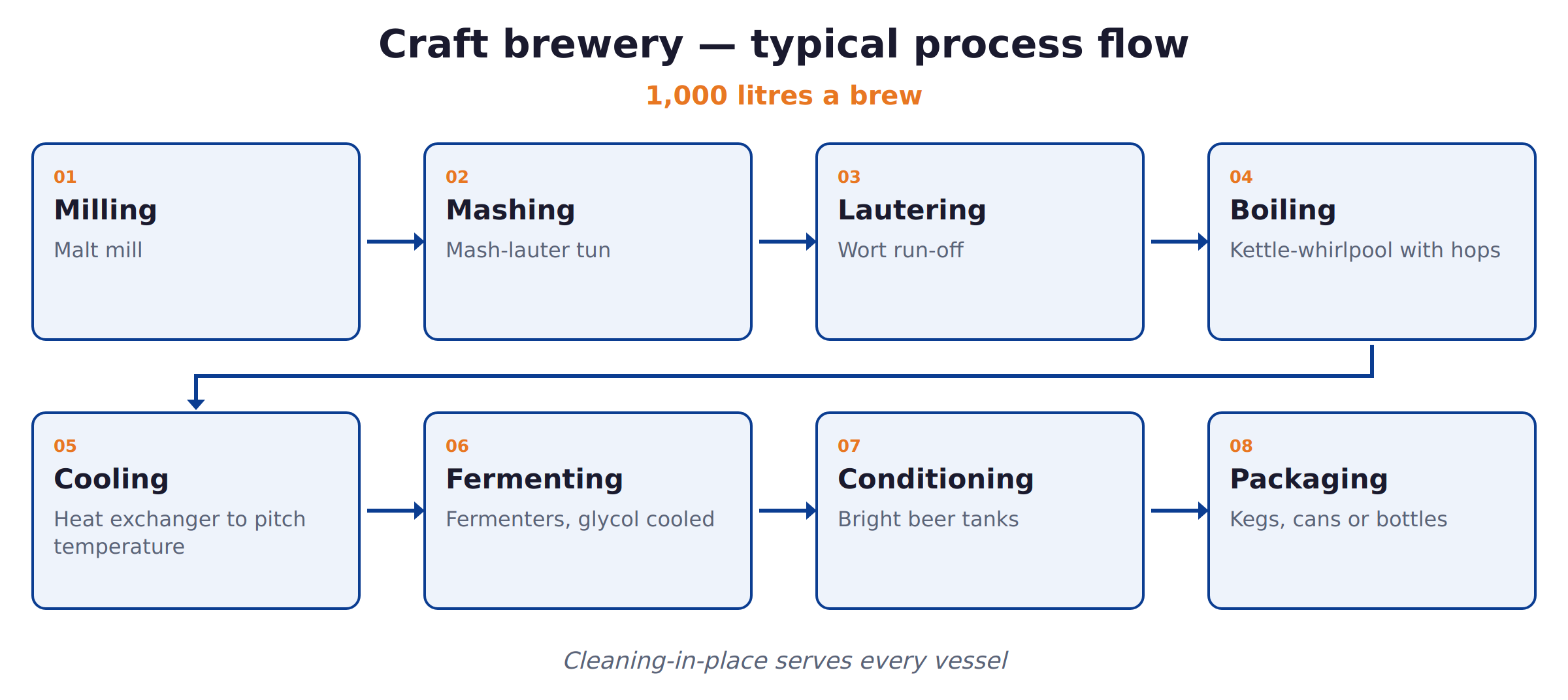
A brewhouse makes wort. Beer is made in the cellar, where it ferments and conditions for one to three weeks or longer. A 1,000-litre brewhouse that brews twice a day is useless without enough fermenters and bright tanks to hold the beer. Size the cellar from your planned weekly sales, then choose the brewhouse.
Ask any brewery supplier three things:
- Brew length and brews per day, and how many fermenters and bright tanks the plan needs for your sales.
- How the beer is cooled, with glycol chiller capacity at your summer temperatures.
- How you will package it: kegs, cans or bottles, and at what speed.
What to check in the supplier
Vessel quality
Ask for the stainless grade, wall thickness, welding finish and pressure rating of fermenters and bright tanks. Poor internal welds harbour bacteria and spoil beer.
Heating and utilities
Brewhouses are heated by steam, electricity or direct fire. Steam is efficient at larger sizes but needs a boiler. Electric heating is simple but draws a large load. Ask for the heating power and the water and effluent each brew uses.
Packaging
Packaging is where small breweries lose most beer and money. Canning and bottling machines must control oxygen pick-up and fill levels. Ask for oxygen and fill-level figures, not only cans per minute.
Where to find brewery equipment suppliers
- Craft brewing associations and festivals connect brewers and suppliers.
- SARS Excise and the liquor authorities explain the licences you need before you choose a site.
- Running breweries: visit one using the brewhouse class and packaging you are considering.
- China: a large share of brewhouses and tanks sold in Africa are made in China. Check the factory with our supplier audit checklist before paying.
Brewery equipment sellers are not named or rated on this page.
How to choose: a 10-point checklist
- Weekly sales plan turned into brew length and cellar size.
- Fermenters and bright tanks enough for your conditioning time.
- Glycol cooling sized for summer.
- Heating method matched to your power and fuel.
- Malt mill and grain handling included.
- Cleaning in place for brewhouse and cellar.
- Packaging: kegs, canning or bottling, with oxygen control.
- Water treatment for brewing water.
- Installation, commissioning with test brews, and brewer training.
- Support for pumps, valves, sensors and the control panel.
Before you compare suppliers, decide the brewhouse itself: our guide to choosing the best brewery equipment covers batch size, heating and fermentation capacity.
Ten questions to ask
- How many brews a week can the brewhouse make, and how many tanks does that need?
- What is the stainless grade and pressure rating of each tank?
- How is the brewhouse heated, and what power or steam does it use?
- What glycol capacity is included, at what ambient temperature?
- Is a malt mill included?
- Is cleaning in place included for every vessel?
- What packaging is included, and what oxygen pick-up does it achieve?
- Is installation, commissioning and training included?
- How quickly can I get valves, seals and sensors?
- Which brewery in South Africa runs this equipment, and can I see it working?
Comparing brewery quotes
| Section | What each quote should state |
|---|---|
| Milling | Malt mill, grist case, conveyor |
| Brewhouse | Vessels, brew length, heating method |
| Cellar | Number and size of fermenters and bright tanks, pressure rating |
| Cooling | Glycol chiller and tank capacity |
| CIP | Cleaning unit and pipework |
| Packaging | Kegging, canning or bottling, speed, oxygen control |
| Water and utilities | Water treatment, boiler, compressor |
| Controls | Panel, automation level |
| Installation and training | Engineer days, test brews, brewer training |
| Owner's scope | Building, drainage, power, licences |
Make every quote cover the same scope before comparing the bottom lines. The same-scope comparison walks through it.
Common mistakes
- Buying a brewhouse and too few tanks. Capacity is set by the cellar.
- Undersized glycol. Fermentation runs warm in summer and flavours suffer.
- Packaging by hand at volume. Oxygen pick-up shortens shelf life.
- Ignoring effluent. Brewery waste water is high in organic load.
- Choosing the site before checking licences.
Brewery equipment prices in 2026
Indicative, in USD, from our microbrewery price guide:
| Purchase | Capacity | Indicative price (2026) |
|---|---|---|
| Brewhouse and cellar | 1,000 L per brew, five or six fermenters, glycol, CIP | About US$90,000–160,000 ex-works |
| Brewery with packaging line | 1,000–2,000 L per brew, plus canning or bottling | About US$200,000–500,000 ex-works |
| Craft gin distillery | 300–500 L still | Quoted per configuration |
| Larger or automated brewery | 3,000 L and up per brew | Quoted per configuration |
Licences, excise and duty in South Africa
- Excise licensing first. A brewery must license with SARS Excise before manufacturing and file monthly excise accounts.
- Excise on beer. Malt beer carries excise of R149.98 per litre of absolute alcohol in the 2026 schedule, about R2.55 on a 340 ml bottle at 5% alcohol.
- Spirits are higher. Gin carries R302.84 per litre of absolute alcohol, about R97.67 on a 750 ml bottle at 43%.
- Liquor licences. The Liquor Act 59 of 2003 lets micro-manufacturers produce up to a prescribed threshold, set in the regulations at 100 million litres a year for beer; provincial liquor licences cover sales.
- Food premises. The brewery must meet R638 of 2018 and hold a Certificate of Acceptability.
- Duty-free equipment. Brewery machinery (8438.40), tanks (7309.00) and filling machines (8422.30) are free of general duty, but heat exchange units (8419.50) carry 15%. VAT vendors reclaim the 15% import VAT; our import duty guide has the detail.
Where CISH fits
CISH is a turnkey brewery company. We specify brewhouses, cellars, utilities and packaging lines from audited factories in China against your sales plan and beers, ship and clear them, and install and commission the brewery with test brews and packaging runs, and your brewers trained. We suit brewers building a production brewery with packaging. For a pilot kit or a single tank, a local fabricator is often the better choice.
Frequently asked questions
Who sells brewery equipment in South Africa?
Local stainless fabricators, dealers and agents of imported equipment, Chinese brewhouse makers selling direct, and turnkey companies that design and commission complete breweries.
How much does a 1,000-litre brewery cost?
As an indication for 2026, a 1,000-litre brewhouse with fermenters, glycol cooling and CIP costs about US$90,000–160,000 ex-works. Adding a canning or bottling line takes it to about US$200,000–500,000.
How much excise does a craft brewery pay?
Malt beer carries R149.98 per litre of absolute alcohol in the 2026 schedule, about R2.55 on a 340 ml bottle at 5%.
What licences does a brewery need?
A SARS Excise licence before you brew, liquor licences under the Liquor Act and provincial law, and a Certificate of Acceptability for the premises.
How many fermenters do I need?
Enough to hold your weekly sales for the full fermentation and conditioning time. Size the cellar first, then the brewhouse.
Does CISH sell pilot brewing kits?
No. We supply complete production breweries with packaging, installed and commissioned. For a pilot kit or extra tanks, a local fabricator is usually the better route.