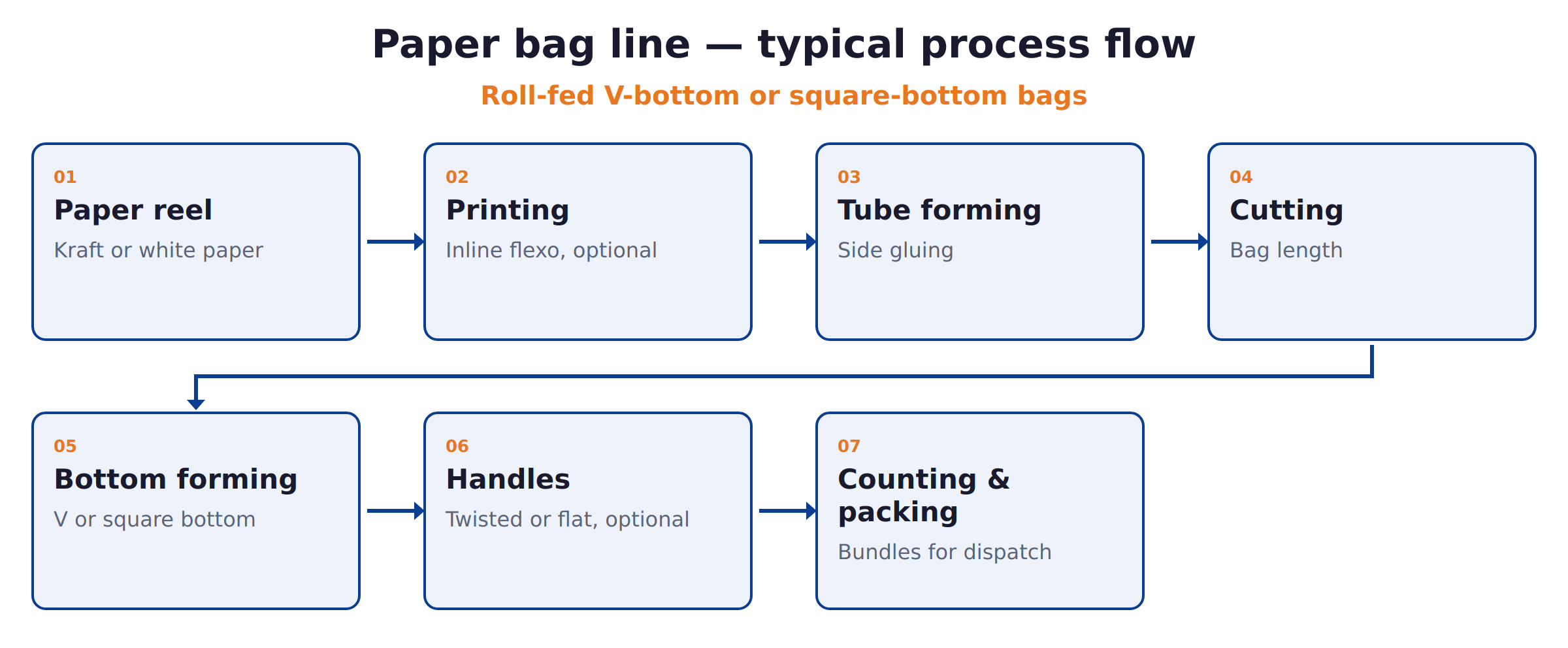
Printing is usually done inline with a flexographic unit or on a separate printer, and adds to the price. Choose by bag type first, then by speed and printing. Demand is supported by retailers moving to paper and by the 100% recycled-content rule for plastic carrier bags from January 2027, though that is a signal, not a guarantee.
The short answer: three bag types, three machine classes
| Bag type | Typical customers | Machine | Indicative price (2026) | Typical speed |
|---|---|---|---|---|
| V-bottom (flat) bag, no handle | Bakeries, takeaways, pharmacies, butchers | Roll-fed V-bottom machine | Within US$30,000–90,000 | Several hundred bags a minute on small sizes |
| Square-bottom (SOS) bag, no handle | Groceries, fast food, flour and sugar packs | Roll-fed square-bottom machine | Within US$30,000–90,000 | About 100–250 bags a minute |
| Square-bottom bag with handles | Fashion, retail, gift and promotional | Handle bag machine with inline twisted or flat handle unit | About US$115,000–370,000 | About 80–200 bags a minute |
Speeds depend on size, paper weight and the operator. Ask for speed on your bag, not the brochure maximum.
Match the machine to your situation
Starting a paper bag business
Start where you have buyers. Bakery and takeaway bags (V-bottom) and plain grocery bags (square-bottom) sell in large volumes to many small customers. A roll-fed machine with one or two size changes covers most of them. Handle bags have higher margins per bag but need retail customers and a bigger investment.
Adding handle bags
If you already sell to retailers and they ask for handle bags, a handle machine is the next step. It needs more floor space, a larger power supply and skilled setting.
Printing
Most customers want their logo. Options:
- Inline flexo on the bag machine: one to four colours, printed as the bag is made.
- Separate flexo printer: prints rolls before bag making; better for longer runs and more colours.
- Buy pre-printed rolls: simplest, but you depend on a printer.
Limited budget
A V-bottom or square-bottom machine with a simple inline printer is the lowest-cost route to a sellable product. Avoid buying a handle machine before you have retail orders.
What separates a good paper bag machine
| Feature | What to check |
|---|---|
| Size range | Bag width, length and gusset range for your customers |
| Paper range | Grammage (for example 40–140 g/m² depending on bag) and kraft or white paper |
| Glue system | Even glue on the bottom and side seam; cold or hot glue |
| Size change time | Hours to change size, and the parts needed |
| Controls | Servo drives and touch screen for faster changes |
| Print register | Accurate registration for printed bags |
| Handle unit | Twisted or flat handles, patching and gluing strength |
Ask for a test run on your paper with your bag size, and check bottom strength and glue lines yourself.
Food contact and customers
Bakeries, takeaways and food producers are food premises under R638 of 2018 and will ask for confirmation that paper, glue and ink are suitable for food contact. Keep declarations from your paper, ink and glue suppliers. Greaseproof and PE-coated papers are used for oily foods.
EPR and recycling
Paper packaging falls under the Extended Producer Responsibility scheme for paper, packaging and some single-use products (GN R.1187 of 2020). Brand owners and producers register with a producer responsibility organisation; for paper, Fibre Circle is one. As a converter, know whether your customers or you carry the obligation for the bags you supply.
Demand: paper versus plastic
The amended plastic bag regulations require plastic carrier and flat bags to contain 100% post-consumer recycled content from 1 January 2027. Some retailers are comparing paper alternatives. Treat this as a demand signal: price, strength and wet performance still decide whether a buyer switches.
Chinese, European and local machines
We do not rate brands. Most paper bag machines sold in South Africa come from Chinese factories, from simple roll-fed machines to servo handle machines. European machines are fast and precise, for large converters, at higher prices. Local engineering shops support repairs and some parts. Paper bag machines under tariff heading 8441.30 enter duty-free; VAT applies.
What a wrong choice costs
- Wrong size range: your best customer's bag does not fit the machine.
- Handle machine without retail buyers: the largest investment, standing idle.
- Weak glue system: bottoms that open, returned orders.
- No printing plan: customers go to competitors who can print their logo.
- No space for paper rolls: paper stock blocks the factory.
Five things to confirm before you decide
- Bag types and sizes your customers order, with monthly volumes.
- Paper: grammage, kraft or white, coated or uncoated, and supplier.
- Printing: colours, inline or separate.
- Site: three-phase power, floor space, roll storage, forklift.
- Size changes: how often you will change sizes and how long each takes.
Worked example: bakery bags first, handle bags later
A packaging distributor in Durban buys bakery and takeaway bags from importers and waits weeks for printed orders. It installs a roll-fed V-bottom machine with a two-colour inline flexo printer and makes plain and printed bags for bakeries and fast-food outlets in its own area, using kraft paper of about 40–60 g/m². With most orders under a week, it wins customers from importers on delivery time and short runs. Two years later a fashion retailer asks for handle bags. The distributor does not buy a handle machine on one customer's word; it signs a supply agreement first, then orders a square-bottom machine with an inline twisted-handle unit and plans a larger building. The figures are illustrative.
Paper supply
Paper is most of the cost of a bag. Compare local and imported kraft and white paper delivered to your door, keep a few weeks of reels in a dry store, and check that the paper runs on your machine: moisture, curl and strength vary between mills and batches. Ask your bag machine supplier to run test bags on your paper before you sign.
Checking bag quality
Test bags from every new paper delivery and every size change: fill a bag with a known weight and lift it by the handles or top, drop-test filled grocery bags, check that bottom and side seams hold when wet for bakery and takeaway use, and measure print registration on branded bags. Keep a few bags from every batch with the date, so a customer complaint can be checked against the bags you actually supplied.
How CISH helps you choose
We start from your bags and your customers. We specify the bag machine, printing, handle unit where needed, and roll handling as one line, supply it from audited factories in China, ship and clear it, install and commission it on your paper at the agreed speed and bag quality, and train your operators. For a used single machine, a local seller is often the better choice.
For the business around the machine, see how to start a paper bag business in South Africa.
Frequently asked questions
What is the best paper bag making machine for a small business?
A roll-fed V-bottom or square-bottom machine with a simple inline printer, costing within about US$30,000–90,000.
How much is a paper bag machine with handles?
As an indication for 2026, about US$115,000–370,000 for a square-bottom machine with an inline handle unit.
What paper is used for paper bags?
Kraft or white paper, usually between about 40 and 140 g/m² depending on the bag, with greaseproof or coated paper for oily foods.
Can the machine print my logo?
Yes, with an inline flexo printer, or you can print rolls separately before bag making.
Are paper bags covered by EPR?
Yes. Paper packaging falls under the paper and packaging EPR scheme in GN R.1187 of 2020.
Does CISH supply paper bag machines?
Yes, as complete lines with printing, commissioning and training.