Demand is growing as retailers and brands look for alternatives to plastic and as plastic carrier bags move to 100% recycled content from 1 January 2027. Printing with the customer's logo adds value. Add a flexographic printer if you print. Paper is the largest running cost; buy the right grade, weight and width, and keep stock. Food bags must be clean and suitable for food contact, and paper packaging falls under the extended producer responsibility (EPR) scheme for paper and packaging.
Step 1: choose your bag types
| Bag type | Uses | Machine |
|---|---|---|
| Flat and V-bottom bags | Bakeries, takeaways, pharmacies, butchers, sweets | Roll-fed V-bottom machine |
| Square-bottom bags without handles | Groceries, takeaways, coffee shops | Roll-fed square-bottom machine |
| Square-bottom bags with twisted handles | Retail, fashion, gift shops | Square-bottom machine with inline handle unit |
| Square-bottom bags with flat handles | Takeaways, delivery, supermarkets | Square-bottom machine with flat handle unit |
| Printed bags | Any of the above, with brand | Add a flexographic printer inline or separate |
Start with the bags your local buyers use most, often V-bottom bakery and takeaway bags or square-bottom takeaway bags. Our guide to choosing a paper bag machine explains the machine types.
Step 2: find buyers
- Bakeries and takeaways: steady volumes of plain or printed bags.
- Restaurants and delivery: square-bottom bags with flat handles.
- Retailers: branded bags for clothing, books, gifts and pharmacies.
- Supermarkets and groceries: larger square-bottom bags, sometimes as an alternative to plastic.
- Distributors and packaging wholesalers: stock bags for many small shops.
Ask what sizes, paper weights, colours and printing buyers need, and the volumes and prices they pay. Large retailers buy through tenders or annual contracts.
Step 3: paper supply
Bags are made from kraft paper (brown or white), sometimes with recycled content, in weights suited to each bag. Paper comes from local mills and imports. Agree supply with more than one supplier, buy the reels in the widths your machines need, and store them dry and flat. Food bags need paper suitable for food contact. Paper is most of your cost, so waste from set-up and trim matters.
Step 4: machines and costs
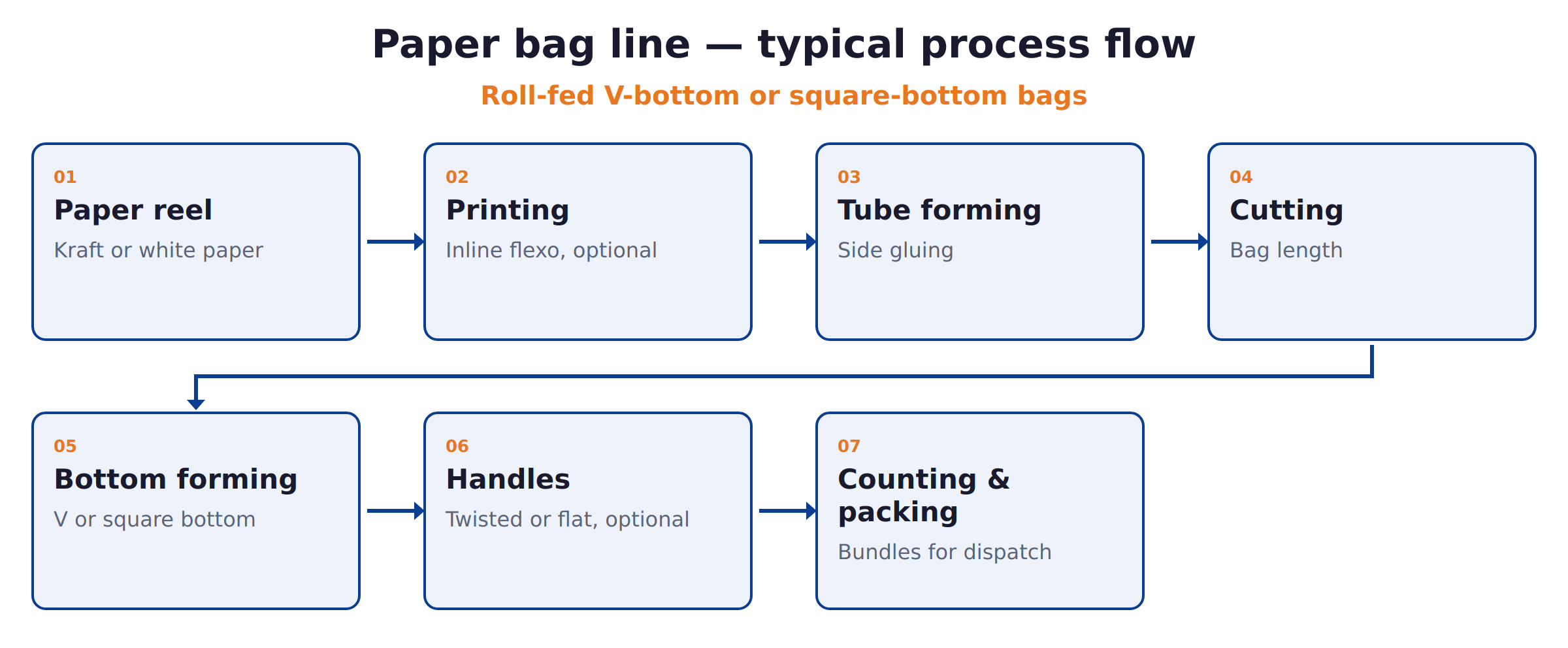
| What you buy | Indicative price (2026) |
|---|---|
| Roll-fed V-bottom or square-bottom machine, no handle | About US$30,000–90,000 ex-works |
| Square-bottom machine with inline twisted or flat handles | About US$115,000–370,000 |
| Flexographic printer | Priced by colours and width |
Machines differ by bag size range, speed, handle type and how quickly they change size. Our paper bag machine price guide shows the bands, and our guide to paper bag machine suppliers lists what a quote must include.
Step 5: printing
Printing brands on bags adds value and keeps customers. Flexographic printing is common for paper bags, with one to several colours. You need printing plates for each design, food-safe inks for food bags, and colour matching. Inline printers save handling; separate printers give more flexibility. Charge for plates and set-up on small orders.
Step 6: rules and EPR
Paper packaging falls under the EPR scheme for paper, packaging and some single-use products (GN R.1187 of 2020). Brand owners and producers register with a producer responsibility organisation; for paper, Fibre Circle is one. Check with your buyers who carries the EPR obligation for bags you make for them. Food bags should be made in a clean area with suitable materials; buyers in food may ask about hygiene and food-contact suitability.
The numbers
Cost per thousand bags is paper (the largest share), glue, handles, ink and plates, power, labour, waste, packaging, delivery and finance. Bags are priced per thousand by size, paper weight, handles and printing. Long runs of one size make the most money; many short runs with size changes cost time and waste.
Worked example: a takeaway bag maker in Cape Town
A packaging distributor in Cape Town sells imported paper bags to takeaways and bakeries. It installs a roll-fed square-bottom bag machine and a two-colour flexographic printer, buys kraft paper from two suppliers, and offers printed bags with short lead times. Later, with demand from restaurants and delivery services, it adds a flat handle machine. The figures are illustrative.
Quality
Check bag dimensions, glue lines and bottoms for strength, handle pull strength, and print quality on every run. Load-test sample bags with the weight customers expect. Test a few bags from each reel of paper as well, because paper strength can vary between deliveries, and record which reel each batch came from. Keep samples from every order.
Space and power
Paper bag lines are long and need space for paper reels, the machine, the printer, finished bags and loading. Plan forklift or reel handling, three-phase power and a dry building.
Common mistakes
- The wrong machine for the bags your buyers want.
- No paper supply agreement.
- Too many sizes and short runs.
- Poor glue and handle strength.
- Ignoring EPR obligations.
Glue, handles and consumables
Bag strength depends on glue as much as paper. Use glue suited to your paper and speed, and check it in cold and humid weather, when bonds can fail. Twisted paper handles and flat handles come on reels or are made inline from paper strips; check that handle supply matches your machine. Keep spare blades, tubes and forming plates for your sizes.
Size changes and stock
Each size change takes set-up time and wastes paper, so group orders by size, offer standard sizes that cover most needs, and keep stock of popular plain bags. Charge more for short runs of special sizes, and agree minimum order quantities for printed bags.
Growing into new markets
Once one line runs well, look at the next product your customers ask for: flat handle takeaway bags, larger grocery bags, printed retail bags, or food bags with windows. Each may need a different machine or unit, so let real orders decide which comes next. Some bag makers also stock or make related paper products for the same customers, such as paper cups, food boxes and wrapping paper, using the same delivery routes.
Delivery and customer service
Small shops and takeaways order little and often, so plan delivery routes and minimum order values, or sell to them through packaging wholesalers. Larger buyers want fixed delivery days, stock held for them, and quick replies to quotation requests. Keep artwork files and print plates for every customer on record, so repeat orders run without delays, and tell buyers early when paper prices change.
Where CISH fits
We supply complete paper bag lines, V-bottom and square-bottom machines, handle units and flexographic printers, from audited factories in China, sized to your bags and volumes. CISH ships, clears, installs and commissions the line on your paper, and trains your team. For a single used bag machine, a local dealer is usually the better buy.
Frequently asked questions
How do I start a paper bag business?
Find buyers, choose the bag types and machine, secure paper supply, and add printing for branded bags.
How much does a paper bag machine cost?
As an indication for 2026, a roll-fed machine without handles costs about US$30,000–90,000 ex-works, and a machine with inline handles about US$115,000–370,000.
What paper is used for paper bags?
Kraft paper, brown or white, in weights suited to each bag.
Who buys paper bags?
Bakeries, takeaways, restaurants, retailers, supermarkets and packaging distributors.
Do paper bags fall under EPR?
Yes. Paper packaging falls under the EPR scheme in GN R.1187 of 2020.
Does CISH supply paper bag lines?
Yes, complete lines with printing, commissioning and training.