Semi-automatic and tabletop machines make about 40–100 pads a minute with manual feeding and folding and cost about US$4,000–50,000, but quality varies from pad to pad and hand handling makes hygiene and SANS 1043 consistency hard. High-speed full-servo lines of 400–800 or more pads a minute cost about US$230,000–550,000 ex-works for the equipment. The real comparison is waste and consistency, not the machine price: every rejected pad wastes imported materials. Products delivered to schools must be SABS compliant, tested for safety, absorption and microbial contamination.
The short answer: three classes of pad line
| Class | Pads per minute | Indicative price (2026) | Labour | Consistency | Best fit |
|---|---|---|---|---|---|
| Semi-automatic or tabletop | About 40–100 | About US$4,000–50,000 | High: manual feeding, folding, packing | Variable | Training, samples, very small local sales |
| Complete automatic line | About 60–150 | About US$150,000–400,000 | Low to moderate | Good | New brands, retail, provincial tenders |
| High-speed full-servo line | About 400–800+ | About US$230,000–550,000 ex-works (equipment) | Low, but skilled | High | Large brands, private label, national supply |
Pad output is only useful if the pads pass testing and the packs sell. Ask every supplier for output of good pads per hour on your design, and the expected waste at start-up and in steady running.
Why waste rate matters more than speed
Most of the cost of a pad is material: fluff pulp or airlaid paper, superabsorbent polymer (SAP), non-woven top sheet, PE back sheet, hot-melt glue, release paper and wrapping film, much of it imported. A line that wastes material at every splice, roll change or jam loses money on every shift. Good automatic lines have:
- Automatic splicing of material rolls without stopping.
- Web guiding and tension control so layers stay aligned.
- Vision or sensor rejection of faulty pads.
- Servo drives that keep settings when you change speed.
- Accurate SAP dosing so absorption is consistent and SAP is not wasted.
Match the line to your situation
New brand
If you have retail or wholesale buyers lined up, a complete automatic line of about 60–150 pads a minute is the realistic start. It makes consistent pads that can be tested to SANS 1043 and packed in retail packs.
Tender supplier
The Sanitary Dignity Programme supplied free pads to about 4 million learners in Quintile 1–3, farm and special schools in 2025/26, through provincial departments. Products delivered must be SABS compliant, meaning tested for safety, absorption and the absence of microorganisms. Tender volumes need an automatic line, consistent quality records and capacity to deliver on time.
Existing converter growing
If you run a small automatic line and sell everything, the step is a faster line with servo control and better waste control, or a second line for a different pad size.
Limited budget
A semi-automatic machine can train staff and make samples, but it rarely supports a business on its own. Spend on the right automatic line, a small laboratory for absorbency and pH checks, and material stock.
Can the line meet SANS 1043?
SANS 1043 is the South African standard for disposable sanitary towels; the current edition on the SABS webstore is SANS 1043:2026. In March 2026 the SABS opened an amended draft for comment that strengthens product marking, including clearer disclosure of fibre composition and declaration of substances, additives, treatments and cautionary statements. Whether your pads pass depends on materials, design and process control as much as on the machine. Ask the supplier to make test pads on the line with your materials and have them tested at an accredited laboratory before you finalise the order. Our SANS 1043 guide explains the standard and the marks.
What separates a good automatic line
| Feature | What to check |
|---|---|
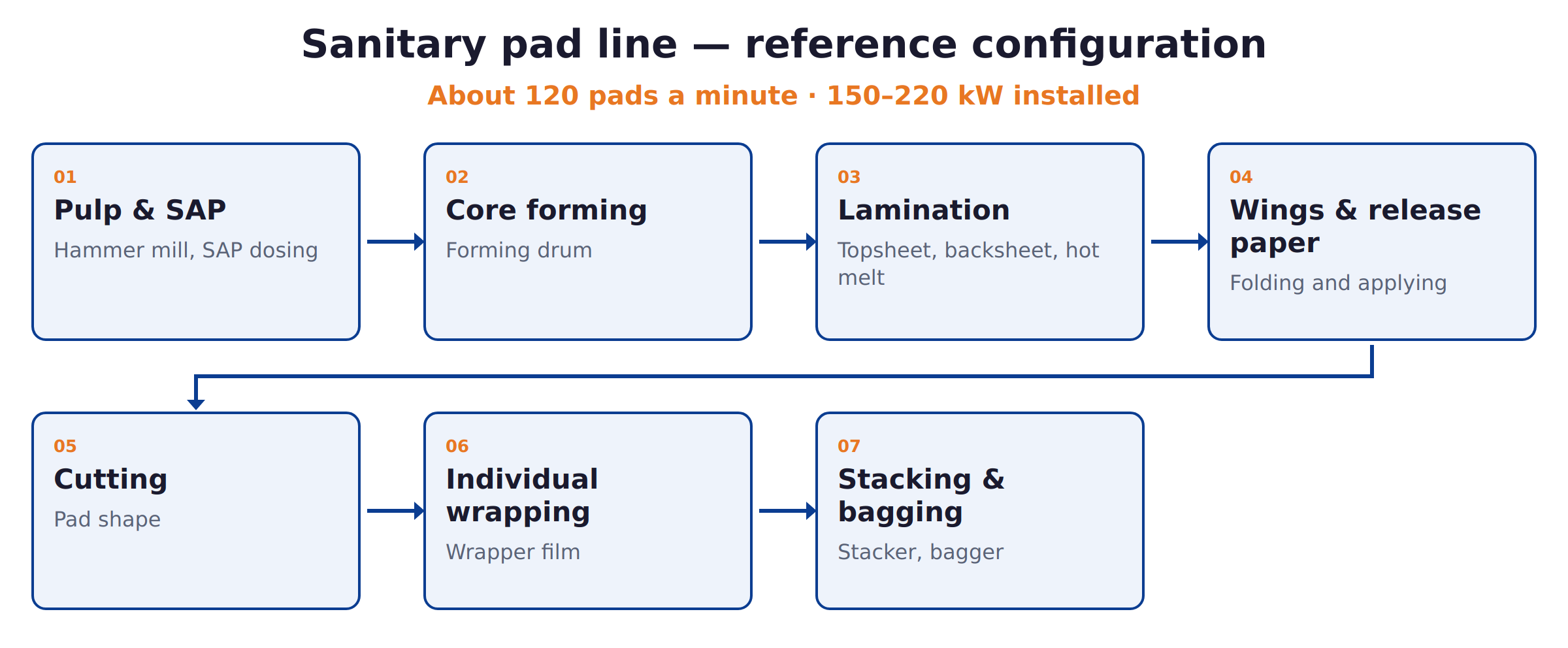
| Core forming | Pulp mill and forming drum, or airlaid core; uniform weight |
| SAP dosing | Accuracy and placement |
| Lamination | Hot-melt glue system, pattern and amount |
| Wings and release paper | Placement accuracy |
| Folding and wrapping | Individual wrapping and three-fold quality |
| Controls | Servo drives, recipe storage, rejection system |
| Change parts | Moulds and knives for each pad size: day, night, panty liner |
| Clean design | Enclosed sections, easy cleaning, dust extraction |
Chinese, European and local equipment
We do not rate brands. Most pad lines bought by new South African producers come from Chinese factories, from semi-automatic to full-servo. European lines are fast and precise for large brands, at higher prices. There is little local manufacture of pad lines, so spares planning matters: knives, anvil rolls, belts, sensors, heating elements and servo parts. Machines for making and packing pads under headings such as 8479.89, 8441.80 and 8422.40 generally enter duty-free; VAT applies.
What a wrong choice costs
- Semi-automatic for a tender: inconsistent pads and missed volumes.
- Fast line without waste control: material costs eat the margin.
- No change parts for your sizes: day pads only, no night pads or liners.
- No testing plan: pads fail SABS testing and cannot be delivered.
- No dust control: pulp dust in the factory and in the product.
Five things to confirm before you decide
- Pad range: sizes, wings, core type (pulp or airlaid), ultra-thin or maxi.
- Volume: packs a month you can sell and deliver.
- Materials: suppliers for pulp, SAP, non-woven, film and release paper, and lead times.
- Testing: laboratory access for absorbency, pH and microbiology.
- Site: clean production room, three-phase power, compressed air, storage for materials and stock.
Worked example: a women-owned start-up
A women-owned business in Limpopo distributes pads to schools as a subcontractor and wants to make its own. It compares a tabletop machine and an automatic line of about 100 pads a minute. The tabletop machine is cheap, but the pads vary in core weight and the folding is done by hand, which makes consistent SABS testing and a hygienic process difficult. The business plans an automatic line with change parts for day pads and panty liners, a clean room with washable walls, dust extraction for the pulp mill, and a small laboratory for absorbency checks. It sends test pads made on the supplier's line with its chosen materials to an accredited laboratory before paying the balance. The figures are illustrative.
Materials and stock
Most pad materials are imported and come in large rolls and bales. Plan a dry store with enough stock for several weeks of production, and check lead times for SAP, non-woven and release paper, because a missing material stops the whole line. Keep material certificates for every batch: they support your product testing and tender files.
How CISH helps you choose
We start from your pad range and your buyers. We specify the line, change parts, packing and dust control, supply it from audited factories in China, ship and clear it, install and commission it on your materials at the agreed good-pad output and waste rate, and train your operators. Sanitary pads have been zero-rated for VAT since 1 April 2019, which matters for your pricing. For a tabletop machine for training, a local seller is often the better buy.
Frequently asked questions
Is a semi-automatic or fully automatic sanitary pad machine better?
Fully automatic for any business that sells to retailers or tenders. Semi-automatic machines suit training and samples.
How much does a sanitary pad making machine cost?
As an indication for 2026, semi-automatic machines cost about US$4,000–50,000, complete automatic lines about US$150,000–400,000, and high-speed lines about US$230,000–550,000 ex-works.
How many pads does a machine make per minute?
Semi-automatic machines about 40–100, automatic lines about 60–150, and high-speed lines 400–800 or more.
Do pads for schools need SABS approval?
Products delivered under the Sanitary Dignity Programme must be SABS compliant, tested for safety, absorption and microorganisms.
What raw materials do I need?
Fluff pulp or airlaid paper, SAP, non-woven top sheet, PE back sheet, hot-melt glue, release paper and wrapping film.
Does CISH supply pad making lines?
Yes, complete automatic lines with commissioning on your materials and training.