Sanitary pad machines in South Africa are sold by dealers of imported hygiene machinery, Chinese factories that build semi-automatic and full-servo pad lines, agents for high-speed lines, and turnkey companies that set up a complete pad plant with packing and raw materials planned. Choose the supplier who commits to pads per minute at your pad design and passes SABS testing.
Who sells sanitary pad machines
Hygiene product entrepreneurs, women-owned businesses targeting tenders, existing converters and retail private-label suppliers ask for pad machines. They meet four supplier types.
| Supplier type | What they sell | Price | Who answers for output | Best fit |
|---|---|---|---|---|
| Dealer of imported hygiene machinery | Tabletop and semi-automatic pad machines, sealers | Low to moderate | The dealer, per machine | Small workshops and training projects |
| Chinese factory, direct | Semi-servo and full-servo pad lines, nappy lines | Lowest on the quote | You, after delivery | Buyers with hygiene-line technicians |
| Agent for high-speed lines | Full-servo lines for national brands | Highest | The maker, through the agent | Large brands |
| Turnkey pad plant company | Pad line, packing, compressed air and raw material plan, commissioned | Between direct and agent | The turnkey company, at agreed pads per minute | New plants and tender suppliers |
A pad line is materials and packing, not only forming
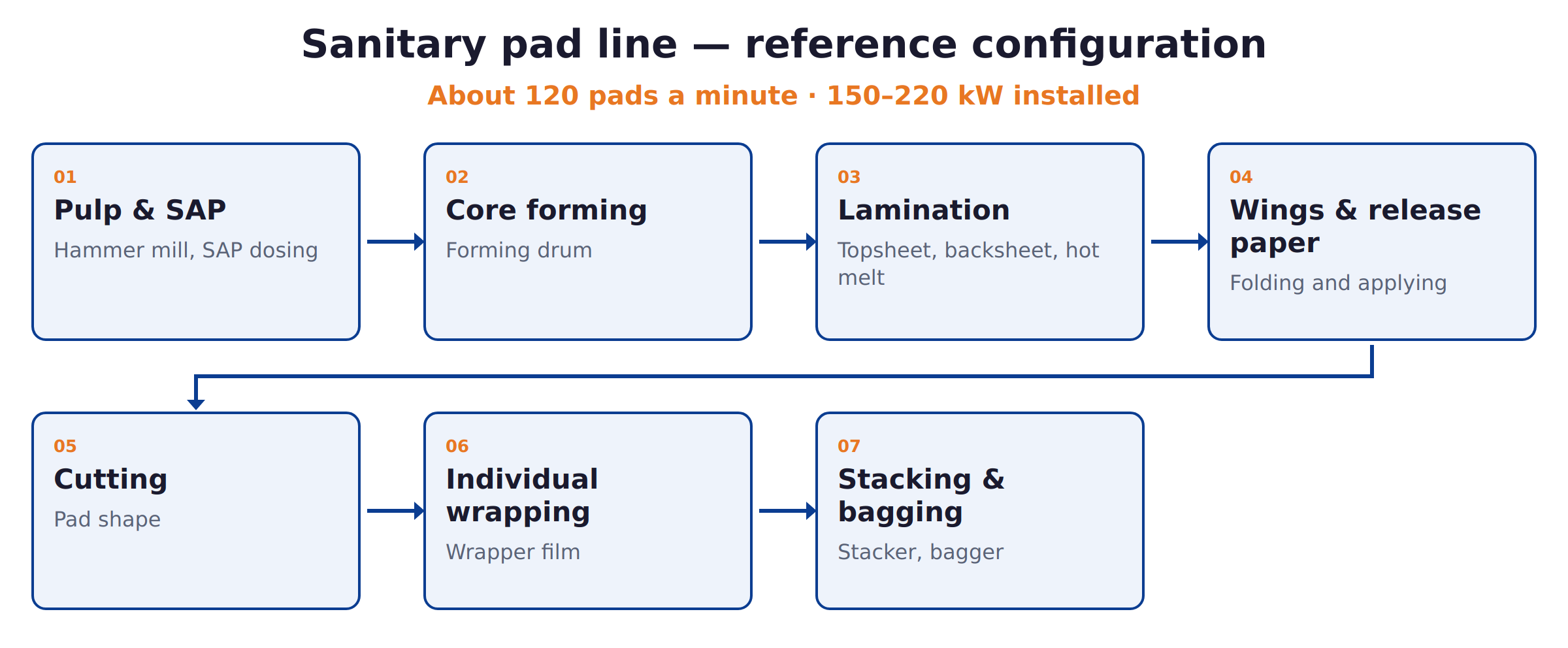
A pad is layers: a top sheet, an absorbent core of fluff pulp and often superabsorbent polymer, a back sheet, release paper and wings, sealed and cut, then folded and individually wrapped. Machine speed means little if the core forming is uneven or packing is manual. Many tabletop machines make pads but leave folding, wrapping and bagging to hand labour.
Ask any supplier three things:
- Which pad: day, night, panty liner or maternity, with length, wings and core design.
- Pads per minute, stable over a shift, including individual wrapping and bagging.
- What core forming the line uses, and how evenly it distributes pulp and polymer.
What to check in the supplier
Core forming and sealing
Ask how the line forms and weighs the core, whether it seals with glue or ultrasonic heads, and how it detects missing or misplaced parts.
Packing
Individual wrapping, three-fold and bag packing are where labour costs gather. Ask what packing is automatic.
Raw materials
Fluff pulp, polymer, non-wovens, film and glue are mostly imported. Ask which materials the line is set up for and the material waste rate.
Where to find pad machine suppliers
- SABS sells SANS 1043 and runs the testing most buyers expect.
- Government programme briefings, such as those on the Sanitary Dignity Programme, explain what products must meet.
- Working plants: visit a line making pads like yours, with packing running.
- China: most pad lines sold in Africa are made in China. Our supplier audit checklist covers the factory checks.
We name no pad machine suppliers here.
How to choose: a 10-point checklist
- Pad designs defined: sizes, wings, core, packs.
- Pads per minute, stable, demonstrated at handover.
- Core forming with weight control.
- Sealing: glue or ultrasonic.
- Quality detection: missing parts, misplacement.
- Folding, individual wrapping and bagging automated.
- Compressed air and power for the line.
- Raw material plan and waste rate.
- Installation, commissioning, training and SABS test support.
- Support for knives, ultrasonic horns, belts and controls.
Considering nappies as well? See how to start a diaper manufacturing business.
Ten questions to ask
- What pads per minute does the line hold over a shift?
- Which pad designs and sizes can it make, and how long is a changeover?
- How is the core formed and weighed?
- Does it seal with glue or ultrasonic heads?
- What packing is automatic?
- What material waste rate should I expect?
- What compressed air and power does it need?
- Is installation, commissioning and training included?
- Will you support SANS 1043 testing on the first production?
- Which plant runs this line, and may I see packed product from it?
Comparing pad line quotes
| Section | What each quote should state |
|---|---|
| Forming | Core forming, pulp mill, polymer dosing |
| Assembly | Unwinds, glue or ultrasonic sealing, cutting |
| Quality | Detection and rejection |
| Folding and wrapping | Three-fold, individual wrap |
| Bagging | Counting, bag packing |
| Utilities | Compressor, dust extraction, power |
| Spares | Knives, horns, belts |
| Installation and training | Engineer days, operator training |
| Owner's scope | Building, raw materials, SABS testing |
Line the quotes up on scope first. The same-scope comparison explains the steps.
Choose by situation
| Your situation | Usual route |
|---|---|
| Training project or community workshop | Tabletop or semi-automatic machine from a local dealer |
| Private label for one retailer | Complete automatic line at 60–150 pads a minute, with individual wrapping |
| Provincial or national programme bids | Automatic line with bagging, SABS-tested product and CSD registration |
| National brand volumes | High-speed full-servo line from a specialist maker |
| Adding baby nappies later | Plan the building and compressed air for a second line from day one |
Buyers decide the pack format and speed, so secure a first buyer's specification before you choose the machine.
Common mistakes
- Buying a tabletop machine for a tender volume.
- Manual packing at scale. Labour and hygiene suffer.
- No core weight control. Absorption tests fail.
- Ignoring raw material lead times.
- Bidding before SABS testing.
Pad line prices in 2026
Indicative, in USD, from our sanitary pad line cost guide:
| Purchase | Capacity | Indicative price (2026) |
|---|---|---|
| Semi-automatic or tabletop machine | 40–100 pads/min, manual folding | About US$4,000–50,000 |
| Complete automatic pad line, landed | 60–150 pads/min | About US$150,000–400,000 |
| High-speed full-servo line | 400–800+ pads/min | Equipment about US$230,000–550,000 ex-works |
| Baby nappy line, landed | 300–500 nappies/min | About US$400,000–900,000 |
Standards, buyers and duty in South Africa
- SANS 1043. Disposable sanitary towels are made to SANS 1043; the current edition listed by SABS is SANS 1043:2026, and SABS sought comment in March 2026 on stronger marking requirements.
- Tested for programmes. Officials told Parliament in March 2026 that products delivered under the Sanitary Dignity Programme are SABS compliant, tested for safety, absorption and the absence of micro-organisms.
- Reusable pads. Washable, reusable pads have their own standard, SANS 1812:2020.
- VAT zero-rated. Sanitary pads have been zero-rated for VAT since 1 April 2019; your inputs still carry VAT, so register and claim.
- Procurement rules. Provincial bids run under the Preferential Procurement Regulations 2022, with the Public Procurement Act 28 of 2024 still to come into operation.
- Duty-free machinery. Pad machines are usually entered as other machines (8479.89.90) or paper-converting machinery (8441.80), and packing machines (8422.40), all free of general duty. VAT vendors reclaim the 15% import VAT; see the import duty guide.
Where CISH fits
CISH is a turnkey pad plant company. We specify complete pad lines from audited factories in China against your pad designs and buyers, with packing and a raw material plan, ship and clear them, and install and commission the line with pads per minute demonstrated, and your operators trained. For a tabletop machine, a local dealer is often the better choice.
Frequently asked questions
Who sells sanitary pad machines in South Africa?
Dealers of imported hygiene machinery, Chinese factories selling direct, agents for high-speed lines, and turnkey companies that supply complete pad plants.
How much is a sanitary pad machine?
As an indication for 2026, a semi-automatic or tabletop machine costs about US$4,000–50,000, and a complete automatic line for 60–150 pads a minute about US$150,000–400,000 landed.
Which standard applies to sanitary pads?
SANS 1043 for disposable sanitary towels, with SANS 1812 for washable, reusable pads. Buyers usually expect SABS testing.
Are sanitary pads VAT-free?
They have been zero-rated for VAT since 1 April 2019. Manufacturers still pay VAT on inputs and claim it back.
Is pad machinery duty-free?
Pad and packing machines are usually free of general duty in SARS's 2026 tariff. Import VAT of 15% applies.
Does CISH sell tabletop pad machines?
No. We supply complete automatic pad lines, installed and commissioned. For a tabletop machine, a local dealer is usually the better route.