Choose the supplier who commits to blocks per shift at a strength that passes SANS 1215, and who includes batching, pallets, curing and handling.
Who sells brick and block machines
| Supplier | What you buy | Cost | Who answers for strength and output | Fits |
|---|---|---|---|---|
| Local machine manufacturer | Manual presses, egg-layers, small stationary machines, moulds, local service | Low to moderate | The manufacturer, for the machine | Small yards and rural builders |
| Dealer of imported machines | Stationary machines from stock, moulds | Moderate | The dealer | Yards upgrading from egg-layers |
| Chinese factory, direct | Semi-automatic and automatic block machines, pallet systems, stackers | Lowest on the quote | You, after delivery | Producers with their own fitters |
| Turnkey yard company | Batching, block machine, pallets, curing, handling and layout, installed and commissioned | Depends on scope | The yard, at agreed blocks per shift and strength | New commercial block yards and producers moving to automation |
Cement block, clay brick or interlocking?
Three different products, three different plants:
- Concrete blocks and pavers made by vibration and compression from cement, sand and stone; made to SANS 1215 for masonry units and SANS 1058 for paving blocks.
- Burnt clay bricks made from clay, extruded or pressed, dried and fired in a kiln; made to SANS 227. A clay plant is a much larger project.
- Interlocking soil-cement bricks made in hand or hydraulic presses from stabilised soil; dry-stack building systems are their main market.
Most enquiries are for concrete blocks and pavers. Our block machine price guide compares the tiers.
What decides a good block machine supplier
Strength, not just shape
Blocks sold for building must reach the strength class in SANS 1215. Strength comes from mix, vibration and compaction, and curing. Ask the supplier for blocks made on their machine with your materials, tested for compressive strength.
The yard around the machine
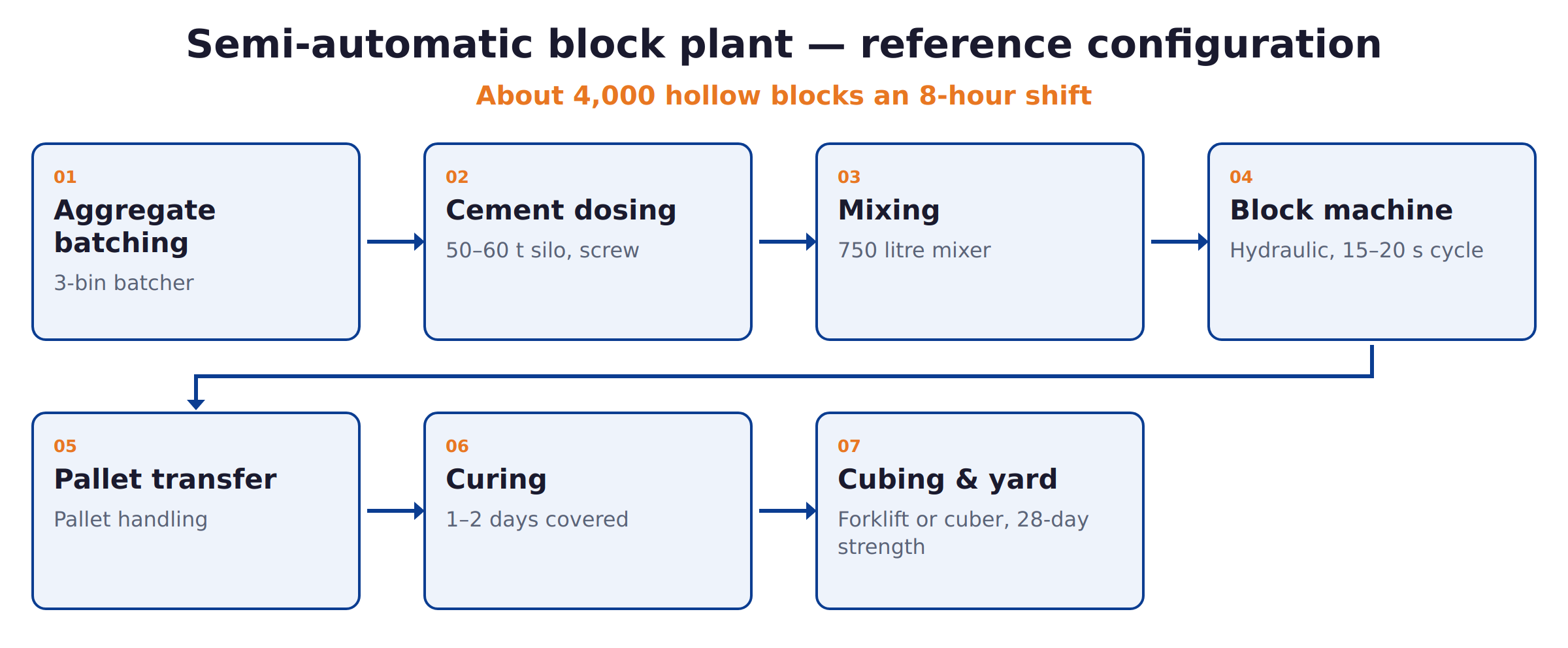
A block machine is the centre of a yard that also needs aggregate storage, batching or a mixer, cement storage, production pallets, a block transport system, curing space or chambers, and cubing or stacking. A "block plant" quote that is only the machine leaves most of the yard to you.
Moulds and pallets
Each product needs a mould. Ask how long moulds last, what they cost, and whether pallets are steel, wood or plastic. Pallets and moulds are a large and recurring cost.
Where to find block machine suppliers
- The Concrete Manufacturers Association represents precast and block producers that meet its quality criteria; CMA Certification lists the SANS standards it certifies.
- The Clay Brick Association represents the clay brick sector.
- Builders' merchants know which local yards make consistent blocks, and what machines they run.
- Existing yards: visit one of the size you plan; ask about mould life, rejects and breakdowns.
- China: most semi-automatic and automatic block machines sold in Africa are built in China; use our supplier audit checklist.
We have kept company names off this guide.
Ten checks before buying
- Products: block sizes, pavers, kerbs, with a mould for each.
- Output in blocks per shift of each product, demonstrated.
- Strength to SANS 1215 or SANS 1058 with your materials, tested.
- Batching and mixing: weighing, mixer type, water control.
- Pallets and transport: pallet type, block carrier or conveyor.
- Curing: yard curing, chambers, or covers; time to dispatch.
- Stacking and cubing: manual, semi or automatic.
- Power and foundations: vibrator and hydraulic loads; machine foundations.
- Installation, commissioning and training.
- Moulds and spares: life, price, lead time.
Questions for a block machine supplier
- How many blocks of each size will the machine make per shift?
- Will blocks from my materials pass SANS 1215, and will you test them?
- What does the quote include apart from the machine?
- How many pallets come with it, and what are they made of?
- How are blocks cured and handled?
- How long do moulds last, and what do new ones cost?
- What power and foundations does the machine need?
- Who installs and commissions it?
- What does the warranty exclude?
- Which yard runs this machine, and may I visit?
A full block yard quote lists
| Area | Check |
|---|---|
| Aggregates | Storage bays, loader or conveyor feed |
| Cement | Silo or bag splitting, screw feeder |
| Batching and mixing | Scales, mixer, water dosing |
| Block machine | Vibration, compaction, moulds for each product |
| Pallets and transport | Pallet type and number, block carrier |
| Curing | Yard layout, chambers or covers |
| Stacking | Cuber or manual stacking, strapping |
| Installation and commissioning | Trial production and strength testing |
| Training | Operators, mix control, maintenance |
| Owner's scope | Slab, power, water, drainage, permits |
Add the missing items to each quote before you compare; our same-scope method shows how.
From a delivered project: A regional developer asked for a 12,000 blocks-a-day automatic plant; sized to real off-take, the plant built was about 6,500 blocks a day over two shifts, online in 22 weeks and at 78% effective utilisation within three months. Read the block and paver plant case study.
Mistakes that cost block yards money
- Buying the machine and forgetting the yard. Output is set by pallets, curing space and handling.
- No strength testing. Blocks that fail SANS 1215 lose contractors and tenders.
- Cheap moulds. They wear fast and blocks lose their shape.
- Wrong scale for the market. An automatic plant needs steady orders to pay back.
- Second-hand machines without a permit. Used machinery needs an ITAC import permit before shipment.
Block machine prices in 2026
Indicative, in USD, from our block machine price guide:
| Tier | Indicative price (2026) | Basis |
|---|---|---|
| Manual or mobile machine | US$8,000–40,000 | Machine price; a whole small project stays under about US$80,000 |
| Semi-automatic block plant | US$120,000–450,000 | Landed and commissioned |
| Fully automatic plant | US$600,000–1.5 million and up | Plant scope; civils extra |
The South African context
- Standards. Concrete masonry units are made to SANS 1215, burnt clay masonry to SANS 227 and concrete paving blocks to SANS 1058.
- Housing demand. The Department of Human Settlements' 2026/27 budget was R26.972 billion with a target of 39,058 housing units; in 2025/26 it delivered 23,027 units. Public housing work follows budgets, and delivery has lagged them.
- Builders' registration. Home builders must register with the NHBRC, which inspects new homes; contractors look for blocks from consistent, tested suppliers.
- No duty on imported blocks or bricks. Cement building blocks (6810.11) and clay building bricks (6904.10) are free of general duty in SARS's 2026 tariff, as is machinery for moulding mineral products (8474.80). Local yards compete on transport cost and service, not on tariff protection. VAT vendors reclaim the 15% import VAT on equipment; see the import duty guide.
- Used machinery. Second-hand machines need an ITAC import permit before they are shipped.
Where CISH fits
CISH designs, supplies, installs and commissions complete block and paver yards: batching, block machine, moulds, pallets, curing and handling, from audited factories in China. We test blocks from your materials against SANS 1215 and hand over at an agreed output per shift with your team trained. We suit commercial yards moving from egg-layers to stationary or automatic production. For a single manual or egg-laying machine, a local manufacturer is usually the better buy.
Frequently asked questions
Who makes brick making machines in South Africa?
Local manufacturers make manual, egg-laying and small stationary machines; dealers sell imported machines; Chinese factories sell semi-automatic and automatic machines direct; turnkey companies build complete yards.
How much is a brick making machine in South Africa?
As an indication for 2026, manual and mobile machines cost about US$8,000–40,000. A semi-automatic block plant landed and commissioned runs about US$120,000–450,000, and fully automatic plants start around US$600,000.
What standard must concrete blocks meet?
Concrete masonry units are made to SANS 1215, and paving blocks to SANS 1058. Clay bricks follow SANS 227.
How many blocks can a machine make per day?
It depends on the machine, block size and how many pallets and curing space you have. Ask each supplier for blocks per shift of each product, demonstrated on your materials.
Can I import a used block machine?
Yes, with an ITAC import permit obtained before shipment. New machinery does not need a permit.
Does CISH sell single block machines?
We supply complete block and paver yards. For a single manual or egg-laying machine, a local manufacturer is usually the better route.