Choose the supplier who will calibrate weighing to a stated accuracy, design for the SANS product you will sell, and commission the plant with your aggregates.
Four kinds of batching plant supplier
A builder who wants concrete on one site, a ready-mix start-up and a precast yard making kerbs and culverts all look for batching plants. The supplier types differ in what they deliver and who answers when the concrete is wrong.
| Supplier type | What they sell | Price | Who answers for the mix | Best fit |
|---|---|---|---|---|
| Local mixer and plant builder | Pan mixers, small batching plants, moulds, vibrating tables; local service | Moderate | The builder, for the machine | Block and small precast yards, site batching |
| Agent of an imported batching brand | Engineered stationary plants, twin-shaft mixers, control systems | High | The agent, for their plant | Large ready-mix and precast producers |
| Chinese factory, direct | Stationary HZS-class plants, mobile plants, cement silos and screw conveyors | Lowest on the quote | You, after delivery | Contractors with their own plant fitters |
| Turnkey yard company | Batching, product lines, curing, handling and layout, installed and commissioned | Between direct and imported | The turnkey company, at agreed output and calibration | First precast yards and producers adding lines |
Stationary or mobile, ready-mix or precast?
Decide what the plant is for before you compare suppliers:
- Project or site batching: a mobile plant that moves between contracts.
- Ready-mix: a stationary plant with truck loading, sized for peak hourly demand.
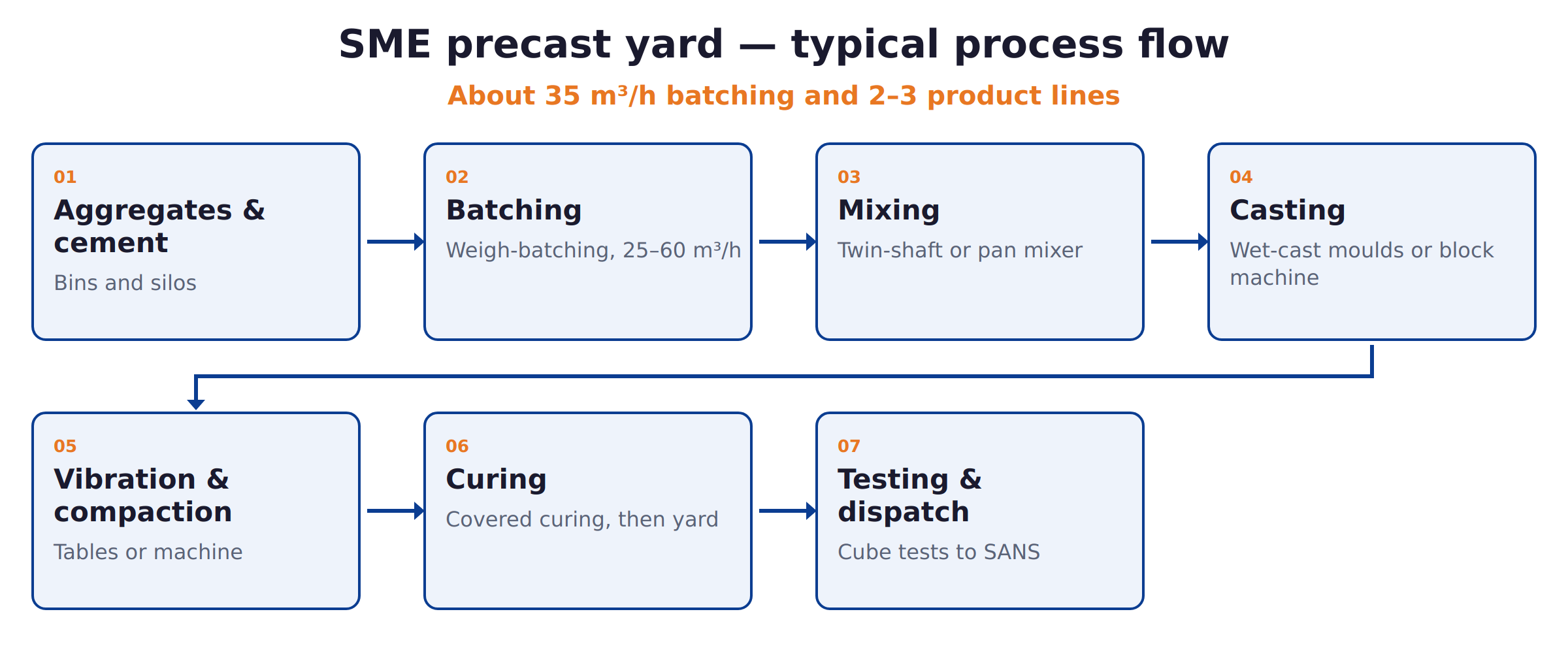
- Precast or block yard: a stationary plant feeding product lines at a steady rate, where the downstream moulds, curing and handling matter as much as the batching.
Our batching plant and precast yard cost guide explains the plant classes and capacity.
What separates batching plant suppliers
Weighing accuracy and calibration
Concrete quality starts at the scales. Ask what accuracy the cement, water, aggregate and admixture weighing will achieve, how it is calibrated at commissioning, and how often it should be re-checked. A plant without calibration records cannot defend the strength of what it makes.
Designing for the product standard
Precast products sold in South Africa are made to SANS specifications: paving blocks to SANS 1058, kerbs to SANS 927, concrete pipes to SANS 677, culverts to SANS 986, manhole sections to SANS 1294, fence components to SANS 1372 and prestressed lintels to SANS 1504. A supplier who has never produced to the standard you need will not know what the plant, moulds and curing must do.
Trial mixes with your own aggregates
Local sand and stone vary widely. Ask for commissioning to include trial mixes with your aggregates and cement, tested for strength, before handover.
Where to find batching plant suppliers
- The Concrete Manufacturers Association. The CMA represents precast producers that meet its quality criteria and works with SABS on product standards; members are the best references for plant suppliers.
- CMA Certification lists the SANS specifications its certification covers, which tells you what a compliant yard must achieve.
- Construction and mining shows in Johannesburg exhibit batching plants and mixers regularly; check current dates with the organisers.
- Other yards: visit one making the product you plan to make, and ask about breakdowns and calibration.
- China: most mid-sized batching plants sold in Africa are built in China; read our supplier audit checklist first.
We do not name or rate suppliers.
How to choose: a 10-point checklist
- Purpose: site, ready-mix or precast, and the plant class to match.
- Real capacity: cubic metres per hour at your mix, not the mixer's nameplate.
- Weighing accuracy stated for each material, with calibration at commissioning.
- Mixer type: pan, planetary or twin-shaft, suited to your mixes.
- Cement storage: silo size and screw conveyor capacity; dust control.
- Controls: recipe storage, batch records and moisture correction.
- Downstream fit: for precast, the product lines, moulds, curing and handling designed with the batching.
- Safety: guarding and operator training under the OHS Act and the machinery regulations.
- Installation and commissioning with trial mixes on your materials.
- Support: who services the mixer, scales and controls, and how parts are supplied.
Selling to government or municipal projects? See Central Supplier Database registration for manufacturers.
Still deciding between a mobile and a stationary plant? Our comparison of the best concrete batching plant for your work sets out when each fits.
Ten questions to ask
- What output will the plant deliver per hour at my mix?
- What weighing accuracy will you guarantee, and how is it calibrated?
- Which mixer type is it, and why for my products?
- What silo capacity and cement feed rate is included?
- How are batch records stored?
- Have you supplied plants producing to the SANS standard I need?
- What foundations and civil works does the plant need?
- Is installation, commissioning and trial mixing included?
- What does the warranty cover?
- Which plant in South Africa runs your equipment, and may I visit?
Comparing batching and precast quotes
| Section | What each quote should state |
|---|---|
| Aggregate storage and feed | Bins, belt or skip, capacity |
| Cement and additives | Silos, screw conveyors, admixture dosing |
| Weighing | Scales for each material, stated accuracy |
| Mixer | Type, batch size, cycle time |
| Controls | Recipes, records, moisture correction |
| Product lines | Block or paver machine, wet-cast moulds, pipe or culvert equipment |
| Curing and handling | Curing area or chambers, racks, forklifts or gantry |
| Freight and installation | Incoterm, clearance, erection, commissioning, trial mixes |
| Training and documents | Days, manuals, calibration certificates |
| Owner's scope | Slab and foundations, power, water, drainage, permits |
Add what each quote leaves out before you compare. Our same-scope comparison explains how.
Common mistakes
- Buying a batching plant without the downstream yard. For precast, the moulds, curing and handling decide output.
- Skipping calibration. Without records, you cannot prove the strength of your product.
- Undersized cement handling. Silos and screws that cannot keep up cap the plant.
- Ignoring dust and water. Dust control and washout water handling are part of a compliant yard.
- Chasing tenders without the standard. Public work specifies SANS products; plan the plant around the standard first.
Batching and precast prices in 2026
Indicative, in USD, from our batching plant and precast yard cost guide:
| Purchase | Capacity | Indicative price (2026) |
|---|---|---|
| Batching plant only | 25–60 m³/h stationary | USD 20,000–60,000 |
| Single precast machine | Per machine, with a standard mould set | USD 2,000–25,000 per machine |
| SME precast yard | About 35 m³/h batching plus 2–3 wet-cast product lines | USD 150,000–450,000 |
| Pipe, culvert and tender plant | Reinforced products to SANS specifications | Quoted per configuration |
South African facts that shape the choice
- SANS product standards for paving blocks, kerbs, pipes, culverts, manholes, fence components and lintels are listed by CMA Certification; certified product needs a plant that can make it consistently.
- Public housing demand. The Department of Human Settlements' 2026/27 budget was R26.972 billion, with targets of 39,058 housing units and 25,186 serviced sites; in 2025/26 it delivered 23,027 units against a target of 37,779. Plan on demand that follows budgets, and delivery that lags them.
- Machine safety. The Occupational Health and Safety Act 85 of 1993 and the driven machinery regulations cover mixing machines and lifting equipment, including operator training.
- Import duty. Concrete and mortar mixers (8474.31) and machinery for moulding mineral products (8474.80) are free of general duty in SARS's 2026 tariff. Import VAT of 15% applies and VAT vendors can claim it back; see our import duty guide.
Where CISH fits
CISH is a turnkey yard company. We specify batching plants and precast or block lines from audited factories in China, design the yard around the SANS products you will sell, ship and clear the equipment, and install and commission it with trial mixes on your aggregates and calibrated weighing, with your team trained. We suit first precast yards and producers adding product lines. For a single pan mixer or a set of moulds, a local supplier is usually the better buy.
Frequently asked questions
Who sells concrete batching plants in South Africa?
Local mixer and plant builders, agents of imported batching brands, Chinese factories selling stationary and mobile plants direct, and turnkey yard companies. Small yards often buy locally; precast yards building to SANS standards often combine an imported plant with local steelwork.
How much does a concrete batching plant cost?
As an indication for 2026, a stationary batching plant of 25–60 m³/h costs about USD 20,000–60,000 ex-works China. An SME precast yard with batching and two or three product lines runs about USD 150,000–450,000.
Should I buy a mobile or a stationary batching plant?
Mobile plants suit contractors moving between sites. Stationary plants suit ready-mix and precast production at one location, where higher capacity, larger silos and steady output matter more than mobility.
What standards apply to precast concrete products?
SANS specifications, including SANS 1058 for paving blocks, SANS 927 for kerbs, SANS 677 for non-pressure pipes, SANS 986 for culverts, SANS 1294 for manhole sections, SANS 1372 for fence components and SANS 1504 for prestressed lintels.
Is there import duty on batching plants?
Concrete and mortar mixers (8474.31) and machinery for moulding mineral products (8474.80) are free of general duty in SARS's 2026 tariff. Import VAT of 15% applies.
Does CISH sell single mixers or moulds?
No. We supply, install and commission complete batching plants and precast or block yards. For a single mixer or moulds, a local supplier is usually the better route.