Briquette machines in South Africa are sold by dealers of imported presses, local fabricators of simple screw and roller presses, Chinese factories that make crushers, dryers, carbonisation furnaces and presses, and turnkey companies that set up a complete briquette or pellet plant. Choose the supplier who commits to tonnes per hour of finished briquettes on your feedstock.
Who sells briquette machines
Sawmills, charcoal makers, farmers with crop residues, braai fuel brands and recyclers look for briquette machines. Four supplier types serve them.
| Supplier type | What they sell | Price | Who answers for output | Best fit |
|---|---|---|---|---|
| Dealer of imported presses | Screw, roller and piston presses | Moderate | The dealer, per machine | Buyers with dry fines or sawdust |
| Local fabricator | Simple presses, mixers, drying racks | Low | The fabricator, for its items | Small producers |
| Chinese factory, direct | Crushers, dryers, carbonisation furnaces, presses, pellet mills | Lowest on the quote | You, after delivery | Buyers with process skills |
| Turnkey briquette plant company | Feedstock to packed briquettes or pellets, with emission control, commissioned | Between direct and dealer | The turnkey company, at agreed tonnes per hour | New plants and sawmills |
Charcoal briquettes, sawdust briquettes or pellets?
| Charcoal briquettes | Sawdust or biomass briquettes | Wood pellets | |
|---|---|---|---|
| Feedstock | Charcoal fines, or wood carbonised on site | Dry sawdust, shavings, crop residues | Dry sawdust and wood chips |
| Process | Crush, mix with binder, press, dry | Dry, crush, press (heat and pressure) | Dry, hammer mill, pellet mill, cool, screen |
| Buyers | Braai and retail | Industrial boilers, households | Boilers, export, retail heating |
| Key rule | Emission licence above 20 t of char a month | Feedstock origin | Pellet grade for export |
What to check in the supplier
Drying
Feedstock moisture decides whether a press makes solid briquettes. Ask what moisture the press needs and whether a dryer is included.
Carbonisation and smoke
If you carbonise on site, the furnace and its smoke treatment decide your licence. Ask how emissions are controlled and what standards the furnace meets.
Wear parts
Screws, rollers, dies and rings wear fast on abrasive feedstock. Ask their life and price.
Where to find briquette machine suppliers
- Forestry and sawmilling associations know where sawdust and offcuts are available.
- The air quality licensing authority in your municipality or province explains emission licences.
- Working plants: visit one using your feedstock.
- China: most briquette presses, furnaces and pellet mills sold in Africa are made in China. Run our supplier audit checklist before paying.
This page names no briquette machine suppliers.
How to choose: a 10-point checklist
- Product chosen: charcoal briquettes, biomass briquettes or pellets.
- Tonnes per hour of finished product, demonstrated at handover.
- Feedstock tested: type, moisture, contamination.
- Drying to the moisture the press needs.
- Carbonisation with smoke treatment, if on site.
- Pressing: screw, roller, piston or pellet mill.
- Cooling, screening and packing.
- Dust and spark control.
- Installation, commissioning on your feedstock, and training.
- Support for screws, dies, rollers and burners.
Using pallet offcuts as feedstock? See pallet making machine suppliers.
Planning a charcoal business? See how to start a charcoal business in South Africa and the 20-ton emission rule.
Ten questions to ask
- What tonnes per hour of finished briquettes on my feedstock?
- What feedstock moisture does the press need?
- Is a dryer included, and what fuel does it use?
- If carbonising, how are emissions treated?
- What binder, if any, is needed?
- What power does the plant draw?
- How long do screws, dies and rollers last?
- Is installation, commissioning and training included?
- How quickly can I get wear parts?
- Which plant runs this equipment on similar feedstock, and may I visit?
Comparing briquette plant quotes
| Section | What each quote should state |
|---|---|
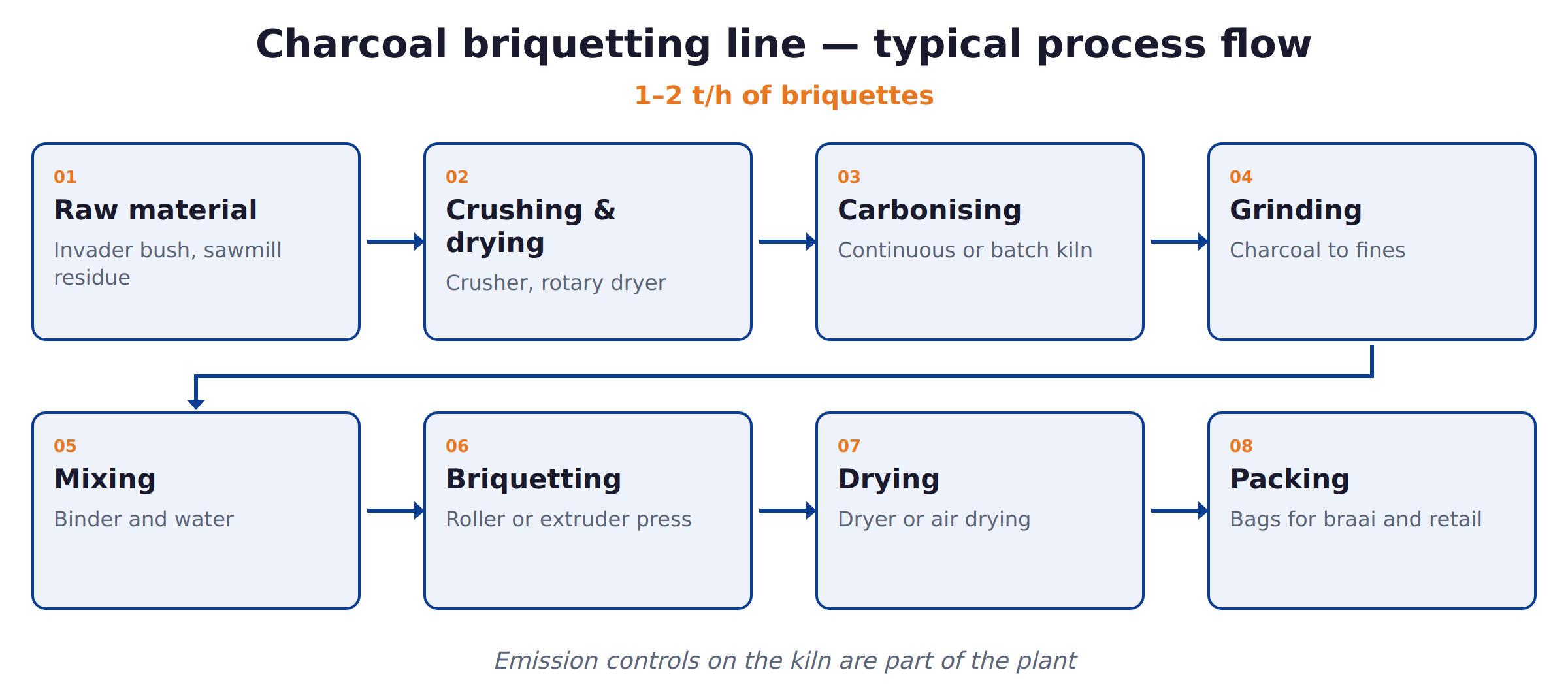
| Feedstock preparation | Crusher, screen, conveyor |
| Drying | Dryer type, burner, fuel, capacity |
| Carbonisation | Furnace, smoke treatment |
| Mixing | Binder mixer |
| Pressing | Press or pellet mill, tonnes per hour |
| Finishing | Cooler, screen, packing |
| Dust and fire | Filters, spark detection |
| Installation and training | Engineer days, trials |
| Owner's scope | Building, licences, power, feedstock |
Set every quote to one scope before comparing totals; the same-scope comparison explains it.
Choose by situation
| Your situation | Usual route |
|---|---|
| Buying charcoal fines from producers | Mixer, briquette press and dryer; no carbonisation on site |
| Sawmill with dry sawdust | Biomass briquette press or a pellet line, depending on buyers |
| Farm with crop residues | Crusher, dryer and briquette press, tested on your residue |
| Wanting your own charcoal | Carbonisation furnace with smoke treatment, sized against the 20 t a month threshold |
| Export pellet buyers | Pellet line built to the buyer's grade, with FSC paperwork |
Common mistakes
- Buying a press for wet feedstock. Briquettes crumble.
- Carbonising without checking the licence threshold.
- No dryer. Output depends on weather.
- Ignoring wear parts. Abrasive feedstock eats screws.
- No feedstock contract.
Briquette and pellet plant prices in 2026
Indicative, in USD, from our charcoal, briquette and pellet plant cost guide:
| Purchase | Capacity | Indicative price (2026) |
|---|---|---|
| Briquette press only | Up to about 1–2 t/h | About US$1,000–25,000 ex-works |
| Carbonisation and charcoal briquetting line, landed | 1–2 t/h | About US$150,000–350,000 |
| Wood or biomass pellet line, landed | 1 t/h | About US$150,000–350,000 |
| Export pellet plant | 3 t/h and up | Quoted per configuration |
Licences, feedstock and duty in South Africa
- Small charcoal plants. Plants with a design capacity of up to 20 tonnes of char a month are declared controlled emitters under GN 602 of 2015 and must meet the emission standards set for them.
- Larger plants need a licence. Char and charcoal production above 20 tonnes a month is a listed activity under GN 893 of 2013, needing an atmospheric emission licence.
- Feedstock rules. Cutting indigenous trees can need a licence under the National Forests Act, especially for protected species.
- Certification for buyers. Retail and export buyers often expect FSC chain-of-custody certification, and export pellet buyers specify recognised grades.
- Power. A 1 tonne an hour pellet line draws roughly 150–250 kW connected load, mostly in the hammer mill and pellet mill.
- Duty-free equipment. Industrial furnaces (8417.80), wood dryers (8419.35), crushing and mixing machines (8479.82) and presses and pellet mills (8479.89.90) carry no general duty. VAT vendors reclaim the 15% import VAT; see the import duty guide.
Where CISH fits
CISH is a turnkey briquette and pellet plant company. We specify drying, carbonisation, pressing and packing from audited factories in China against your feedstock and product, with emission control, ship and clear them, and install and commission the plant with tonnes per hour demonstrated, and your operators trained. For a single press, a local dealer is often the better choice.
Frequently asked questions
Who sells briquette machines in South Africa?
Dealers of imported presses, local fabricators, Chinese factories selling direct, and turnkey companies that supply complete briquette and pellet plants.
How much is a briquette machine?
As an indication for 2026, a press on its own costs about US$1,000–25,000, and a complete carbonisation and briquetting line about US$150,000–350,000 landed.
Do I need a licence to make charcoal?
Plants up to 20 tonnes of char a month are controlled emitters with set standards; above 20 tonnes a month you need an atmospheric emission licence.
What feedstock can I use?
Charcoal fines, sawdust, wood shavings and crop residues, dried to the moisture the press needs. Check feedstock rules for indigenous wood.
Is briquette machinery duty-free?
Furnaces, dryers, crushers and presses carry no general duty in SARS's 2026 tariff. Import VAT of 15% applies.
Does CISH sell single presses?
No. We supply complete briquette and pellet plants, installed and commissioned. For a single press, a local dealer is usually the better route.