The opportunity is usually local feedstock, especially invader bush cleared from farms and sawmill residue, turned into a consistent product under a regional or private-label brand. The emission rules depend on size: plants with a design capacity of up to 20 tons of char a month are declared controlled emitters under GN 602 of 2015, with emission limits and an annual report, while plants making more than 20 tons a month are a listed activity under GN 893 of 2013 (Subcategory 3.4) and need an Atmospheric Emission Licence before they are built.
Step 1: choose your product
| Product | Raw material | Equipment | Buyers |
|---|---|---|---|
| Lump charcoal | Hardwood, invader bush | Kilns or retorts, sorting, bagging | Braai buyers, restaurants, export |
| Charcoal briquettes | Charcoal fines and binder | Mill, mixer, briquette press, dryer | Retail braai market, private label |
| Carbonised briquettes from biomass | Sawdust, bush, residues | Dryer, press, carbonisation furnace | Retail and export |
| Unbaked biomass briquettes | Sawdust, husks | Screw or piston press | Stoves and boilers (not charcoal) |
Many small producers start by buying charcoal fines from lump producers and pressing them into briquettes, which needs only a mill, mixer, press and dryer.
Step 2: secure feedstock
Invader bush, such as encroaching species on farms in the Northern Cape, Limpopo and North West, is a large resource, and farmers often pay to clear it. Sawmills produce offcuts and sawdust. Agree supply in writing, with quantities, price and who harvests and transports it. Harvesting trees may need permission under the National Forests Act for protected species, and some export buyers ask for chain-of-custody certification such as FSC. Feedstock must be dried before carbonising, so plan drying space or a dryer.
Step 3: the 20-ton rule for emissions
- Up to 20 tons a month: GN 602 (Government Gazette 39220, 18 September 2015) declares small-scale char and charcoal plants with a design capacity not exceeding 20 tons of char a month to be controlled emitters. They must meet emission limits and report annually.
- More than 20 tons a month: GN 893 of 2013, Subcategory 3.4, "Char, Charcoal and Carbon Black Production", applies, and you need an Atmospheric Emission Licence from your licensing authority before you build, and possibly environmental authorisation under NEMA as well.
A 1–2 t/h briquette line making its own charcoal is far above 20 tons a month. Traditional earth kilns release a lot of smoke; retorts and modern carbonisation furnaces that burn the gases reduce emissions and recover heat. Ask the licensing authority early.
Step 4: equipment and costs
| What you buy | Capacity | Indicative price (2026) |
|---|---|---|
| Briquette press only | Up to about 1–2 t/h | About US$1,000–25,000 |
| Carbonisation and briquetting line, landed | 1–2 t/h of briquettes | About US$150,000–350,000 |
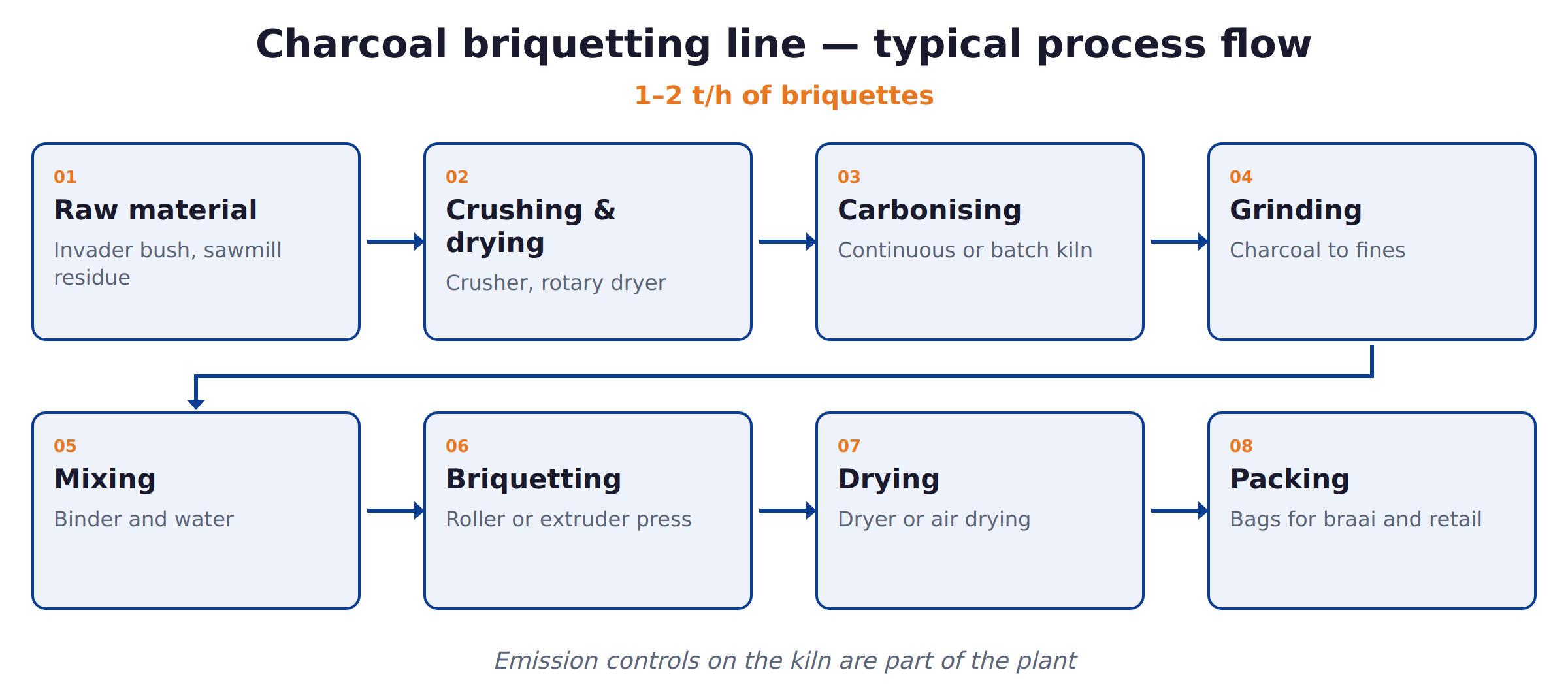
A full line includes feedstock drying, a carbonisation furnace or retort, a mill and binder mixer, a briquette press, a dryer for the green briquettes, smoke treatment, cooling, and packing. Our charcoal and briquette plant cost guide explains each tier.
Step 5: product quality
Buyers want charcoal that lights easily, burns hot and long, makes little smoke and sparks, and leaves little ash. For briquettes, binder (often starch) and moisture control decide strength and burn. Keep moisture low, screen out fines and stones, and test burn time and ash content. Consistency between bags builds repeat sales.
Step 6: packaging and selling
- Retail: supermarkets, hardware and outdoor stores, garages and convenience stores, in paper bags with clear branding, weight and lighting instructions.
- Private label: supplying retailers' own brands, which needs steady volumes and consistent quality.
- Restaurants and caterers: bulk lump charcoal.
- Export: to buyers in Europe and the Middle East, who want certification, consistent sizing and container loads.
Bags must show net weight under the Legal Metrology rules. Braai season peaks in summer and around holidays, so build stock ahead.
The numbers
Cost per bag is feedstock (harvest and transport), drying and carbonisation energy (often from the process gases), labour, binder, packaging, compliance, transport and finance. Yield matters: charcoal is a fraction of the dry wood weight, so feedstock cost per ton of charcoal is several times the cost per ton of wood. Retail brands earn more per bag than bulk sales, but need marketing and retailer listings.
Worked example: a bush-clearing co-operative in the Northern Cape
A group of farmers clears invader bush under a land restoration project. They form a co-operative, set up a site with drying yards and a carbonisation furnace that burns its own gases, and a briquette press with a dryer and packing line. Because the plant will make more than 20 tons a month, they apply for an Atmospheric Emission Licence before building. They supply a regional retailer's private-label braai briquettes and sell lump charcoal to restaurants. The figures are illustrative.
Safety and fire
Charcoal plants handle hot material, fire and dust. Keep carbonisation areas away from stores and buildings, cool charcoal fully before bagging, control dust in milling and packing, provide fire-fighting equipment, and train staff. Charcoal can self-heat in large stores, so monitor temperature in bulk piles.
Common mistakes
- Building above 20 tons a month without an Atmospheric Emission Licence.
- Wet feedstock that wastes energy and gives poor charcoal.
- Weak briquettes from poor binder or drying.
- Competing on price with imported lump charcoal instead of building a local brand.
- No feedstock contract.
Building a brand on the shelf
Retail charcoal and briquettes sell on trust and on the bag. Shoppers want a bag that is the weight it says, lights easily and does not spark or smoke. Print clear lighting instructions, the net weight, your contact details and where the wood comes from, because many buyers now ask whether charcoal is made from invader bush or sustainably harvested wood. Paper bags with a strong base and a handle sell better than loose sacks. Offer two or three sizes, and keep the product consistent from bag to bag. Supermarkets and garages want reliable delivery through the braai season and promotions around public holidays, so plan stock and transport for the peaks.
Using the by-products
Carbonisation gives off gases and liquids that can be burned to heat the dryer or furnace, cutting fuel costs and smoke. Fines and dust from screening go back into briquettes. Ash and very fine char can be sold as a soil additive in some markets. Using every stream lowers cost per bag and helps keep emissions within the limits.
Where CISH fits
We supply charcoal carbonisation and briquetting lines, drying, carbonisation with gas recovery, milling, mixing, pressing, drying and packing, from audited factories in China, sized to your feedstock and tonnes. CISH ships, clears, installs and commissions the line on your material, and trains your team. Emission licences stay with you as the operator; we design the plant so it can meet them. For a single small briquette press, a local supplier is usually the better buy.
For the thresholds in detail, see does your plant need an atmospheric emission licence.
Frequently asked questions
Do I need a licence to make charcoal in South Africa?
Plants up to 20 tons of char a month are controlled emitters under GN 602; above 20 tons a month you need an Atmospheric Emission Licence.
How much does a charcoal briquette plant cost?
As an indication for 2026, a complete 1–2 t/h carbonisation and briquetting line costs about US$150,000–350,000 landed.
What raw material can I use?
Hardwood, invader bush, sawmill residue, or charcoal fines for briquettes.
How are charcoal briquettes made?
Charcoal fines are milled, mixed with a binder, pressed, dried and packed.
Who buys charcoal?
Retailers, garages, restaurants, private-label brands and export buyers.
Does CISH supply charcoal plants?
Yes, carbonisation and briquetting lines with commissioning and training.