CISH supplies, installs and commissions complete food canning lines; beverage can lines are a different product.
Canning equipment prices, 2026
| What you buy | Capacity | Indicative price (2026) | Note |
|---|---|---|---|
| Batch retort (steriliser) | One unit, steam or water-spray | About US$8,000–20,000 per unit | Size by cans per cycle and cycle time |
| Small fruit and vegetable canning line | Small plant | About US$12,000–30,000 ex-works China | Washing, filling, seaming and retort; scope varies |
| Fully automatic canning line | Higher speed, continuous | Quoted per configuration | Exhausting, automatic seaming, continuous sterilising, labelling |
| Fish or meat canning line | Any | Quoted per configuration | Different preparation and sterilising |
Prices are listing prices before freight, duty, VAT and installation.
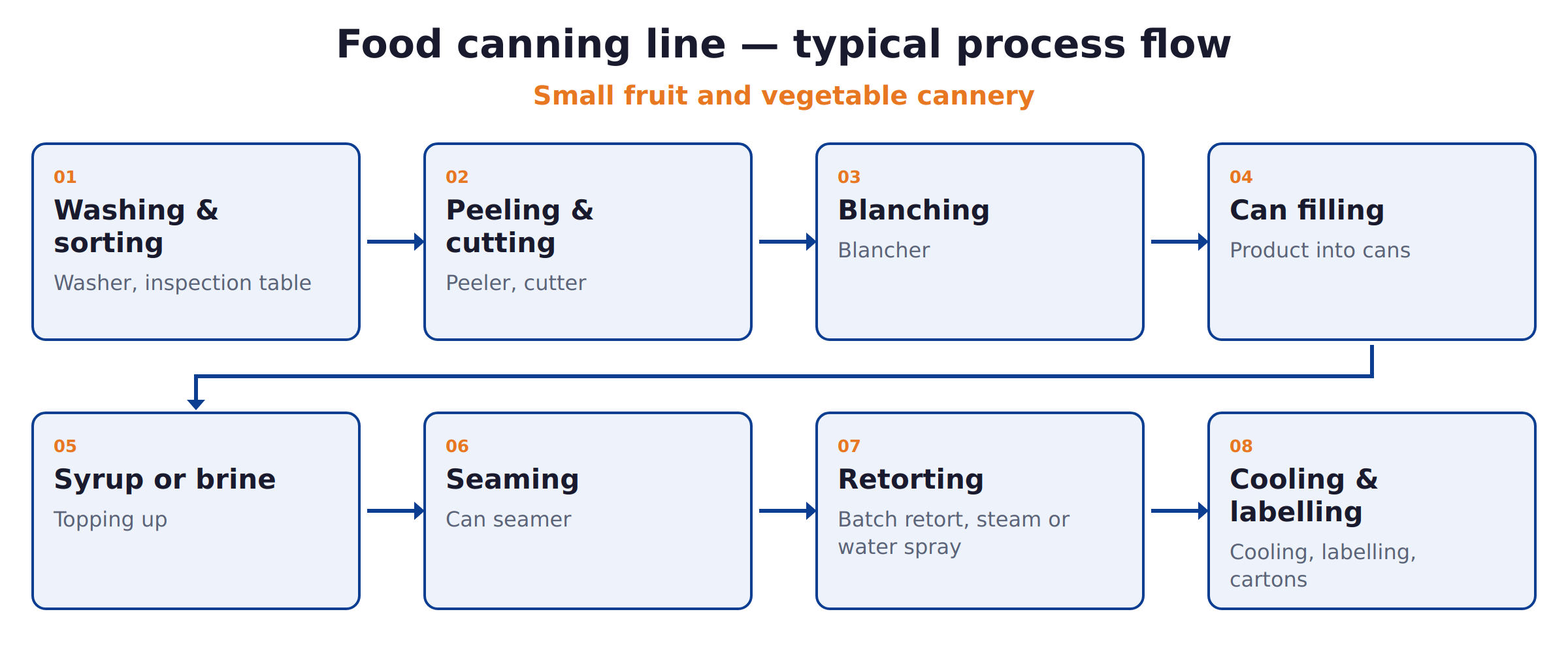
What a canning line contains
- Raw material preparation: washing, sorting, peeling, cutting, blanching.
- Can handling: depalletising, can washing.
- Filling of solids and liquid (brine, sauce or syrup).
- Exhausting to remove air before closing.
- Seaming: the double seam that seals the can.
- Sterilising in a retort at a time and temperature validated for the product and can size.
- Cooling in chlorinated water.
- Drying, labelling, coding and packing.
- Laboratory checks: seam inspection, incubation tests and records.
Seaming and sterilising are the two steps that decide food safety. A line with a poor seamer or an unvalidated retort makes cans that look fine and fail later.
Who sells canning equipment, and why prices differ
Local engineering firms supply blanchers, conveyors and tanks and service seamers. Agents of European canning brands sell high-speed seamers and continuous sterilisers to large canners. Chinese factories sell complete small and medium lines and batch retorts at low prices. Turnkey companies design and commission the whole cannery. Prices differ most on the seamer (manual, semi-automatic or automatic), the retort type and controls, and how much of the preparation is mechanised.
The cheap line versus the cannery that sells safe food
The listing price buys machines. A cannery that sells to retailers also needs a sterilising process validated for each product and can size, temperature recording for every retort cycle, trained seamer operators who check seams routinely, a laboratory for incubation tests, and a food safety system. Without those, a cheap line is a recall waiting to happen.
What moves the price
- Products: low-acid foods such as beans, vegetables, fish and meat need full sterilisation under pressure; acid foods such as many fruits need milder heat.
- Can sizes and changeover.
- Seamer speed and automation.
- Retort type: batch steam, water-spray or water-immersion, or continuous sterilisers.
- Preparation: how much peeling, cutting and blanching is mechanised.
- Boiler and utilities: retorts need steam, water and compressed air.
Where the money goes
The machinery is usually less than half of a cannery. The boiler and steam system, water treatment and cooling water, the building with food-grade finishes, effluent handling, the laboratory, installation and commissioning take the rest.
Choose by scenario
| Situation | Usual choice |
|---|---|
| Farm or co-operative canning seasonal produce | Small line with batch retort and semi-automatic seamer |
| Processor adding canned products (expansion) | New seamer and retorts sized to the new product, using existing preparation |
| Supplier to retail chains | Automatic seaming, multiple retorts, labelling and a laboratory |
| Fish or meat canning | Specialised line, quoted per configuration |
How to compare canning line quotes
Ask each supplier for: cans per hour by size, preparation steps, filler type, exhauster, seamer model and speed, retort type, number and size, retort controls and recording, cooling, boiler and steam requirement, labelling, installation and commissioning including process validation, training of seamer and retort operators, and warranty. Add what each quote leaves out.
Running costs and common mistakes
Monthly costs in a cannery are dominated by raw produce, empty cans and lids, and steam. Cans are often bought in, so their price and supply decide the business; a seasonal product canned for three months a year must carry the plant's cost for twelve. Steam for blanching and sterilising is the largest energy use, so the boiler's fuel and efficiency matter more than the machine price.
Mistakes we see most often:
- Buying a retort without a validated process. Every product and can size needs its own time and temperature; guessing is a food safety risk.
- A seamer nobody can set. Seamers need trained operators and routine seam measurements; budget for training and gauges.
- Undersized steam. Retorts that wait for steam slow the whole line.
- No incubation testing. A sample of every batch should be incubated and checked before release.
- Ignoring effluent. Blanching and cooling water carries organic load that the municipality will regulate.
South African rules and costs that shape a cannery
- Zero-rated staple. Canned pilchards and sardinella (excluding pet food and sardines) are zero-rated for VAT under item 8 of Part B of Schedule 2 to the VAT Act, which keeps that category very price-sensitive.
- Product duty. Several canned products carry specific rather than percentage duties in SARS's 2026 tariff, for example 4.15 cents per kilogram on canned peas (2005.40.90) and shelled beans (2005.51), and 2.4 cents per kilogram on sardines in oil (1604.13.05), so imports compete mainly on cost.
- Duty-free equipment. Filling, closing and sealing machinery (8422.30) and other heat-treatment machinery (8419.89) are free of general duty; import VAT of 15% applies and VAT vendors reclaim it. See the import duty guide.
- Food premises, HACCP and labels. The cannery must meet R638 of 2018; the HACCP regulations (R908 of 2003) set out how a HACCP system is applied, and retail buyers expect one; cans are labelled under R146 of 2010.
- Pressure equipment. Retorts and boilers are pressure equipment under the Occupational Health and Safety Act's regulations, with inspection and operator requirements.
Configurations and lead times
Small lines and batch retorts are built to order and shipped by sea, about 22–30 days to Durban. Allow time for the boiler, steam lines and water treatment on site, and for process validation runs with your product before commercial production.
Where CISH fits
CISH supplies, installs and commissions complete food canning lines from audited factories in China: preparation, filling, exhausting, seaming, retorts, cooling and labelling, with the boiler and utilities sized to the line, and commissioning that includes sterilising runs on your product and can sizes. We suit co-operatives and processors starting or adding canned products. Beverage can filling lines are outside this page.
Frequently asked questions
How much does a canning machine cost in South Africa?
As an indication for 2026, a batch retort is listed at about US$8,000–20,000 per unit and a small fruit and vegetable canning line at about US$12,000–30,000 ex-works China. Fully automatic lines are quoted per configuration.
What equipment do I need to start a canning business?
Preparation equipment, a can filler, an exhauster, a can seamer, a retort with a boiler, cooling, labelling and a small laboratory, in a food-grade building.
What is a retort?
A pressure vessel that sterilises sealed cans at a set time and temperature. The process must be validated for each product and can size.
Why is the seamer so important?
The double seam is what keeps the can sealed. Poor seams let air and bacteria in after sterilising, so seam checks are routine in every cannery.
Are canned foods zero-rated for VAT?
Canned pilchards and sardinella are zero-rated under item 8 of Part B of Schedule 2 to the VAT Act (pet food and sardines excluded). Most other canned foods carry standard VAT.
Is there import duty on canning machines?
Filling and seaming machinery (8422.30) and other heat-treatment machinery (8419.89) are free of general duty in SARS's 2026 tariff. Import VAT of 15% applies.
Does CISH supply beverage canning lines?
This page covers food canning. For beverage filling, see our filling machine suppliers guide.