The right supplier matches the filling principle to your product's viscosity and foam, commits to containers per minute at your fill accuracy, and covers capping, labelling and coding as one line.
Who sells filling machines
A sauce start-up, a detergent maker and a juice producer all search for filling machine suppliers. They need different machines, and the supplier landscape splits four ways.
| Supplier type | Usual offer | Price | Lead time | Responsibility | Typical buyer |
|---|---|---|---|---|---|
| Local filler builder or reseller | Piston, gravity and pump fillers, small cappers and labellers; local service | Low to moderate | Stock to a few weeks | The machine | Small food, cosmetic and chemical producers |
| Agent of a European filling brand | High-speed rotary fillers and monoblocks for one product family | Highest | Months | Their machines | Large beverage and dairy plants |
| Chinese factory, direct | Monoblocks, rotary fillers, cappers, labellers, shrink tunnels | Lowest on the quote | Build plus shipping and clearance | You, once delivered | Producers with a maintenance engineer |
| Turnkey line company | Product tanks and pumps, filler, capper, labeller, coder, conveyors and packing, installed and commissioned | Between local and European | One programme | The line, at agreed containers per minute | Producers moving from hand filling to a line |
Match the filler to the product
The filling principle comes before the brand:
- Gravity or overflow fillers for thin, still liquids such as water and some juices.
- Piston fillers for viscous products: sauces, creams, honey, pastes.
- Pump or flowmeter fillers for a range of liquids where accuracy and changeover matter.
- Net-weight fillers for high-value or large-pack products and where foaming makes volume unreliable.
- Counter-pressure fillers for carbonated drinks.
- Hot-fill and aseptic fillers for products that must keep without preservatives.
A supplier who offers the same filler for honey and mineral water is selling what is in stock. Ask which principle they recommend for your product and why.
Questions that separate filling suppliers
What accuracy, at what speed?
Every filler can be fast or accurate; the question is both at once. Ask for fill accuracy in grams or millilitres at your target speed, and test it with your product. Over-filling by a few percent on every container is a large cost over a year.
Does the line end at the capper?
A filler alone is not a line. Capping, labelling, date coding, cap and bottle feeding, and packing into cases or shrink packs decide the real output and the labour.
How long is a changeover?
If you fill several products or sizes, changeover time matters more than top speed. Ask how long a size change and a product change take, and what change parts are included.
Where to find filling machine suppliers
- Propak Africa at the Johannesburg Expo Centre, 7–10 March 2028, with FoodPro, Pro-Plas and ProLabel alongside, is the country's main show for filling, labelling and packaging.
- Container and closure suppliers see many filling lines and know which machines run their bottles and caps well.
- Producers of similar products: ask a supplier for a reference line on a product with the same viscosity.
- Importing: our supplier audit checklist covers what to check before paying a Chinese factory.
We have deliberately left individual company names off this page.
A 10-point checklist for filling equipment
- Product data: viscosity, particulates, foam, temperature, and whether hot-fill is needed.
- Filling principle recommended and justified.
- Speed and accuracy stated together, tested with your product.
- Containers and closures: sizes, materials and change parts included.
- Capping: screw, press-on, crimp or induction sealing as needed.
- Labelling and coding: label type and position, date and batch coding.
- Hygiene: product-contact materials, cleaning-in-place or easy strip-down.
- Line integration: bottle unscrambling or feeding, conveyors, packing.
- Installation, commissioning and operator training.
- Spares and service: seals, nozzles and change parts available locally.
Ten questions for a filling machine supplier
- Which filling principle do you recommend for my product, and why?
- What accuracy will you guarantee at what speed?
- How long does a size change take, and are change parts included?
- Is capping, labelling and coding part of the quote?
- How is the filler cleaned?
- What air and power does the line need?
- Can you run a trial with my product and containers?
- Who installs and commissions the line, and is it priced in?
- What warranty applies, and what does it exclude?
- Where can I see one of your lines running?
What a complete filling line quote lists
| Item | Look for |
|---|---|
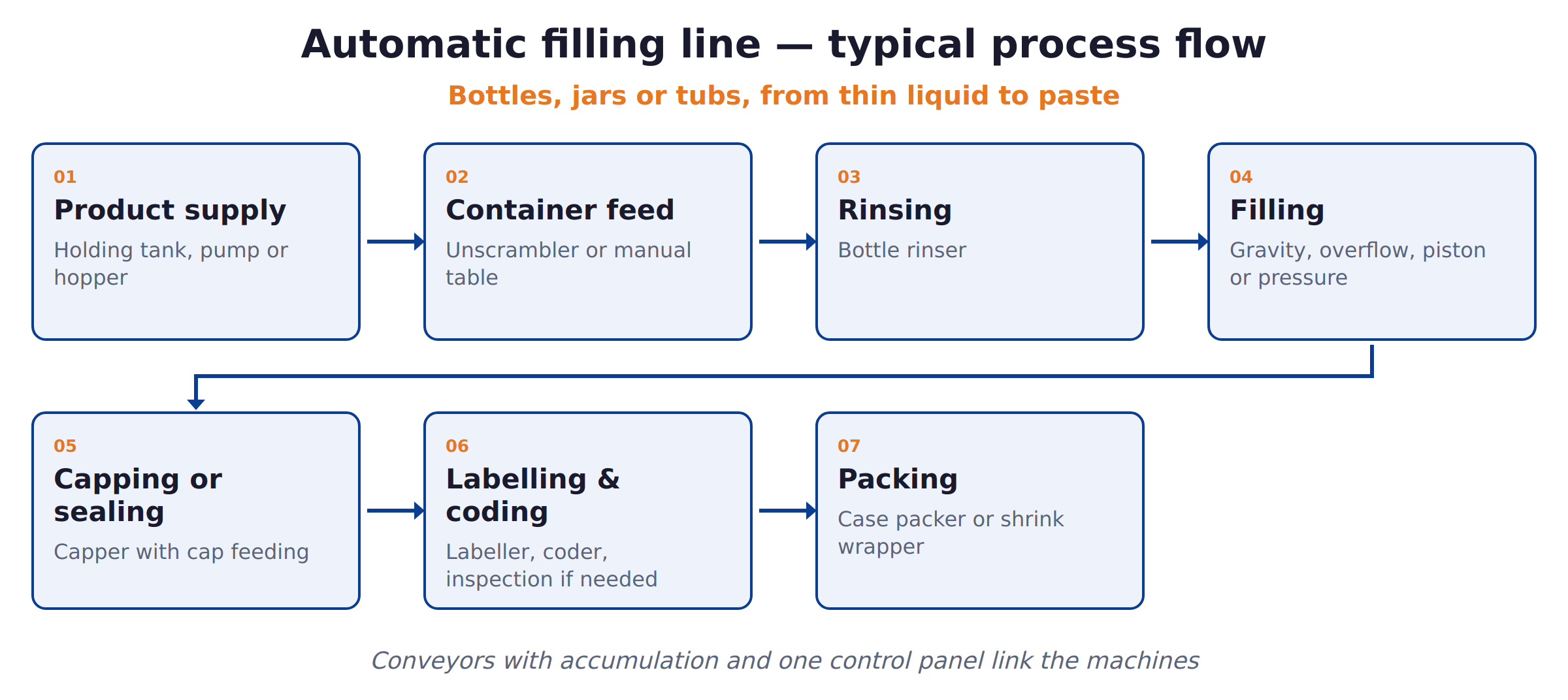
| Product supply | Holding tank, pump, hopper or heat exchanger for hot-fill |
| Container handling | Unscrambler or manual table, rinser for bottles |
| Filler | Principle, number of heads, speed, accuracy |
| Closing | Capper or sealer type, cap feeding |
| Labelling and coding | Labeller, coder, inspection if needed |
| Packing | Case packer or shrink wrapper |
| Conveyors and controls | Line conveyors, accumulation, control panel |
| Installation and commissioning | Engineer days, trial on your product |
| Training and documents | Operator and maintenance training, manuals |
| Owner's scope | Floor space, compressed air, power, water |
Price the gaps in each quote before comparing; putting offers on the same scope shows how.
From a delivered project: A South African food manufacturer that ordered a packaging-line upgrade of about US$420,000 direct from a Chinese factory found two non-compliant subassemblies and a controls package that did not match the contract at the FAT video walk-through; renegotiated milestones protected the deposit and the line reached SAT three months later. Read the FAT rescue case study.
Mistakes buyers make with fillers
- Choosing by speed alone. A fast filler with poor accuracy gives product away.
- Ignoring foam. Detergents and some juices foam; the filler must handle it.
- Forgetting the closures. Cap feeding and torque control cause many stoppages.
- No plan for labelling law. Net content must be marked correctly on every container.
- Buying a monoblock for products it cannot clean between. Allergen and flavour changes need proper cleaning.
Filling equipment prices in 2026
Indicative, in USD, from our filling machine price guide:
| Purchase | Indicative price (2026) | Typical use |
|---|---|---|
| Semi-automatic filler, capper or labeller | US$1,000–10,000 each | Start-ups and short runs |
| Automatic fill–cap–label monoblock | US$13,000–60,000 | Growing producers, one product family |
| Complete bottling line | From about US$150,000 | Beverages and high-volume liquids |
South African rules that affect a filling line
- Net content marking. Prepackaged goods must carry net content markings to SANS 289, incorporated under the Legal Metrology Act by Notice 877 of 2018, so fill accuracy is a legal matter as well as a cost.
- Food labelling. Food and drink products are labelled under R146 of 2010; the labeller and coder must apply compliant labels and date codes.
- Food premises. Filling rooms for food are inspected under R638 of 2018 for hygiene and cleanability.
- Bottled water. Water is filled under R.718 of 2006, which sets categories and labelling.
- Tariffs. In SARS's 2026 tariff, machines for filling, closing, sealing or labelling containers (8422.30), bottle washers (8422.20) and other packing machines (8422.40) are duty-free, while imported plastic bottles (3923.30) carry 15%. Import VAT of 15% on the equipment is recovered by VAT-registered producers. Our import duty guide has the arithmetic.
Where CISH fits
CISH supplies, installs and commissions complete filling lines, from product tank to packed case, built by audited factories in China and matched to your product, containers and output. We test fill accuracy on your product, and hand over at an agreed speed with your team trained. We are the right fit when you are moving from hand or semi-automatic filling to a line. For a single semi-automatic filler, a local reseller will usually be quicker and cheaper.
Need cartoning, wrapping or palletising after the filler? See packaging machine manufacturers in South Africa.
Frequently asked questions
Who sells filling machines in South Africa?
Local filler builders and resellers, agents of European filling brands, Chinese factories selling fillers and monoblocks direct, and turnkey companies supplying complete lines. Small producers usually start local; lines for beverages and household products are often imported.
How much does a filling machine cost?
As an indication for 2026, semi-automatic fillers, cappers and labellers cost about US$1,000–10,000 each, an automatic fill–cap–label monoblock about US$13,000–60,000, and a complete bottling line from about US$150,000.
Which filling machine is best for thick products?
Piston fillers usually suit viscous products such as sauces, creams and pastes. Net-weight fillers suit high-value products. Test with your product before choosing.
What does SANS 289 mean for filling?
SANS 289 sets how net content is marked on prepackaged goods under the Legal Metrology Act. Your fill accuracy must support the declared quantity.
Is there import duty on filling machines?
Machinery for filling, closing, sealing and labelling containers (8422.30) is duty-free in SARS's 2026 tariff. Import VAT of 15% applies and is claimable by VAT vendors.
Does CISH sell single filling machines?
No. We supply complete filling lines, installed and commissioned. For a single filler, a local reseller is usually the better option.