A mobile plant is built on one or two trailers with the aggregate bins, conveyor, mixer and controls together, so it can be towed and running again in days on a simple base. A stationary plant is erected on concrete bases with separate aggregate bins, cement silos and often a larger twin-shaft mixer, and gives higher output, more storage and lower cost per cubic metre at one site. Mobile plants are priced per configuration. Cement silos, trucks, a loader and water add to either. CISH supplies, installs and commissions complete batching plants and precast yards.
The short answer
| Mobile batching plant | Stationary batching plant | |
|---|---|---|
| Best for | Road, dam, mine and housing projects that move | Ready-mix, precast yards, long contracts at one site |
| Typical output | About 25–75 m³/h | About 25–180 m³/h and more |
| Set-up | Towed in; level base; running in days | Concrete bases, erection, weeks |
| Cement storage | Usually one or two smaller silos | Two or more large silos |
| Aggregate storage | Compact bins on the trailer | Larger bins, often a ground hopper and conveyor |
| Moving cost | Low | High: dismantle, transport, re-erect |
| Price (2026) | Quoted per configuration | About US$20,000–60,000 for a 25–60 m³/h plant alone |
| Cost per m³ at one site | Higher | Lower |
Match the plant to your situation
Project contractor
If your work moves every few months, a mobile plant avoids building bases and dismantling every time. Size it for the peak pour of your typical project, not the average day, and plan how cement will be delivered on remote sites.
Ready-mix supplier
A stationary plant at a yard close to your customers, with silo storage for several days of cement and enough aggregate stock, gives lower cost and steady quality. Ready-mix is a delivery business: the number of truck mixers and the distance to site decide your output as much as the plant does. Our ready-mix business guide has the numbers.
Precast yard
Blocks, pavers, kerbs, culverts and manholes need a stationary plant with accurate batching, often a pan or twin-shaft mixer, feeding product machines close by. Our batching plant and precast yard guide shows the yard bands.
Limited budget
A smaller stationary plant with a good mixer and accurate weighing beats a larger plant with poor controls. Concrete strength depends on consistent water-cement ratio and weighing.
Mixer type
- Twin-shaft mixers mix quickly and evenly; common in ready-mix and larger plants.
- Planetary or pan mixers suit precast products, coloured paving and dry mixes.
- Drum mixers appear on smaller and some mobile plants; simpler, slower to mix stiff concrete.
Choose the mixer for your concrete, not only the plant size.
Output: read the figure carefully
A plant labelled '60 m³/h' rarely delivers 60 m³ every hour. Real output depends on mixer size, cycle time, aggregate feeding, truck loading and how fast trucks return. Ask for output with your mix design and loading method, and size the plant 20–30% above your peak hourly need.
What else the plant needs
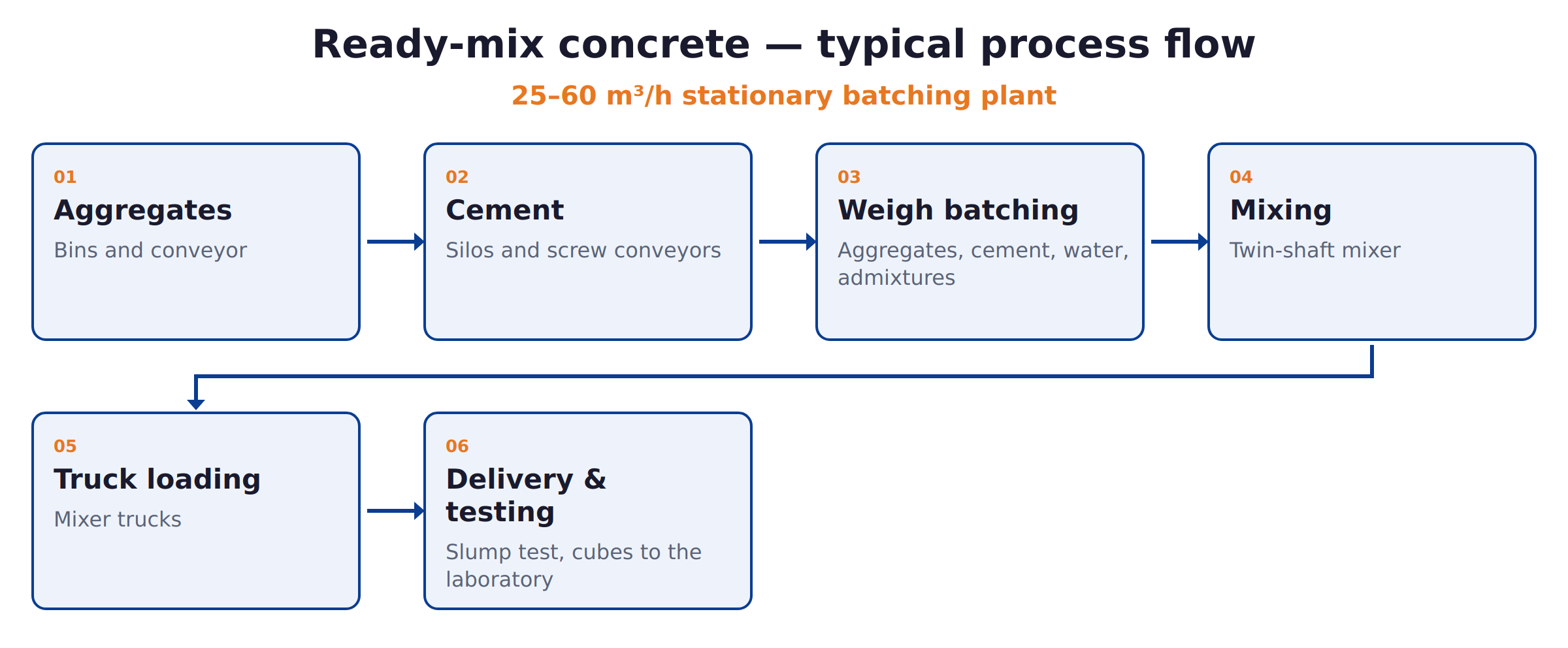
- Cement silos and a screw conveyor, sized for delivery frequency.
- Water supply and storage, plus admixture dosing.
- Aggregate stockpiles with dividing walls, and a front-end loader.
- Power: a three-phase supply or a generator sized for starting the mixer and conveyors.
- Dust control on silo filling and the mixer.
- Truck washout and settling ponds for wash water.
- Laboratory: cube moulds, slump cone and a curing tank.
Safety and compliance
Batching plants are driven machinery under the OHS Act's Driven Machinery Regulations, 2015: guard conveyors and mixers, lock out before cleaning, and train operators. Concrete and precast products must meet the specification the customer orders; the Concrete Manufacturers Association publishes technical guidance, and housing projects follow NHBRC requirements. Batching plants under tariff heading 8474.31 enter South Africa duty-free; VAT applies.
Chinese, European and local plants
We do not rate brands. Local fabricators supply simple plants and steelwork and handle repairs. Chinese factories supply complete mobile and stationary plants at moderate prices. European plants offer advanced controls at higher prices. Check weighing accuracy, mixer liners and arms, control system language and spare parts, and whether the plant was designed for your aggregate sizes.
Demand
Public housing, roads, municipal infrastructure and private building drive concrete demand. The Department of Human Settlements' budget for 2026/27 was about R26.97 billion. Mining and energy projects in remote areas favour mobile plants.
What a wrong choice costs
- Stationary plant for moving work: bases rebuilt and plant dismantled every project.
- Mobile plant for a ready-mix yard: small silos run out, higher cost per m³.
- Undersized silos: pours stop when cement deliveries are late.
- Poor weighing: strength failures and rejected pours.
- No wash-water plan: environmental complaints and blocked drains.
Five things to confirm before you decide
- Volume: cubic metres per day and peak per hour.
- Moves: how many times a year the plant will relocate.
- Product: ready-mix, precast or site concrete, and the mix designs.
- Site services: water, power, access for cement tankers and trucks.
- Fleet: truck mixers, loader and pump you already have or need.
Worked example: a contractor deciding
A civil contractor in Mpumalanga wins road and culvert work that moves every four to six months, with peak pours of about 40 m³ an hour. A stationary 60 m³/h plant would need new bases and a crane at every site, and about two weeks of dismantling and erection each time. A mobile plant of similar output can be towed to the next site and running within days on a compacted, levelled base. The contractor also plans a precast yard for culverts at its depot in a few years. It buys a mobile plant for the projects now, and plans a stationary plant with a pan mixer at the depot later, sized for precast. The figures are illustrative; the point is that each plant is chosen for the work it will do most of its life.
Questions to ask before you sign
- What output does the plant reach with my mix designs and loading method?
- How accurate are the cement, water, aggregate and admixture scales, and how are they calibrated?
- How long do mixer liners and arms last on my aggregates?
- Which spares are held in South Africa?
- Who will commission the plant, test the first pours and train my batcher?
How CISH helps you choose
We start from your volumes, your projects and your site. We specify the plant, mixer, silos, weighing, controls and, for precast yards, the product machines and curing, supply them from audited factories in China, ship and clear them, install and commission them on your mix designs, and train your operators. For a single small drum mixer, a local supplier is usually the better buy.
Frequently asked questions
Is a mobile or stationary batching plant better?
Mobile is better for contractors who move often; stationary is better for ready-mix and precast at one site.
How much does a concrete batching plant cost?
As an indication for 2026, a stationary plant of about 25–60 m³/h costs about US$20,000–60,000 ex-works for the plant alone; silos, trucks and site work add to that. Mobile plants are quoted per configuration.
How do I size a batching plant?
Size it 20–30% above your peak hourly need, using real cycle times and truck turnaround.
Which mixer is best for a batching plant?
Twin-shaft for ready-mix; planetary or pan mixers for precast and paving.
Is there import duty on batching plants?
Concrete mixing machinery under 8474.31 enters South Africa duty-free; VAT applies.
Does CISH supply complete batching plants?
Yes, including silos, controls, commissioning and, for precast yards, the product machines.