Dry mix mortar and tile adhesive plants in South Africa are supplied by local bulk-handling and mixing builders, dealers of European mixing equipment, Chinese factories that sell mixers, sand dryers and complete tower or flat plants direct, and turnkey companies that design and commission the whole plant. Tile adhesives are made to SANS 52004 classes and plasters and mortars to SANS 2001 specifications, so the plant must dose cement, sand and additives accurately and keep the sand dry.
Who sells dry mortar plants
Building material suppliers, quarries, cement merchants and tile adhesive brands look for dry mix plants. Four types of supplier answer.
| Supplier type | What they sell | Price | Who answers for output | Best fit |
|---|---|---|---|---|
| Local mixing and bulk-handling builder | Silos, screws, hoppers, steel structures, bagging | Moderate to high | The builder, for its scope | Expanding an existing plant |
| Dealer of European mixing equipment | Ploughshare mixers, packers, dosing | High | The dealer, per item | Large producers upgrading sections |
| Chinese factory, direct | Mixers, sand dryers, screens, tower and flat plants, valve-bag packers | Lowest on the quote | You, after delivery | Buyers with plant engineers |
| Turnkey dry mix plant company | Sand drying to palletised bags, commissioned | Between direct and European | The turnkey company, at agreed tonnes per hour | New plants and first lines |
Dry sand and accurate additives make the product
A dry mix product is cement, dry graded sand, fillers and small amounts of additives such as cellulose ethers and redispersible powders. Two things decide quality:
- Sand moisture. Wet sand reacts with cement in the bag. Most plants need a sand dryer and screens unless they buy dried sand.
- Additive dosing. Additives may be well under 1% of the mix but decide open time, slip resistance and adhesion. Small scales and accurate dosing matter more than the mixer size.
Ask any supplier how the plant dries and grades sand, and the dosing accuracy for the smallest additive.
What to check in the supplier
Mixer type
Ploughshare and twin-shaft paddle mixers mix quickly and evenly; ribbon mixers are cheaper but slower. Ask for mixing time per batch and how the mixer discharges without segregation.
Tower plant or flat plant
Tower plants stack silos above the mixer so materials fall by gravity; flat plants spread equipment on the ground with screw conveyors. Tower plants use less floor space and energy but need a tall building.
Dust and packing
Cement and fine sand dust is a health and housekeeping problem. Ask about dust collection at the mixer, the bagger and the sand dryer, and the packing speed in bags per hour.
Where to find dry mix plant suppliers
- Concrete and building materials associations and the SANS specifications are the starting point for product classes.
- Construction and building materials trade shows feature mixing and packing equipment; check the dates with organisers.
- Working plants: visit a plant making products and volumes like yours.
- China: many dry mix plants sold in Africa are made in China. Our supplier audit checklist sets out what to verify before you pay.
We do not name dry mix plant suppliers.
How to choose: a 10-point checklist
- Products listed: tile adhesive classes, plasters, mortars, screeds.
- Tonnes per hour of packed product, demonstrated at handover.
- Sand drying and screening, or a reliable dried-sand supply.
- Silos for cement, sand and fillers.
- Additive dosing with small, accurate scales.
- Mixer type, batch size and mixing time.
- Packing: valve-bag packer, bag weights, palletising.
- Dust collection throughout.
- Installation, commissioning on your recipes, and training.
- Support for mixer tips, liners, screws and packer spouts.
Ten questions to ask
- What tonnes per hour of packed product does the plant make?
- How is sand dried and screened, and what fuel does the dryer use?
- How many silos are included, and what sizes?
- What is the dosing accuracy for the smallest additive?
- What mixer type and mixing time per batch?
- What packing speed and bag weights?
- What dust collection is included?
- Is installation, commissioning and training included?
- What wear parts come with the plant?
- Which plant in South Africa runs this layout, and may I visit?
Comparing dry mix plant quotes
| Section | What each quote should state |
|---|---|
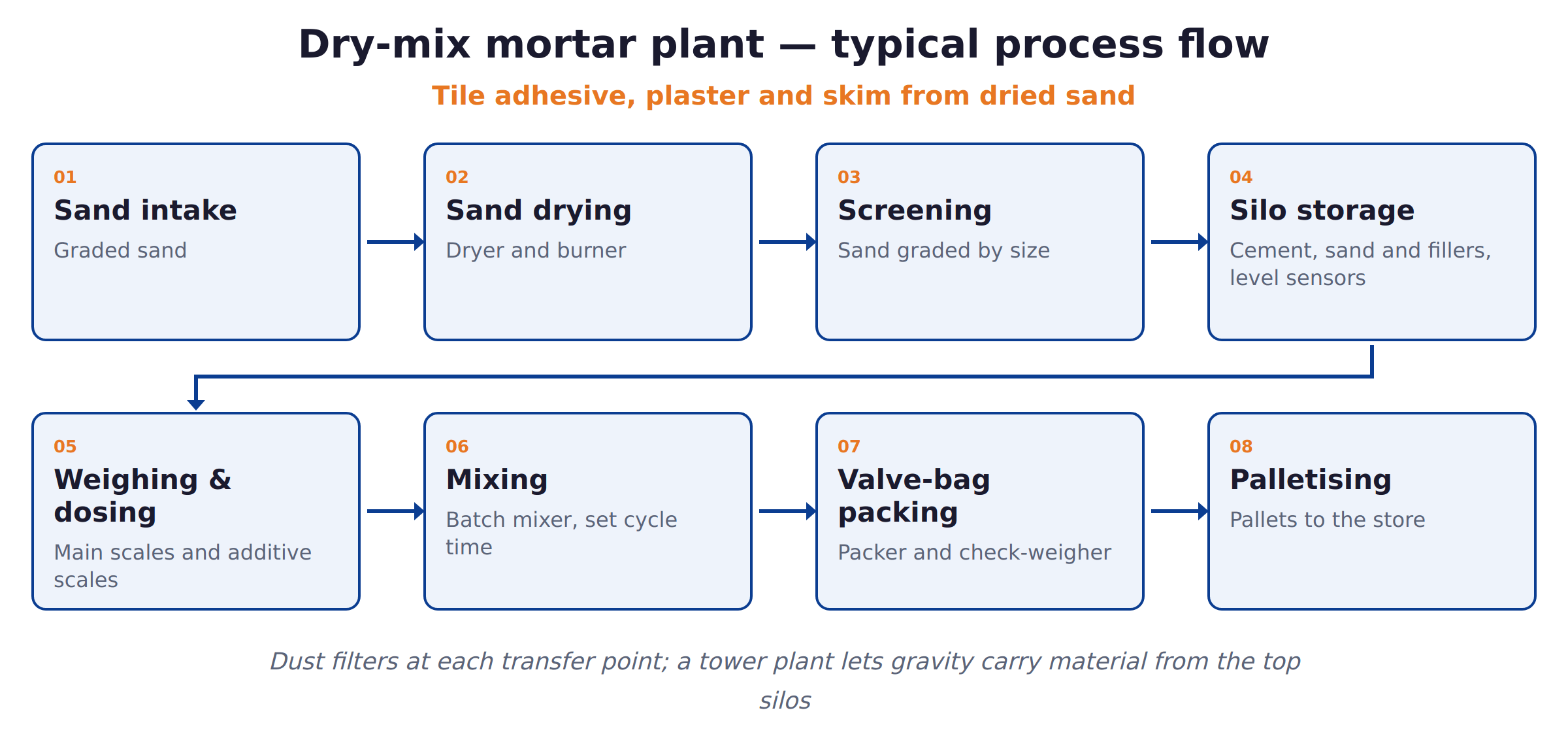
| Sand handling | Intake, dryer, burner, screens |
| Storage | Silos, capacities, level sensors |
| Weighing and dosing | Main scales, additive scales, accuracy |
| Mixing | Mixer type, batch size, cycle time |
| Packing | Valve-bag packer, check-weigher, palletising |
| Dust | Filters at each point |
| Steel structure | Tower or flat, height, cladding |
| Controls | Batch control, recipe storage |
| Installation and training | Engineer days, recipe trials |
| Owner's scope | Building, civils, power, gas or diesel for the dryer |
Compare like with like only after the scopes are the same; the same-scope comparison explains how.
Common mistakes
- No sand dryer. Damp sand starts the cement reacting in the bag.
- One big scale for everything. Additives cannot be dosed accurately.
- Ignoring the tower height. The building must fit the plant.
- No dust collection. Health and product losses follow.
- Copying a recipe without testing it to the SANS class.
Dry mix plant prices in 2026
Indicative, in USD, from our dry mix mortar plant cost guide:
| Purchase | Capacity | Indicative price (2026) |
|---|---|---|
| Simple mixing station, no sand dryer | 1–5 t/h | About US$5,000–40,000 ex-works |
| Station-type plant with sand drying and silos | 5–10 t/h | About US$60,000–180,000 ex-works |
| Tower plant, landed and commissioned | 10 t/h | About US$350,000–700,000 |
| Large automated plant, palletised | 20 t/h and above | Quoted per configuration |
As a rule, equipment makes up about 35–55% of a landed project once the building, power, freight, installation and working capital are counted.
Standards and duty in South Africa
- Tile adhesives. Cementitious tile adhesives are classed to SANS 52004 (for example C1 and C2), and installers follow the SANS 10107 code of practice.
- Plaster and masonry mortar. Cement plaster follows SANS 2001-EM1 and masonry mortar SANS 2001-CM1.
- Cement and sand. Cement is made to SANS 50197 and masonry cement to SANS 50413, and fine aggregates for plaster and mortar to SANS 1090.
- Worker safety. Mixers, screws and packers are driven machinery under the Occupational Health and Safety Act; dust and noise must be controlled.
- Duty-free equipment. Mixing machinery (8474.31, 8474.39), dryers (8419.39), packing machines (8422.30, 8422.40) and tanks (7309.00) are free of general duty, but separately imported steel structures (7308.90.99) carry 15%. The 15% import VAT is reclaimable for VAT vendors; see the import duty guide.
Where CISH fits
CISH is a turnkey dry mix plant company. We specify sand drying, storage, dosing, mixing and packing from audited factories in China against your products and recipes, ship and clear them, and install and commission the plant with tonnes per hour demonstrated on your recipes, and your operators trained. For a single mixer or valve-bag packer, a local supplier is often the better choice.
Frequently asked questions
Who sells dry mortar plants in South Africa?
Local mixing and bulk-handling builders, dealers of European mixing equipment, Chinese factories selling direct, and turnkey companies that supply complete dry mix plants.
How much does a dry mix mortar plant cost?
As an indication for 2026, a simple mixing station costs about US$5,000–40,000 ex-works, a station-type plant with sand drying about US$60,000–180,000, and a 10 tonne an hour tower plant about US$350,000–700,000 landed.
Do I need a sand dryer?
Usually yes, unless you buy dried sand. Damp sand starts cement hydration in the bag and spoils the product.
Which standard applies to tile adhesive?
Cementitious tile adhesives are classed to SANS 52004, for example C1 and C2, with installation to SANS 10107.
Is dry mix plant machinery duty-free?
Mixing machinery, dryers and packing machines are free of general duty in SARS's 2026 tariff; separately imported steel structures carry 15%. Import VAT of 15% applies.
Does CISH sell single mixers?
No. We supply complete dry mix plants, installed and commissioned. For a single mixer or packer, a local supplier is usually the better route.