The supplier to choose is the one who sizes the dryer on your product's water load, includes the preparation and packing ends, and commits to tonnes of dried product a day at your moisture target.
Four kinds of dryer supplier
A grower drying a few hundred kilograms of mango in a season and a processor running dried vegetables all year both search for a fruit drying machine in South Africa. The answers they get mix very different suppliers. Sort them first.
| Supplier type | What they sell | Price | Lead time | Who answers for the dried output | Best fit |
|---|---|---|---|---|---|
| Local dryer or oven builder | Batch tray dryers, tunnel dryers, sometimes belt dryers built to order | Moderate | Weeks to months | The builder, for the dryer only | Seasonal growers and small processors |
| Agent of an imported brand | Heat-pump chambers, belt dryers or freeze dryers from one manufacturer | High | Months | The agent, for their machine | Processors standardising on one technology |
| Chinese factory, direct | Heat-pump chambers, mesh-belt dryers, washing and slicing machines, sometimes a "complete line" | Lowest on the quote | Build plus shipping and clearance | You, after delivery | Buyers with their own process engineer |
| Turnkey plant company | Receiving, washing, peeling, slicing, pre-treatment, drying, cooling, sorting and packing, installed and commissioned | Between direct and imported brand | One programme | The turnkey company, at an agreed output and moisture | First commercial plants and processors moving to year-round drying |
The dryer is a third of the plant
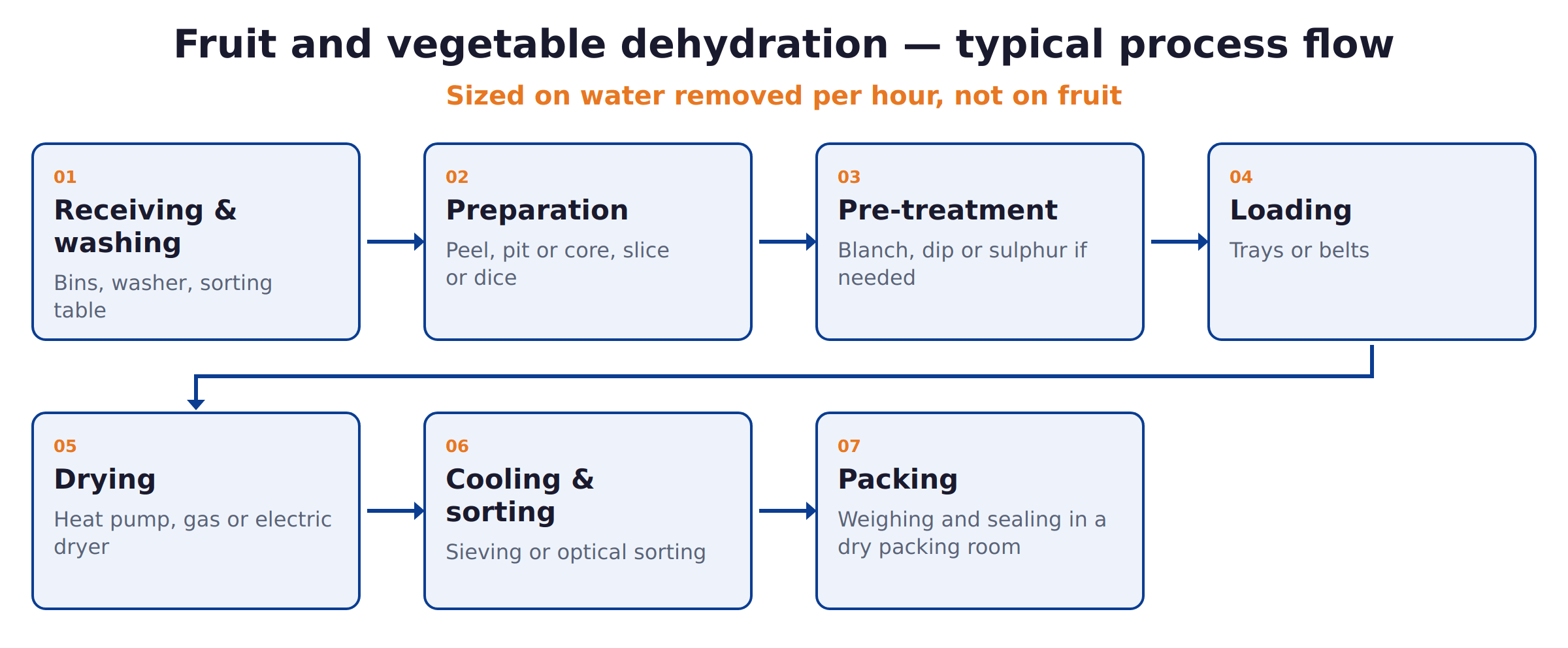
Most dryer quotes are for the drying chamber. A dehydration plant also needs washing, peeling or pitting, slicing, pre-treatment, loading trays or belts, cooling, sorting, and moisture-proof packing. On many products the preparation line takes more labour than the dryer, and the packing room decides whether a retailer will buy. Ask every supplier what happens to the fruit before it enters the dryer and after it leaves.
Size on water, not on fruit
A dryer removes water, and the water in the fruit sets the size. Typical fresh-to-dried ratios are about 10:1 for apple and onion, 6:1 for banana and potato, 5:1 for apricot and 4:1 for garlic. A tonne of fresh apple becomes about 100 kg of dried apple, and the other 900 kg must be evaporated and carried away. A supplier who sizes your dryer in "kilograms of fruit per batch" without asking the product, the slice thickness and the target moisture has not designed it.
Ask for three numbers: fresh intake per day, dried output per day at your target moisture, and the energy used per kilogram of water removed. Those three let you compare a heat-pump chamber against a gas-fired belt dryer on the same basis.
Heat pump, gas or electric?
- Heat-pump chambers recover heat and suit high-value fruit that must keep its colour, at the cost of longer drying times and higher capital per kilogram.
- Gas or diesel-fired tunnels and belts dry faster and suit vegetables and large tonnages, but fuel is a running cost to price.
- Solar-assisted dryers cut energy use but tie output to the weather.
- Freeze drying is a different product and a different investment; treat it as its own project.
A South African review of heat-pump drying noted that development for industrial and agricultural use had been slow, which is one reason buyers should ask for references running the exact dryer type on a similar product.
Where to find fruit drying equipment suppliers
- Fruit South Africa brings the fruit industry associations together and is a route into growers and packers who already dry fruit.
- SAAFoST, the food science and technology association, connects processors with technologists who can advise on drying parameters and pre-treatment.
- Trade shows: FoodPro, held with Propak Africa at the Johannesburg Expo Centre (7–10 March 2028), covers processing and packing equipment.
- Existing dried fruit processors are concentrated in the Western and Northern Cape; ask a supplier for one you can visit.
- China: many heat-pump and belt dryers sold in Africa are built in China. Use our supplier audit checklist before paying a deposit.
We do not list or rate individual suppliers.
How to choose: a 10-point dryer checklist
- Output committed in kilograms of dried product per day at your target moisture, on your product.
- Water load calculated, with the fresh-to-dried ratio stated.
- Energy per kilogram of water removed, with the fuel or electricity source named.
- Air control: temperature, humidity and airflow control, with records for each batch.
- Preparation line included or clearly excluded: washing, peeling, slicing, pre-treatment.
- Food-contact materials: stainless trays, belts and frames that can be cleaned.
- Cooling, sorting and packing: moisture-proof packaging and a dry packing room.
- Installation and commissioning in the price, with trial drying on your product.
- Training for operators and the person who sets drying programmes.
- Support: who services fans, heat pumps, burners and controls, and from where.
Grinding and packing dried herbs and spices? See spice grinding machine prices in South Africa.
Ten questions to ask any dryer supplier
- What dried output will you guarantee per day, at what moisture, for my product?
- How did you calculate the water load?
- What does the dryer use in energy per kilogram of water removed?
- Which products has this exact dryer type dried, and where can I see it?
- How are temperature and humidity controlled and recorded?
- What preparation equipment is included?
- How long does one batch or one pass take?
- Is installation, commissioning and a trial run on my product included?
- What does the warranty cover?
- Who services the heat pump, burner or controls after year one?
Comparing dehydration plant quotes
| Section | What each quote should state |
|---|---|
| Receiving and washing | Bins, washer, sorting table |
| Preparation | Peeler, pitter or corer, slicer or dicer, capacity per hour |
| Pre-treatment | Blanching, dipping or sulphuring where the product needs it |
| Drying | Dryer type, heat source, drying area, capacity in water removed per hour |
| Controls | Temperature, humidity, airflow and batch records |
| Cooling and sorting | Cooling, sieving or optical sorting |
| Packing | Weighing, sealing, nitrogen flushing if needed, dry packing room |
| Installation and commissioning | Engineer days, trial runs on your product |
| Training and documents | Days, manuals, drying programmes |
| Owner's scope | Building, power or gas supply, water, drainage |
Total each quote with the items it leaves out before you compare. Our same-scope comparison shows how.
Common mistakes buying a fruit dryer
- Buying a dryer before the product and moisture target are fixed. A dryer sized for mango will not suit onion.
- No preparation line. Hand slicing caps the plant at the speed of the slicing table.
- Ignoring the packing room. Dried fruit picks up moisture from humid air; it needs a dry room and moisture-proof packs.
- A seasonal plant priced as if it ran all year. If the dryer runs three months a year, the cost per kilogram is much higher; plan a second product.
- Pricing capital, not energy. Over several seasons the fuel or electricity bill can exceed the dryer's price.
Dehydration equipment prices in 2026
Indicative, in USD, from our dehydration plant cost guide:
| Purchase | Capacity | Indicative price (2026) | Usual supplier type |
|---|---|---|---|
| Single dryer | One heat-pump chamber, cabinet or small belt dryer, about 50–1,500 kg wet product per batch | US$4k–25k | Local builder or direct import |
| Complete dehydration plant | 2–5 t/day fresh intake (about 0.2–1 t/day dried product, depending on the fruit) | US$150k–350k | Turnkey company or direct import |
| IQF freezing line | About 500 kg/h | Quoted per configuration | Turnkey company or agent |
South African facts that shape the choice
- A large fruit base. Fruit South Africa figures put 2024/25 production at about 6.74 million tonnes, of which about 4.41 million tonnes were exported, excluding mangoes and litchis. Fruit that does not make export grade is the raw material for drying.
- A small drying sector. Industry figures put South African tree-fruit drying at about 6,600 tonnes in 2025, against more than 100,000 tonnes of dried apricots from Turkey alone, so local plants compete on quality and traceability rather than volume.
- Raisins dominate. The 2025/26 raisin crop forecast was cut to about 86,500 tonnes, down about 14%, after downy mildew and hail; the Northern Cape produces most of it.
- Grading rules. Dried fruit sold in South Africa is graded, packed and marked under the Agricultural Product Standards Act regulations (R3449 of 2023), which your sorting and packing must follow.
- Food premises and labels. The plant is a food premises under R638 of 2018, and packed product falls under the labelling regulations R146 of 2010; sulphur dioxide as a preservative is permitted within the limits of the preservatives regulations.
- Tariff protection for the product. SARS's tariff carries 10% general duty on dried fruit (heading 08.13) and 20% on some dried vegetables (0712.90), while dryers for agricultural products (8419.34) and fruit and vegetable preparation machinery (8438.60) are free of general duty. Import VAT of 15% applies to the equipment and is claimable by VAT vendors; see our import duty guide.
Where CISH fits
CISH is a turnkey plant company. We specify dehydration plants from audited factories in China, size the drying on your product's water load and moisture target, include the preparation and packing ends, ship and clear the equipment, and install and commission the plant with trial runs on your fruit or vegetables. We suit growers and co-operatives moving from seasonal batch drying to a commercial plant, and processors adding a dried product line. For one heat-pump chamber, a local builder or dealer is usually the better choice.
Frequently asked questions
Who sells fruit drying machines in South Africa?
Local dryer and oven builders, agents of imported dryer brands, Chinese factories selling heat-pump and belt dryers direct, and turnkey companies that supply complete dehydration plants. Small seasonal operations usually buy a single dryer; commercial plants need the preparation and packing lines as well.
How much does a fruit dehydration plant cost?
As an indication for 2026, a single dryer costs about US$4k–25k, and a complete plant taking 2–5 tonnes of fresh produce a day costs about US$150k–350k. Building, utilities and freight come on top.
Is a heat-pump dryer better than a gas dryer?
Heat-pump dryers recover heat and protect colour and flavour, which suits high-value fruit, but they dry more slowly and cost more per kilogram of capacity. Gas or diesel-fired dryers dry faster and suit vegetables and larger tonnages. Compare them on energy per kilogram of water removed.
How much fresh fruit makes one kilogram of dried fruit?
It depends on the fruit and the moisture target. Typical ratios are about 10:1 for apple, 6:1 for banana and 5:1 for apricot, so a tonne of fresh apple yields roughly 100 kg of dried apple.
Is there import duty on fruit dryers?
Dryers for agricultural products (8419.34) and fruit and vegetable preparation machinery (8438.60) are free of general duty in SARS's 2026 tariff. Import VAT of 15% applies and VAT vendors can claim it back.
What regulations apply to a dried fruit plant?
Dried fruit grading, packing and marking regulations under the Agricultural Product Standards Act (R3449 of 2023), the food premises hygiene regulations R638 of 2018, the labelling regulations R146 of 2010 and the preservatives regulations for sulphur dioxide.
Does CISH sell single dryers?
No. We supply, install and commission complete dehydration plants. For a single dryer, a local builder or dealer is usually the better route.