Imported ground chilli carries 25% duty in South Africa, which helps local grinders.
Spice equipment prices, 2026
| What you buy | Capacity | Indicative price (2026) | Note |
|---|---|---|---|
| Spice grinder (pulveriser) set | About 50–500 kg/h | About US$1,000–5,000 | Grinder only, sometimes with a cyclone |
| Complete spice processing line | Cleaning to packing | Quoted per configuration | Depends on spices, sterilisation and pack types |
| Blending and packing line | Sachets, jars, pouches | Quoted per configuration | See our packaging guide |
Prices are listing prices before freight, duty, VAT and installation.
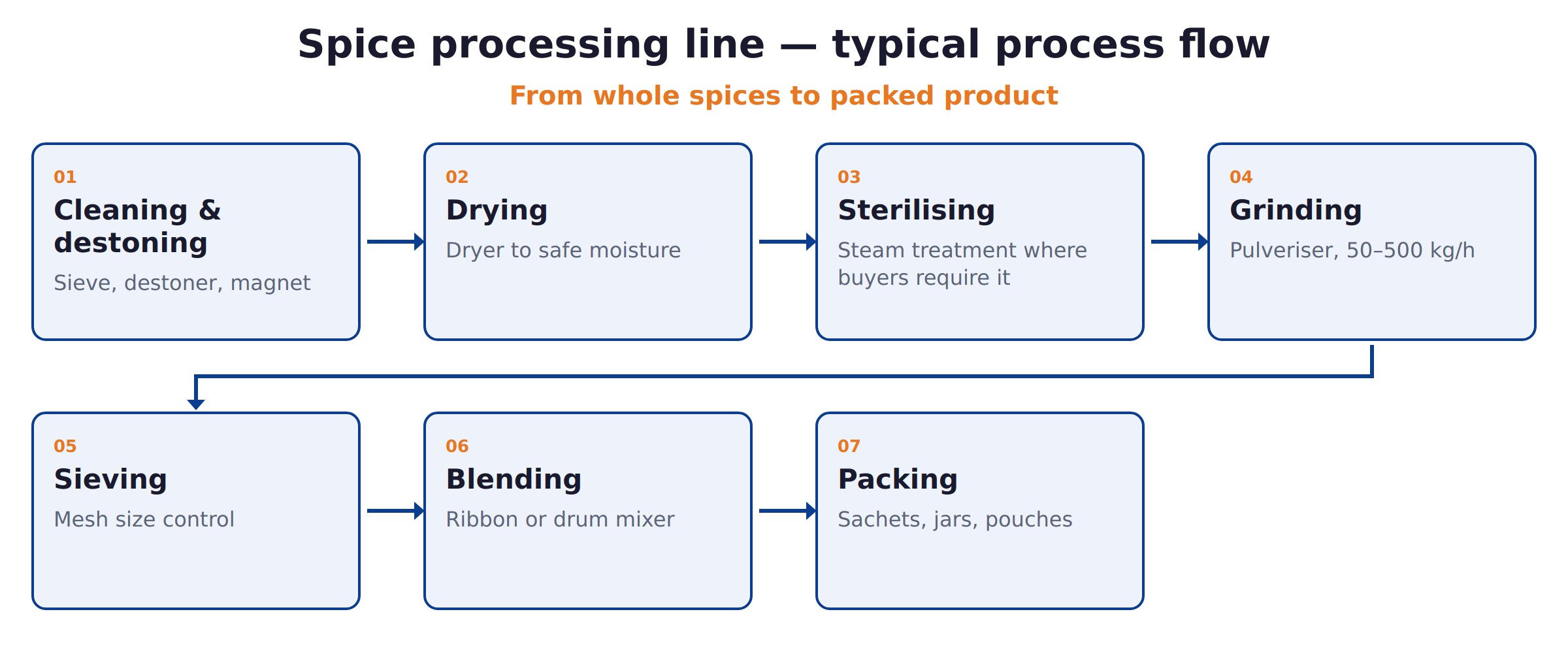
What a spice processing line contains
- Cleaning: sieving, destoning, magnets and aspiration to remove stones, metal and dust.
- Drying for fresh chillies, herbs or roots, where you buy wet raw material.
- Roasting for some spices and blends.
- Grinding: pin mills, hammer mills or air-classifier mills, chosen by spice and fineness.
- Cooling where grinding heats the product; some lines use chilled or cryogenic grinding for oily spices.
- Sieving to the mesh size you sell.
- Sterilisation (steam or other methods) where buyers require low microbial counts.
- Blending for seasonings and curry mixes.
- Packing: sachets, jars, pouches or bulk bags, with weighing and coding.
- Dust collection throughout.
A grinder is one of ten steps. The others decide whether you can sell to retailers and food manufacturers.
Who sells spice equipment, and why prices differ
Local machinery dealers and fabricators sell grinders and mixers. Agents of European milling brands sell high-end mills for large spice processors. Chinese and Indian factories sell grinders and complete lines at lower prices. Turnkey companies design the whole line. Prices differ on mill type and fineness, cooling, stainless construction, sterilisation and automation of packing.
The grinder versus the line buyers will accept
A grinder makes powder. Food manufacturers and retailers buy spices that are clean (no stones or metal), consistent in mesh and colour, within microbial and mycotoxin limits, and packed to the declared weight. That needs cleaning, sieving, testing, possibly sterilisation, and accurate packing.
What moves the price
- Spices: dry, hard spices (pepper, coriander) grind differently from oily ones (cumin, nutmeg) and from chillies.
- Fineness: finer mesh needs different mills and more power.
- Heat: cooling or cryogenic grinding protects flavour but costs more.
- Sterilisation: steam sterilisation adds significant equipment.
- Packing: small sachets at high speed cost more than bulk bags.
- Construction: stainless food-contact parts and dust-tight design.
Where the money goes
On a complete line, the grinders are a modest share. Cleaning, sterilisation, packing, dust collection, the building with food-grade finishes and dust control, electrical supply, installation and commissioning make up most of it.
Choose by scenario
| Situation | Usual choice |
|---|---|
| Small brand packing a few spices | Grinder and sieve set with a semi-automatic packer |
| Supplier to food manufacturers | Cleaning, grinding, sieving and bulk packing with testing |
| Brand moving to retail chains | Full line with sterilisation, blending and automatic packing |
| Butchery and meat spice blender (expansion) | Blending and packing added to existing grinding |
How to compare spice line quotes
Ask each supplier for: output per hour for each spice at your mesh size, cleaning steps, mill type and cooling, sieve sizes, sterilisation method, blending, packing formats and speed, dust collection, materials, installation and commissioning with your spices, and warranty. Add missing items before comparing.
The margin is in the raw material
In spice processing, raw material is most of the cost, and grinding magnifies whatever is wrong with it. Stones, sand and metal damage mills and end up in the product; high moisture clogs screens and spoils powder; mouldy chillies carry aflatoxin that no machine can remove. Buy to a written specification, test incoming lots for moisture and contaminants, clean before grinding, and keep lots traceable from supplier to pack. A clean, consistent intake makes a modest line perform like an expensive one.
Starting out? Our guide on how to start a spice business compares repacking with grinding your own.
Ten questions to ask a spice equipment supplier
- Which spices has this mill ground, at what fineness and output?
- Can you run a trial on my spices before I order?
- How is the product kept cool during grinding?
- What cleaning and destoning comes before the mill?
- What mesh sizes can the sieves give, and how fast are screens changed?
- Is sterilisation included, and which method?
- How is dust collected, and is the system suitable for combustible dust?
- What packing formats and speeds are included?
- Who installs and commissions the line, and is it in the price?
- What wear parts, such as screens, pins and hammers, come with it?
Comparing grinding sets with complete lines
A grinding set and a complete line are different purchases, and should be compared as such. If two quotes differ by several times, check whether one includes cleaning, sterilisation, dust collection and packing and the other does not. Put both on the same list of steps before deciding.
South African rules and costs that shape a spice plant
- Duty on ground chilli. Dried and ground capsicum (0904.21 and 0904.22) carry 25% general duty in SARS's 2026 tariff (free from the EU and UK and SADC, 25% from EFTA), which protects local chilli grinders; turmeric (0910.30) is free.
- Duty-free machinery. Grinding and mixing machinery (8479.82) and food processing machinery (8438.80) are free of general duty; import VAT of 15% applies and VAT vendors reclaim it. See the import duty guide.
- Food premises and labels. The plant must meet R638 of 2018; packs are labelled under R146 of 2010, and net content is marked to SANS 289 under the Legal Metrology Act.
- Mycotoxins. New regulations on maximum levels of mycotoxins in foodstuffs (Notice 7091, February 2026) take effect 24 months after publication; chillies and some spices are prone to aflatoxin, so plan testing and cleaning.
- Dust and safety. Spice dust irritates and can be combustible; dust extraction and guarding are part of meeting the Occupational Health and Safety Act.
Configurations and lead times
Grinder sets ship quickly. Complete lines are built to order and shipped by sea, about 22–30 days to Durban, then installed and commissioned with your spices. Run trials on your raw material before acceptance; spice grinding performance depends heavily on moisture and oil content.
Where CISH fits
CISH supplies, installs and commissions complete spice processing lines from audited factories in China: cleaning, drying, grinding, sieving, sterilisation where needed, blending and packing, with dust control, commissioned on your spices. We suit spice brands moving to retail and suppliers to food manufacturers. For a single grinder, a local dealer is the better choice.
Frequently asked questions
How much does a spice grinding machine cost?
A grinder set of a few hundred kilograms an hour costs about US$1,000–5,000 in 2026. A complete spice processing line from cleaning to packing is quoted per configuration.
What equipment do I need to start a spice business?
At small scale, a grinder, a sieve, a mixer and a packer in a food-grade room. To sell to retailers, add cleaning, dust control, testing and often sterilisation.
Which mill is best for chillies?
It depends on the fineness and the chilli's moisture and oil. Hammer and pin mills are common; ask for a trial on your chillies at your target mesh.
Is there import duty on ground chilli?
Yes. Dried and ground capsicum carry 25% general duty in SARS's 2026 tariff, free from the EU, UK and SADC.
Do spices need to be sterilised?
Many food manufacturers and retailers require low microbial counts, which often means sterilisation. Check your buyers' specifications.
Does CISH sell single spice grinders?
No. We supply complete spice processing lines. For a single grinder, a local dealer is the better route.