Choose the supplier who sizes the dryer on the moisture points you must remove, designs the steel for South African wind and grain loads, and includes aeration, temperature monitoring and safe access.
Four kinds of silo supplier
| Supplier | Typical scope | Price level | Who answers for the yard | Good for |
|---|---|---|---|---|
| Local silo and bin manufacturer | Galvanised bins, hopper-bottom silos, steelwork, erection crews | Moderate | The manufacturer, for the structure | Farms and small depots |
| Agent of an imported silo brand | Engineered silo systems, dryers, aeration and monitoring | High | The brand, for its systems | Large depots and processors |
| Chinese factory, direct | Bolted galvanised silos, bucket elevators, chain conveyors, dryers | Lowest on the quote | You, after delivery | Buyers with their own erection team |
| Turnkey grain yard company | Intake, cleaning, drying, storage, handling and controls, erected and commissioned | Depends on scope | The yard, at agreed intake and drying rates | Farmers' groups, mills and feed plants building storage |
Size by moisture and selling window
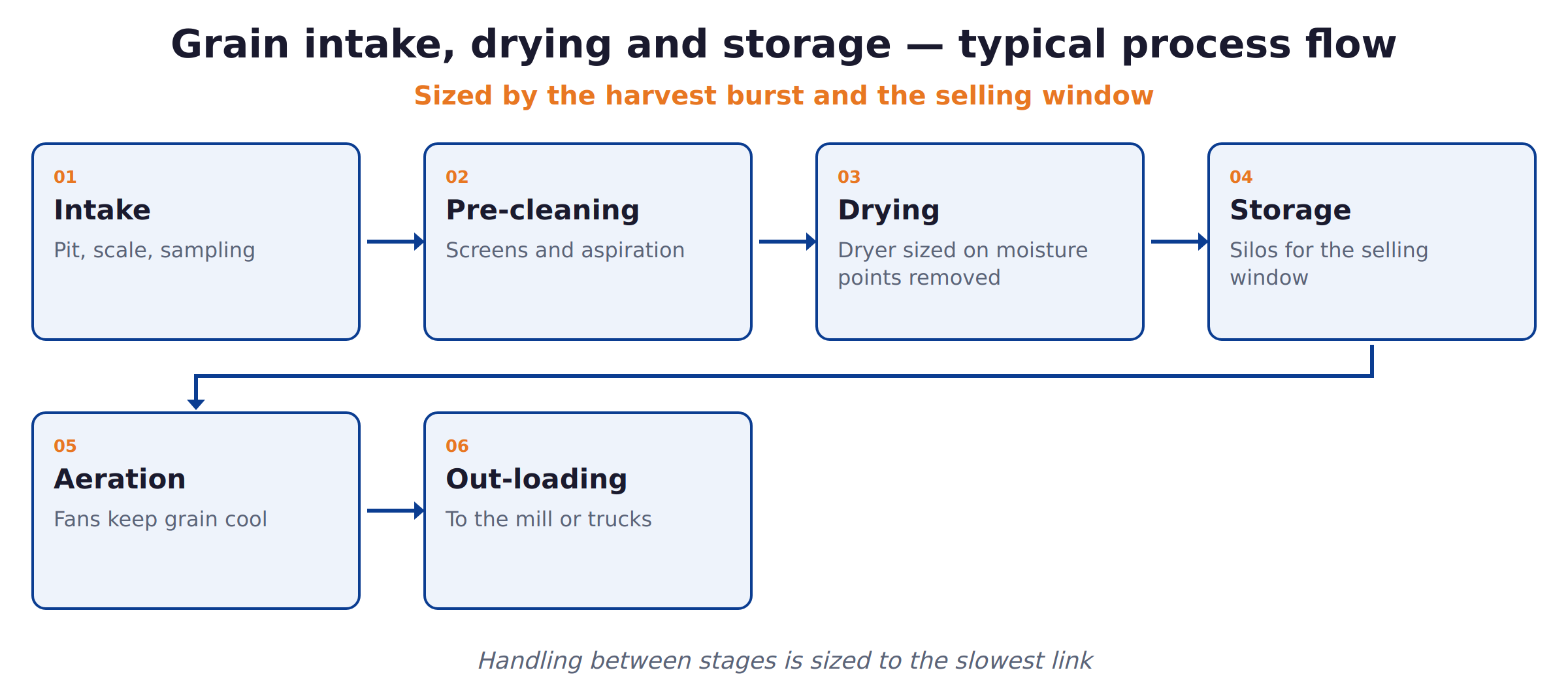
A silo stores; a dryer removes water; a yard moves grain between them. Each is sized differently:
- Intake by how many tonnes arrive per hour at harvest.
- Drying by tonnes per hour multiplied by the moisture points to remove, not by tonnes per hour alone.
- Storage by how long you want to hold grain to sell or mill into a better price window.
- Handling by the slowest link it feeds.
Our silo and dryer sizing guide works through the method.
What separates silo suppliers
Structural design for local conditions
A silo carries grain pressure, wind and, on some sites, seismic loads. Ask for the design basis, the steel grade and galvanising, and who signs the structural design. Foundations are usually the owner's civil work, designed from the supplier's loads.
Aeration and monitoring
Grain in store must be cooled and kept dry. Ask about aeration fans, temperature cables and controls. Hot spots spoil grain and attract insects.
Safe access and dust
Silos are confined spaces, and grain dust can explode. Ask how the design handles access, ladders and platforms, dust extraction at elevators and conveyors, and explosion venting where needed. Safety obligations under the Occupational Health and Safety Act apply to the owner from day one.
Where to find silo suppliers
- Agbiz Grain, which represents the grain handling and storage industry, publishes material on storage structures, grading and grain depot manager training.
- SAGIS, the grain information service, and SAGL, which reports on crop quality each season, are the data sources behind any storage business case.
- Grain SA publishes crop and market reports.
- Agricultural shows and grain days feature silo and dryer suppliers each year; check current dates with the organisers.
- China: bolted galvanised silos and handling equipment are widely imported from China; use our supplier audit checklist.
We do not name silo companies on this page.
Ten points to check
- Capacity in tonnes per crop, with bulk density stated.
- Structural design basis, steel grade, galvanising and the engineer who signs it.
- Foundations: loads supplied for your civil engineer.
- Intake: pit, elevator and conveyor capacity per hour.
- Cleaning: pre-cleaner and screens before storage.
- Drying: capacity at your moisture differential, fuel and burner type.
- Aeration and monitoring: fans, temperature cables, controls.
- Load-out: truck loading rate.
- Safety: access, platforms, dust control and explosion protection.
- Erection, commissioning and training in the price, with spares for elevators and conveyors.
Questions for a silo supplier
- What capacity, for which grain and bulk density?
- Who designed the structure, and to what loads?
- What loads will my foundations carry?
- What is the dryer's capacity at my moisture differential?
- How is grain aerated and its temperature monitored?
- What intake and load-out rates will the yard achieve?
- How is dust controlled?
- Who erects and commissions the yard?
- What does the warranty cover?
- Which yard runs your equipment, and may I visit?
What a grain yard quote should show
| Area | Check |
|---|---|
| Intake | Pit, grid, elevator, capacity |
| Cleaning | Pre-cleaner, screens, aspiration |
| Drying | Dryer type, capacity at stated moisture removal, burner, fuel |
| Storage | Silos or bins, capacity, roof and hopper details |
| Aeration and monitoring | Fans, ducts, temperature cables, controller |
| Handling | Conveyors, elevators, distributors, gates |
| Load-out | Bin or spout, loading rate |
| Safety | Ladders, platforms, dust control, explosion venting |
| Erection and commissioning | Crane, crew, commissioning with grain |
| Owner's scope | Foundations, power, roads, weighbridge |
Fill in what each quote leaves out before comparing; our same-scope method explains it.
Mistakes with grain storage
- Sizing the dryer by tonnes per hour. Removing five moisture points is a different machine from removing two.
- No aeration. Grain heats and spoils in store.
- Ignoring the intake rate. Trucks queue at harvest while the yard waits on one elevator.
- No plan for dust. Elevators and conveyors produce explosive dust.
- Buying storage without a selling plan. Storage pays only if prices rise more than the cost of holding.
What grain storage costs
Grain yards vary too much in capacity, drying and handling for an honest single band, so we quote them per configuration. The sizing guide shows which choices move the cost most.
The South African context
- Big crops need storage. The CEC's seventh forecast for 2025/26 (August 2026) put the commercial maize crop at about 17.4 million tonnes, soybeans at about 3.01 million tonnes and sunflower at about 875,000 tonnes.
- Moisture rules. The maize grading regulations under the Agricultural Product Standards Act set the permitted moisture for graded maize and prescribe how moisture is measured, which makes calibrated moisture meters at intake essential.
- Quality data. SAGL publishes crop quality reports each season, useful for setting cleaning and drying capacity.
- Duty-free equipment. Steel tanks and similar containers (7309.00), grain cleaning and grading machines (8437.10) and pneumatic conveyors (8428.20) are free of general duty in SARS's 2026 tariff; VAT vendors reclaim the 15% import VAT. See the import duty guide.
- Safety. Confined spaces, working at height and dust explosion risks fall under the Occupational Health and Safety Act.
Where CISH fits
CISH designs, supplies, erects and commissions complete grain storage and drying yards: intake, cleaning, drying, storage, aeration and handling, from audited factories in China, with structural loads supplied for your foundations. We hand over at agreed intake and drying rates with your team trained. We suit farmers' groups, mills and feed plants building their own storage. For a single farm bin, a local manufacturer is usually the better route.
Frequently asked questions
Who builds grain silos in South Africa?
Local silo and steel-bin manufacturers, agents of imported silo brands, Chinese factories selling bolted galvanised silos and handling equipment, and turnkey grain yard companies.
How much does a grain silo cost?
It depends on capacity, the number of bins, drying, handling and foundations, so complete yards are quoted per configuration. Ask for costs per tonne stored with the same scope from each supplier.
How do I size a grain dryer?
By tonnes per hour multiplied by the moisture points you need to remove. A dryer quoted only in tonnes per hour has not been sized for your grain.
Do silos need aeration?
Yes. Aeration cools and conditions grain in store and prevents hot spots, mould and insects. Temperature monitoring tells you when to run it.
Is there import duty on silos?
Steel tanks and similar containers (7309.00), grain cleaning machines (8437.10) and pneumatic conveyors (8428.20) are free of general duty in SARS's 2026 tariff. Import VAT of 15% applies.
Does CISH sell single silos?
We supply complete storage and drying yards. For a single farm bin, a local manufacturer is usually the better choice.