Almost every new toilet paper business in South Africa starts with converting, because a small converting line costs about US$10,000–50,000 while a tissue mill is a different scale of project. CISH supplies, installs and commissions complete converting lines.
The process at a glance
| Stage | Step | What happens | Machine |
|---|---|---|---|
| Paper mill | 1. Pulping | Virgin fibre or waste paper broken down in water | Pulper, cleaners, screens |
| Paper mill | 2. Forming and drying | Thin wet sheet formed, pressed and dried on a large heated cylinder | Tissue machine with Yankee dryer |
| Paper mill | 3. Creping and reeling | Sheet scraped off the dryer to make it soft, then wound into parent rolls | Creping blade, reel |
| Converting | 4. Unwinding | Two or three parent rolls unwound together | Unwind stands |
| Converting | 5. Embossing and ply bonding | Pattern pressed in; plies held together | Embossing unit |
| Converting | 6. Perforating | Tear lines cut across the web | Perforation unit |
| Converting | 7. Rewinding | Paper wound onto cores as a long log | Rewinder, core maker |
| Converting | 8. Tail sealing | Loose end glued down | Tail sealer |
| Converting | 9. Cutting | Logs cut into individual rolls | Log saw |
| Converting | 10. Packing | Rolls wrapped singly or bundled | Packing and bundling machines |
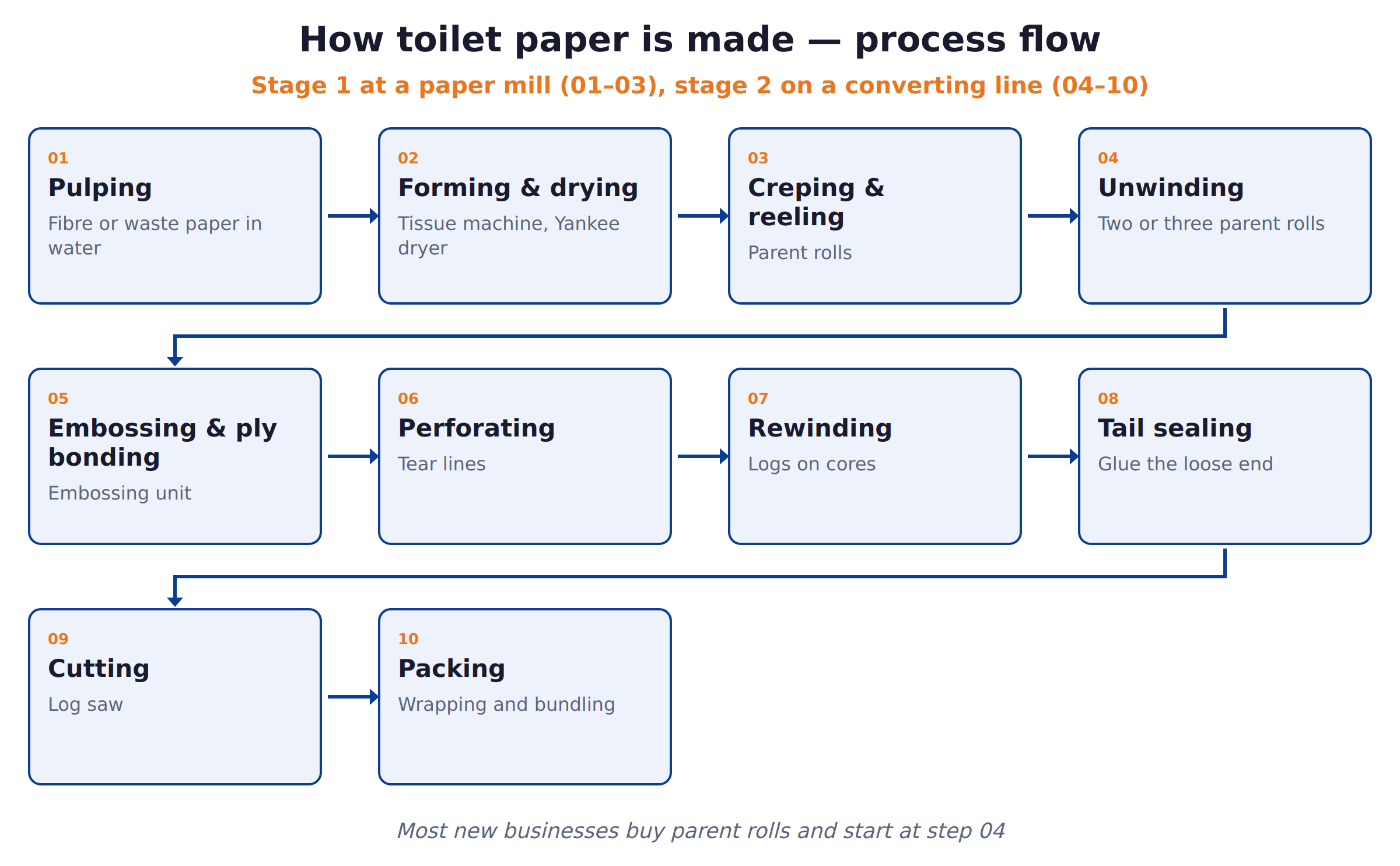
Stage one: how tissue paper is made
Tissue starts as fibre. A mill using virgin pulp buys or makes wood pulp; a mill using recycled fibre pulps waste paper, removes contaminants and, for whiter grades, de-inks it. The fibre is mixed with a great deal of water and pumped to the tissue machine.
On the tissue machine the dilute stock is sprayed between moving fabrics to form a sheet that is mostly water. Presses remove part of the water, and the sheet is then pressed against a large steam-heated cylinder, the Yankee dryer, which dries it in a fraction of a second. A blade scrapes the dry sheet off the cylinder. This creping step crinkles the sheet, which is what makes tissue soft and bulky rather than flat like printing paper. The creped sheet is wound onto a reel to make the parent roll.
A tissue mill needs fibre supply, large amounts of water and steam, effluent treatment and continuous operation to be economic. Pulp and paper production is a listed activity under the Air Quality Act, and a new mill also needs water use and waste authorisations. That is why tissue making in South Africa is concentrated in a small number of large mills, represented with the rest of the paper industry by the Paper Manufacturers Association of South Africa (PAMSA).
Stage two: how a converting line makes rolls
Converting is where most entrepreneurs and small manufacturers come in. The line takes bought-in parent rolls and turns them into the product on the shelf.
Unwinding and embossing
Two or three parent rolls sit on unwind stands, one for each ply. The plies run together into an embossing unit: steel rollers press a pattern into the paper, which adds softness and bulk and, together with a little glue or mechanical edge embossing, holds the plies together. A two-ply roll needs two unwind stands; a three-ply premium roll needs three.
Perforating
A perforation unit cuts a line of small slits across the web at each sheet length. The sheet length and the perforation quality matter to buyers: a roll that tears unevenly gets complaints.
Rewinding
The rewinder is the heart of the line. It winds the paper onto a cardboard core to a set number of sheets and a set diameter, cuts the web, and starts the next core without stopping. The result is a log, as wide as the parent roll. Many lines include an inline core maker that forms cores from strips of board, so you buy board on reels rather than ready-made cores.
Tail sealing and accumulating
The tail sealer folds and glues the loose end of each log so it does not unravel. Logs then wait in an accumulator, which buffers the difference in speed between the rewinder and the saw.
Cutting and packing
The log saw cuts each log into individual rolls, trimming the ends, which go back as waste. Rolls then go to packing: single-roll wrapping, or bundling into packs of 4, 6, 9, 10, 18 or more, followed by shrink film or bags and cartons.
Toilet paper machines and what each costs
Converting machines come as individual machines or as complete lines. As an indication for 2026, in USD:
| Purchase | What you get | Indicative price (2026) |
|---|---|---|
| Small converting line | Unwind, emboss, perforate, rewind, manual tail sealing and band saw cutting | About US$10,000–50,000 (a small line is often about US$25,000) |
| Automatic converting line | Faster rewinder, inline core maker, automatic tail sealer, log saw, accumulator | Up to about US$1 million, with packing |
| Tissue paper mill | Pulping, tissue machine, Yankee dryer, utilities and effluent | Quoted per configuration; a different scale of project |
These are ex-works equipment prices from Chinese factories. Freight, installation, a building, power, working capital for parent rolls and packaging come on top; in most lines we see, equipment is about 35–55% of the project. Our toilet paper machine price guide sets out what each band includes.
How many rolls from a tonne of tissue?
Output is limited by paper, not only by the machine. As an example, a two-ply roll of 200 sheets, each 10 × 10 cm, with tissue of about 17 g/m² per ply, contains roughly 68 grams of paper. A tonne of parent roll would then give in the region of 14,000 rolls, less trim and start-up waste. Your own figure depends on ply, sheet count, sheet size and paper grammage, so ask each supplier to show the calculation for your specification.
That calculation is also how you size the business. If you plan to sell 10,000 rolls a day, you need roughly three-quarters of a tonne of parent roll a day, a reliable supplier for it, and storage for several weeks of stock.
What decides quality
- Parent roll quality. Softness, strength and colour come mostly from the tissue, not the converting machine.
- Embossing pattern and ply bonding. Poor bonding makes plies separate in use.
- Perforation. Clean, consistent tear lines.
- Winding tension and roll firmness. Too loose and the roll looks thin; too tight and it looks small for its sheet count.
- Sheet count accuracy. Your pack must carry a true quantity.
- Clean cutting. A sharp, well-maintained saw blade gives a neat roll edge.
Rules and duty in South Africa
- Pack markings. Prepackaged goods must show their contents correctly under the Legal Metrology Act, which brings in SANS 289; for toilet paper that means sheet count or another declared quantity on the pack.
- Packaging EPR. Paper and packaging producers fall under the Extended Producer Responsibility Regulations of 2020; the wrapping film and cartons you put on the market count.
- Duty on parent rolls. Tissue in large rolls (tariff heading 4803.00) carries 5% general duty, with exemptions for goods from the EU and UK, EFTA and SADC.
- Duty on finished rolls. Imported finished toilet paper (4818.10) carries 20%, which protects local converting.
- Machinery. Converting machines (8441.10, 8441.80) and tissue-making machinery (8439) carry no general duty; 15% import VAT applies and is reclaimable for VAT vendors.
- A mill is regulated differently. A tissue mill brings air quality, water use and effluent permitting that a converting plant does not.
From process to plant: what a converting plant needs
| Item | Small converting plant | Automatic plant |
|---|---|---|
| Building | Dry, clean floor, often 300–600 m² with storage | Larger, with high stacking for parent rolls |
| Power | Three-phase supply sized for the line | Larger supply; ask for the starting load |
| Compressed air | For pneumatic units | Yes |
| Staff per shift | Several operators and packers | Fewer per roll, with technicians |
| Parent roll storage | Weeks of stock, kept dry | Same, at larger volume |
| Packaging stock | Film, bags, cartons, labels | Same |
Common mistakes
- Buying the machine before securing parent roll supply. Without a reliable source at a known price per tonne, the line stands.
- Choosing a rewinder too wide for your parent rolls. Match the machine width to the rolls you can buy.
- Underestimating packing. Hand packing becomes the bottleneck once the rewinder runs well.
- Ignoring trim waste. Plan to bale and sell it, or return it to a mill.
- Storing paper in a damp building. Tissue absorbs moisture and loses quality.
- Assuming you can make paper later cheaply. A tissue mill is a different investment from a converting line.
Where CISH fits
CISH works on the converting side. We specify toilet paper converting lines, from unwinding to packing, from audited factories in China against your roll specification and daily output, ship and clear them, install and commission the line on your parent rolls, and train your operators. We do not build tissue mills, and we will say so if your plan needs one.
Frequently asked questions
How is toilet paper made?
A paper mill makes soft, creped tissue and winds it onto large parent rolls. A converting line then unwinds the rolls, embosses and perforates the paper, rewinds it onto cores as logs, seals the tail, cuts the logs into rolls and packs them.
What machines do I need to make toilet paper?
For converting, you need unwind stands, an embossing and perforation unit, a rewinder, a tail sealer, a log saw and packing machines. A core maker and accumulator are added on automatic lines.
Can I make toilet paper from waste paper?
Tissue can be made from recycled fibre, but that is done in a paper mill with pulping, cleaning and a tissue machine. A converting line cannot use waste paper directly; it needs parent rolls.
How much does a toilet paper making machine cost?
As an indication for 2026, a small converting line costs about US$10,000–50,000 ex-works, and an automatic line with packing can reach about US$1 million.
How many rolls can I make from one tonne of tissue?
As an example, about 14,000 two-ply rolls of 200 sheets, before trim waste. The exact figure depends on ply, sheet count, sheet size and paper weight.
Does CISH build tissue paper mills?
No. We supply complete converting lines that turn parent rolls into packed toilet paper.