Brochures quote the best case for the smallest unit; real yards usually reach well under that because of mixing, pallet handling, mould changes, breakdowns, breaks and, above all, the space to cure what the machine makes. Output depends heavily on the product: a machine that makes 10 maxi bricks per cycle may make only 4 or 5 large hollow blocks. To size a yard, start from what you can sell and deliver a day, then check that the machine, mixer, curing area, cement deliveries and trucks can all keep up. CISH supplies, installs and commissions semi-automatic and automatic block and brick plants.
Rated output versus real output
| Machine class | Rated output per shift (brochure) | Realistic output per shift | Main limit |
|---|---|---|---|
| Manual press or mould | Up to about 1,500 units | Often a few hundred to 1,000 | Labour and mixing by hand |
| Egg-laying (mobile) | Up to about 8,000 blocks | About 3,000–6,000 blocks | Slab space, mixing, curing |
| Semi-automatic static | Up to about 25,000 units | About 8,000–18,000 units | Pallet handling, curing area |
| Fully automatic | 25,000+ units | Close to rated if well run | Raw materials, power, maintenance |
These are typical ranges for standard hollow blocks and bricks; your product, mix and team decide where you land.
How to calculate output
Units per cycle × cycles per hour × productive hours × (1 − reject rate)
As an example, a static machine making 6 hollow blocks per cycle at 3 cycles a minute (180 an hour) for 7 productive hours with 3% rejects gives 6 × 180 × 7 × 0.97 ≈ 7,300 blocks. The same machine making maxi bricks at 15 per cycle could make about 18,000 bricks in the same shift. Always ask the supplier for units per cycle and cycle time for your exact product.
What really limits output
Mixing
The mixer must feed the machine without waiting. A pan mixer that takes a few minutes per batch may limit a fast machine. Weigh batching keeps quality steady.
Pallets and handling
Static machines make units on pallets that must be moved to curing and returned. Too few pallets or slow transport stops the machine.
Curing area
Fresh units need space and time to cure before stacking. A yard that makes 10,000 blocks a day needs room for several days' production in curing. Without that space, the machine waits.
Product changes
Changing moulds for pavers, kerbs or a different block takes time. Plan long runs of one product.
People and breaks
Real shifts include start-up, cleaning, breaks and stoppages. Seven productive hours out of eight is good.
Cement and aggregate deliveries
A plant that makes 15,000 blocks a day uses many tonnes of cement and aggregate; late deliveries stop production.
Strength matters more than speed
Making more blocks per cycle by stretching the mix or shortening vibration time produces weak units. Concrete blocks should meet SANS 1215 for the strength class your customers order, and paving blocks SANS 1058. Test units from each day's production, and adjust cycle time to make strong blocks, not just more blocks.
Size the yard from sales
- Blocks a day you can sell and deliver on an average and a peak day.
- Products and sizes in the mix.
- Shifts you will run.
- Curing space and days in curing.
- Trucks for delivery.
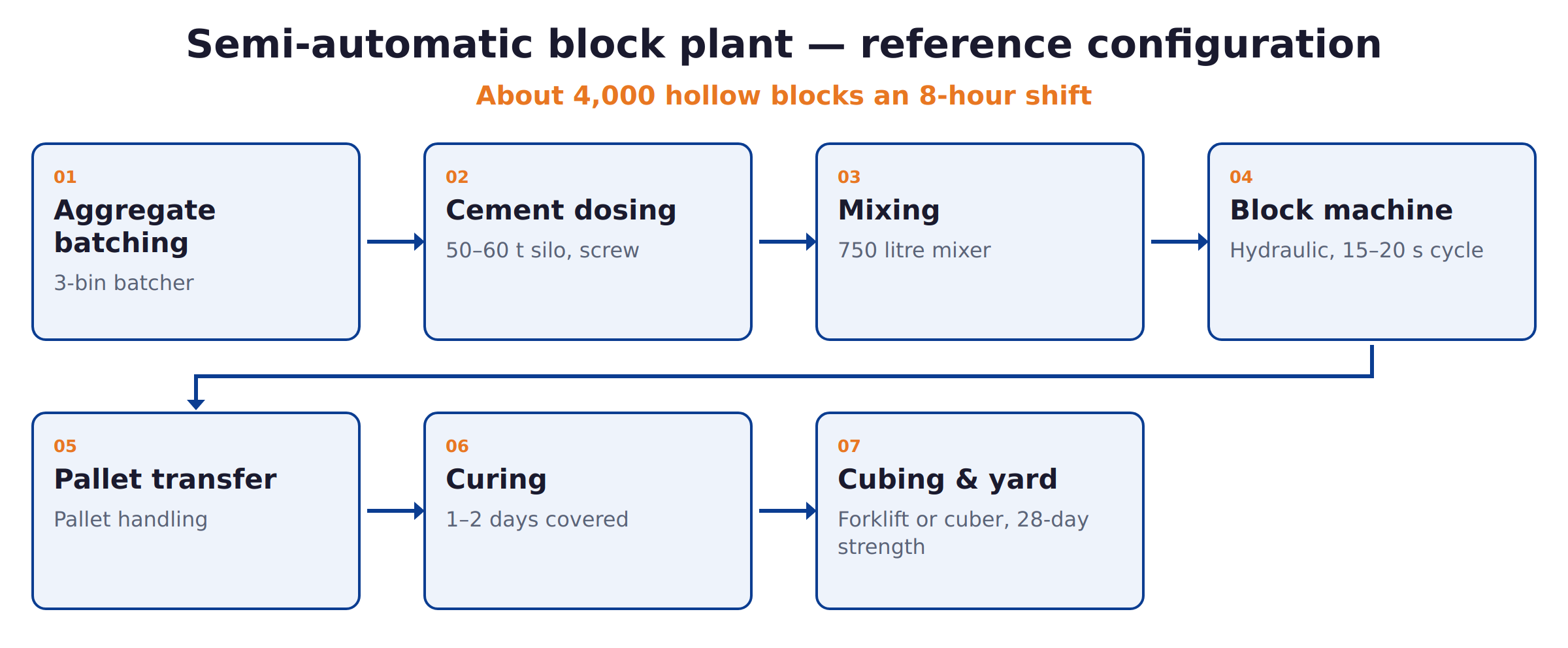
Then choose the machine class whose realistic output covers your peak days with some margin. Our block plant sizing guide sets out yard space and staff for each tier, and our guide to the best brick making machine compares the classes.
Worked example: checking a supplier's claim
A builder in Gauteng is offered a static machine "making 20,000 blocks a day". He asks for the figures for 390 × 140 × 190 mm hollow blocks: 5 per cycle, 15-second cycle (240 cycles an hour), giving 1,200 blocks an hour at best. Over 7 productive hours that is about 8,400 blocks, and his pan mixer and 600 pallets would support about 7,000. He plans for 7,000 a day, adds pallets and a second mixer later, and still finds the machine good value. The figures are illustrative.
Safety while pushing output
Block machines and mixers are driven machinery under the Driven Machinery Regulations. Fit guards, lock out before cleaning moulds, and do not bypass safety switches to gain cycles.
Five questions to ask a supplier
- How many of my units per cycle, and what cycle time?
- What output do your customers achieve in practice?
- What mixer, pallets and curing area does that output need?
- How long does a mould change take?
- What strength do units reach at that cycle time with my materials?
From a delivered project: A regional developer asked for a 12,000 blocks-a-day automatic plant; sized to real off-take, the plant built was about 6,500 blocks a day over two shifts, online in 22 weeks and at 78% effective utilisation within three months. Read the block and paver plant case study.
Common mistakes
- Planning on the brochure figure.
- Too few pallets.
- No curing space for a day's output.
- A mixer slower than the machine.
- Shortening cycles at the expense of strength.
Curing space and labour often limit output
A machine's rated output assumes you can move, cure and store every block it makes. Fresh cement blocks need shade, moisture and time: they are usually kept damp for several days and then stacked to finish curing before sale. If you do not have enough flat, covered yard space, the machine stops waiting for room. Count the area you need for a week or more of production, plus space for sand, stone, cement and finished stock.
Labour matters as much. A manual or semi-automatic machine needs people to mix, feed, carry pallets and stack blocks, and output falls when a worker is absent. Fully automatic plants with conveyors and stackers need fewer people but more skilled maintenance. Real daily output is usually below the brochure figure; plan on a lower number for your first months while the team learns.
Test your blocks
Strength depends on mix, compaction and curing. Have blocks tested by an accredited laboratory, especially if you sell to builders and contractors, and keep the test results to show buyers.
Matching the machine to your market
Before choosing output, count your buyers. A township yard selling to home builders may sell a few thousand blocks a week; a plant supplying contractors and housing projects needs far more, with transport to sites. Choose a machine that can meet steady demand on one shift, with room to add a second shift as orders grow, rather than a large plant that stands idle.
Where CISH fits
We supply semi-automatic and automatic block and brick plants, mixers, batching, machines, moulds, pallets and curing, from audited factories in China, sized to the realistic output you need. CISH ships, clears, installs and commissions the plant on your materials with output demonstrated, and trains your operators. For a manual machine, a local supplier is usually the better buy. Block machines under 8474.80 enter duty-free.
Frequently asked questions
How many bricks can a machine make per day?
It depends on the class: manual presses a few hundred to about 1,500, egg-laying machines about 3,000–8,000 blocks, semi-automatic plants about 8,000–25,000 units and automatic plants 25,000 or more per shift.
Why is real output lower than the brochure figure?
Mixing, pallet handling, mould changes, breaks, curing space and stoppages all reduce productive hours.
How do I calculate brick machine output?
Units per cycle × cycles per hour × productive hours × (1 − reject rate).
Does the block size affect output?
Yes. A machine makes far fewer large hollow blocks than small bricks per cycle.
Can I increase output by shortening the cycle?
Only if the units still reach the required strength; test before changing.
Does CISH supply block and brick plants?
Yes, semi-automatic and automatic plants with commissioning and training.