For tens of thousands of units a day, paving blocks for municipal tenders, or a merchant supply contract, a fully automatic plant at about US$600,000–1.5 million or more is the right class. In every case the blocks must meet SANS 1215, and paving blocks SANS 1058. CISH supplies, installs and commissions complete semi-automatic and automatic block and paver plants.
The short answer: compare the four classes
| Machine class | Output (8-hour shift) | Indicative price (2026) | Labour | Power | Best fit |
|---|---|---|---|---|---|
| Manual press or hand mould | A few hundred to about 1,500 units | Within the US$8,000–40,000 Tier 1 band, at the low end | Heavy, 4–8 people | Little or none | Community projects, own-build, start-up yards |
| Egg-laying (mobile) machine | About 3,000–8,000 hollow blocks | US$8,000–40,000 machine; yard under about US$80,000 | 5–10 people | Small motor or diesel | Builders' yards with a large flat slab |
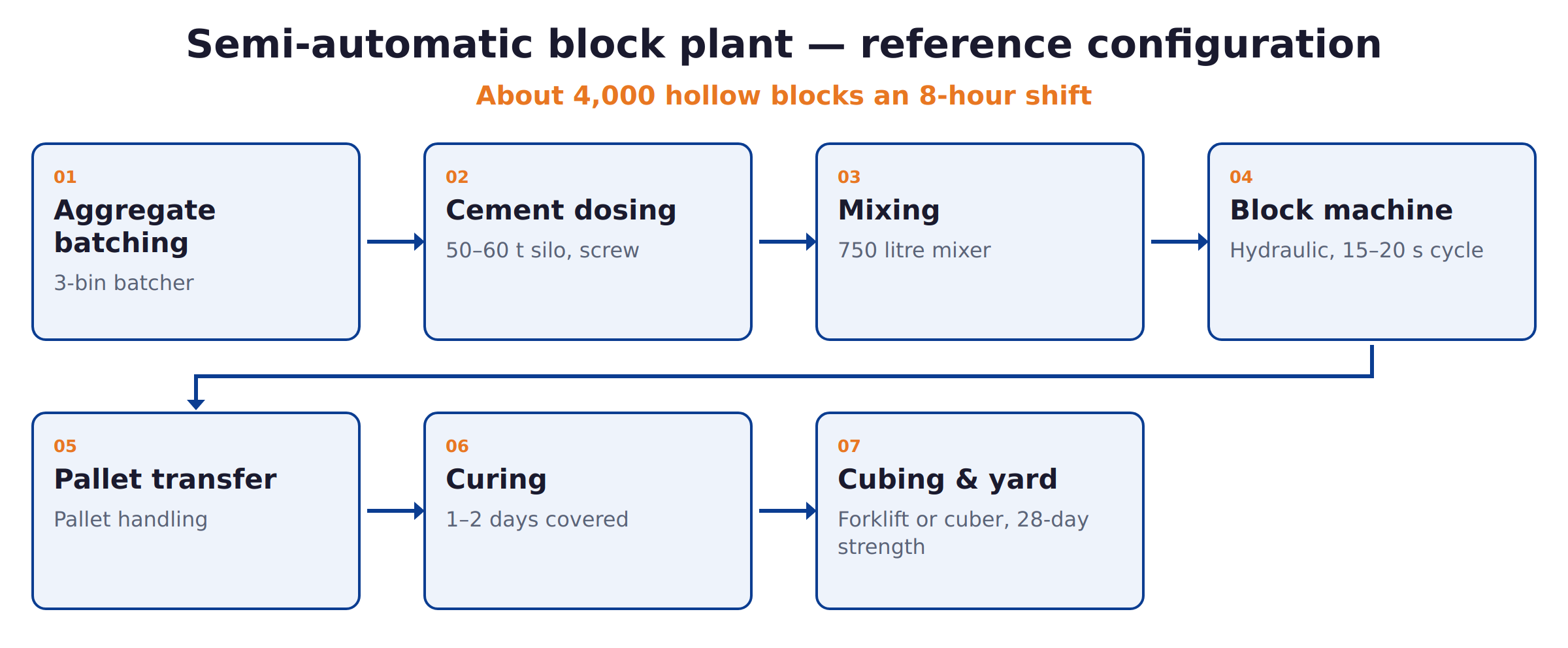
| Semi-automatic static plant | About 8,000–25,000 units | US$120,000–450,000 landed and commissioned | 8–15 people | Three-phase supply | Contractors, merchants, repeat orders |
| Fully automatic plant | 25,000 units and up | US$600,000–1.5 million+ (civils extra) | 5–10 per shift, more skilled | Large supply, often a transformer | Merchant supply, paving tenders, regional brands |
Output depends on the block size, cycle time and how quickly the product can be moved to curing. Ask any supplier to state output for your exact block, not a 'standard brick'.
Match the machine to your situation
Starting a new yard
If you have not yet sold a single block, start with the smallest machine that can make a product good enough to pass SANS 1215 for your target strength. A good egg-laying machine with a proper mixer is a common start. Spend the savings on cement buying, a curing area, a delivery truck and working capital, which are what stop most new yards.
Expanding an existing yard
If you already sell everything you make and customers ask for more, the step is usually from manual or egg-laying to a semi-automatic static plant. The change is not only speed: a static plant with a pan mixer and weigh batching makes every block the same strength, which lets you sell to contractors who test.
Limited budget
Buy a robust machine with a good mixer rather than a bigger machine without one. Hand mixing is the most common reason small yards fail strength tests. A second-hand machine can work, but imported used equipment needs an ITAC import permit before shipment.
Selling to merchants or bidding on tenders
Merchants and public projects ask for test certificates and consistent supply. That points to a semi-automatic or automatic plant, a quality routine with cube or unit tests, and often certification through a SANAS-accredited body. If paving is part of the plan, the plant must be able to make SANS 1058 pavers with a face mix.
Mobile or static?
| Egg-laying (mobile) | Static plant | |
|---|---|---|
| How it works | The machine moves along a slab and lays blocks on the floor | Blocks are made on pallets and carried to curing |
| Floor needed | Large, level concrete slab | Smaller footprint plus a curing area or racks |
| Product range | Mainly hollow and solid blocks | Blocks, bricks, pavers, kerbs with mould changes |
| Consistency | Depends on the operator and the mix | Higher; vibration and compaction are controlled |
| Investment | Lower | Higher |
| Growth path | Add a second machine | Add automation, a stacker, a cuber |
A mobile machine saves pallets and a curing chamber but needs space and good weather. A static plant costs more but suits pavers and higher strength classes.
Interlocking bricks: when they make sense
Interlocking soil-cement or concrete bricks are laid dry or with thin mortar. They suit community housing, boundary walls and projects where builders have been trained in the system. The machines are often manual or hydraulic and modest in price. Before you buy, check who will build with them: most South African builders and plans assume standard blocks and mortar, and structural use must meet the building regulations and your engineer's design. For NHBRC-enrolled homes, use products and systems the builder and inspector accept.
The real differences between Chinese, European and local machines
We do not rate brands. The differences that matter are by type of supplier:
| Local workshop machines | Chinese factory machines | European machines | |
|---|---|---|---|
| Typical range | Manual and egg-laying | Manual to fully automatic | Semi-automatic to high-end automatic |
| Price level | Low | Low to moderate | High |
| Spares and service | Close by | Must be planned: stock wear parts | Usually through an agent |
| Moulds | Often made locally | Supplied with the machine, more at extra cost | Precise, expensive |
| Controls | Simple | PLC on automatic plants | Advanced automation |
| What to check | Steel, vibration motors, mixer | Vibration system, PLC brand, mould steel, references | Total landed cost and lead time |
A good Chinese static plant with a proper mixer and moulds made from wear-resistant steel is a common choice for South African yards that want automatic output at a moderate price. Ask for a factory video making your block, and the mould steel specification.
What a wrong choice costs
- Too small: you lose orders and pay overtime, then buy again within two years.
- Too big: blocks pile up, cement ties up cash, and the loan repayments run while the plant runs half a shift.
- No proper mixer: blocks fail strength tests and builders stop buying.
- No curing plan: blocks crack or are weak, especially in hot, dry and windy months.
- Wrong moulds: your local market wants 390 × 190 × 190 or 390 × 140 × 190 blocks; a mould set for other sizes is wasted.
Five things to confirm before you decide
- Your product and size: maxi bricks, hollow blocks, solid blocks, pavers, kerbs, and the dimensions your buyers use.
- Strength class: SANS 1215 sets nominal compressive strength classes from 3.5 to 21 MPa; know which your customers ask for.
- Sales per day: the volume you can sell and deliver, not the volume the machine can make.
- Site: slab, water, three-phase power, yard space for curing and stock, road access for trucks.
- Raw materials: a steady source of cement, sand and stone at a known delivered price.
Demand and standards in South Africa
Building activity, including public housing, drives block demand. The Department of Human Settlements' 2026/27 budget was about R26.97 billion, and private building, retail and municipal projects add more. Blocks are regulated by product standards rather than licences: SANS 1215 for concrete masonry units, SANS 227 for fired clay bricks and SANS 1058 for concrete paving blocks. The Concrete Manufacturers Association publishes technical guidance and its certification arm lists the relevant specifications. Our SANS 1215 guide sets out the strength and dimension rules.
How CISH helps you choose
We start from your product, your daily sales and your site. For a first manual or egg-laying machine we will usually tell you to buy locally. For a semi-automatic or automatic plant we specify the machine, mixer, batching, moulds, pallet handling and curing for your blocks, supply it from audited factories in China, ship and clear it, install and commission it until it makes your block at the agreed rate, and train your operators. Our block machine price guide shows what each class costs in 2026.
To size the machine, see how many bricks a day a machine really makes once curing and labour are counted.
From a delivered project: A regional developer asked for a 12,000 blocks-a-day automatic plant; sized to real off-take, the plant built was about 6,500 blocks a day over two shifts, online in 22 weeks and at 78% effective utilisation within three months. Read the block and paver plant case study.
Frequently asked questions
What is the best brick making machine in South Africa?
The one that matches your output and market. Manual or egg-laying machines suit small yards; semi-automatic static plants suit contractors and merchants; fully automatic plants suit large-volume and paving work.
How much does a good brick making machine cost?
As an indication for 2026, manual and egg-laying machines cost about US$8,000–40,000, semi-automatic plants about US$120,000–450,000 landed and commissioned, and fully automatic plants about US$600,000–1.5 million or more.
Is a mobile or static block machine better?
Mobile machines are cheaper but need a large slab; static plants cost more but give more consistent blocks and can make pavers.
Are interlocking brick machines a good choice?
They suit trained builders and community housing. Check that builders and inspectors in your market accept the system first.
Do bricks need to meet a standard?
Yes. Concrete blocks should meet SANS 1215, clay bricks SANS 227 and paving blocks SANS 1058.
Does CISH sell manual brick machines?
No. We supply semi-automatic and automatic block and paver plants. For a manual machine, a local supplier is usually the better choice.