In 2026 terms, deck and rack ovens sit in the US$15,000–45,000 single-machine setups and semi-automatic lines from about US$80,000; tunnel ovens sit inside continuous plants of US$250,000–800,000+. CISH supplies, installs and commissions complete bread lines with the oven that fits.
The short comparison
| Oven | Typical output | How it is loaded | Products | Floor space | Labour | Fits |
|---|---|---|---|---|---|---|
| Deck oven | Tens to a few hundred loaves an hour | By hand or loader, deck by deck | Artisan bread, rolls, pastries, cakes, many varieties | Compact per deck; stacks vertically | High per loaf | Retail, artisan and in-store bakeries |
| Rotary rack oven | Several hundred to over a thousand pan loaves an hour, depending on racks | Whole racks rolled in | Pan bread, rolls, confectionery | Moderate | Moderate | In-store and independent bakeries, small plant bakeries |
| Tunnel oven | Thousands of loaves an hour | Continuous belt or pans from the line | One product family at a time | Long: the oven alone can run tens of metres | Low per loaf | Plant bakeries supplying retail chains |
Exact outputs depend on loaf weight, bake time and oven size; ask each supplier to state loaves per hour for your loaf.
Deck ovens: flexibility first
Deck ovens bake on a stone or steel sole with separate control of each deck, so a bakery can run bread on one deck and pastry on another. They give a good crust on hearth breads and handle many short runs. Their limit is labour: every deck is loaded and unloaded by hand or with a loader, so output per baker is low. Choose a deck oven when variety matters more than volume.
Rotary rack ovens: the workhorse of the independent bakery
A rotary oven bakes a whole rack of pans or trays at once, turning it for an even bake. It fits a bakery that proves on racks and bakes pan bread and rolls in batches. One or two rack ovens can carry an independent bakery for years. Their limit is the batch: if you need steady output for a supermarket contract, the proving, baking, cooling and slicing must keep pace, and racks become the bottleneck.
Tunnel ovens: when the bakery becomes a plant
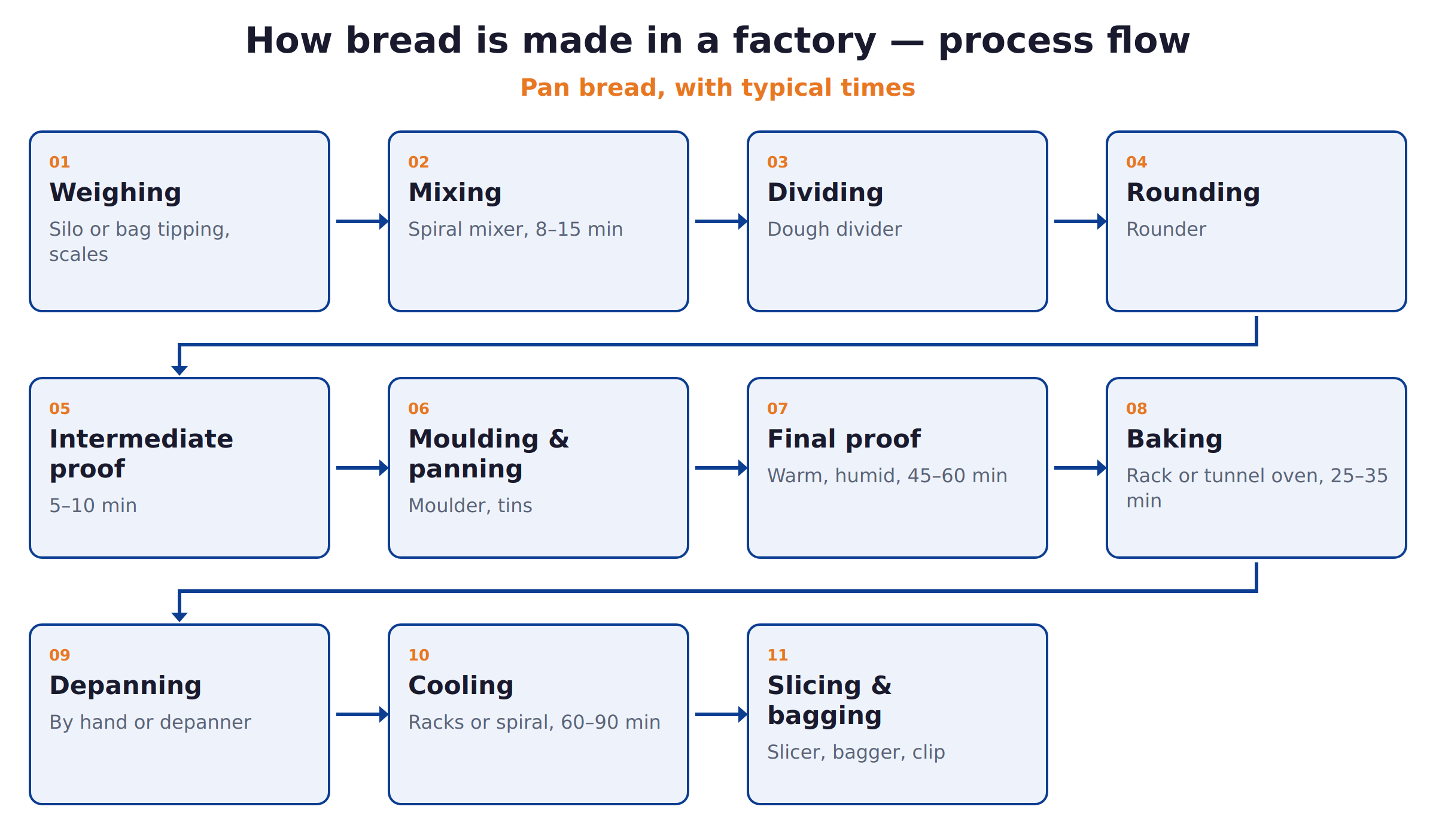
A tunnel oven bakes continuously as pans travel through heating zones on a conveyor. It belongs to a line: divider, rounder, prover, moulder, panner, final prover, oven, depanner, cooler, slicer and bagger, all at one rate. It lowers labour per loaf sharply and gives consistent product. It needs steady volume, long floor space, a large fuel or power supply and a team that can run a line. Buying a tunnel oven without the rest of the line rarely works.
When should a bakery move to a tunnel line?
Consider it when most of these are true:
- You bake one or a few products in volume every day, with steady orders from retailers or institutions.
- Labour for loading, unloading, slicing and bagging is your biggest cost per loaf.
- Your rack ovens run full shifts and you still turn orders away.
- You have, or can build, the floor length and utilities a line needs.
- You can keep the line running most of each shift; a continuous line running half the day costs more per loaf than racks.
If several are false, a second rack oven and better proving and slicing may pay back faster.
Fuel: gas, diesel or electric?
- Gas (LPG or natural gas) heats quickly and is common for rack and tunnel ovens. LPG installations follow SANS 10087 and must be installed and certified by registered gas practitioners.
- Diesel or paraffin is used where gas is not available, with burner maintenance to plan.
- Electric ovens are simple to install and clean to run, but electricity is a large running cost; Eskom's standard tariffs rose 8.76% from 1 April 2026.
Ask each supplier for fuel use per hour at full output and price it at your local rates before comparing ovens.
Choose by scenario
| Situation | Usual choice | Why |
|---|---|---|
| New retail or artisan bakery | Deck oven, possibly one rack oven | Variety and lower capital |
| Independent bakery growing pan bread sales | Rotary rack ovens with better proving and slicing | Output without a full line |
| Bakery winning a supermarket contract | Semi-automatic line around rack or small tunnel oven | Consistency and labour per loaf |
| Plant bakery for national retail | Continuous line with tunnel oven | Volume and lowest cost per loaf |
| Tender for schools or institutions | Line sized to the contract, with reserve | Steady volume and reliability |
What choosing the wrong oven costs
- A tunnel oven running half empty burns fuel to heat an oven that is barely loaded, and the line's labour savings disappear.
- Deck ovens for a volume contract need so many bakers that the margin vanishes.
- A rack oven without matching proving and cooling bakes faster than the rest of the bakery can handle, and quality drops.
- An oven bought without the slicer and bagger leaves packed-bread output capped by hand work.
Chinese, European and local ovens: the factual differences
- European ovens are typically built for long service lives, with refined controls and burner systems, at the highest price.
- Chinese ovens and lines cover the full range from deck ovens to tunnel lines at a much lower price; build quality varies by factory, so audits and acceptance tests matter.
- Locally made ovens come with nearby service and parts, and suit deck and rack sizes well.
Whatever the origin, ask for burner and control brands, insulation, and the warranty on heating elements and burners.
Five things to confirm before you decide
- Your loaves per hour today and in three years, by product.
- Your fuel: gas availability and price, or electrical capacity.
- Your floor: length and width for the oven and the line around it.
- Your labour: how many people per shift you can afford per loaf.
- Your buyers: what packing, labelling and consistency they require.
South African points that shape the choice
- Duty. Bakery ovens (8417.20) and electric resistance ovens (8514.19) are free of general duty in SARS's 2026 tariff; VAT vendors reclaim the 15% import VAT.
- Food premises. The bakery must meet R638 of 2018 and hold a Certificate of Acceptability.
- Bread marking. Under R.405 of 2017, wheat bread must show class, producer and mass, on the bag or, for unwrapped bread, on a sign at the point of sale.
- Product mix and VAT. Brown bread is zero-rated for VAT while white bread carries 15%, which can shift your mix.
- Price pressure. In July 2026 a 700 g loaf averaged R17.72 for brown and R19.61 for white bread in urban areas; your oven choice has to deliver a cost per loaf that works at those prices.
- Skills. The South African Chamber of Baking runs breadmaking certificates for bakers moving to larger ovens and lines.
Where CISH fits
CISH supplies, installs and commissions complete bread lines from audited factories in China, built around the oven type your volume calls for, with proving, cooling, slicing and bagging matched to it. If your bakery is better served by one more rack oven than by a line, we will say so. For who sells which oven in South Africa, see our bakery equipment suppliers guide; for 2026 price levels, the bakery equipment prices guide.
Frequently asked questions
Which bakery oven is best for a small bakery?
For variety and modest volumes, a deck oven. For a bakery baking mostly pan bread and rolls in racks, a rotary rack oven gives more output per baker.
When is a tunnel oven worth it?
When you bake one or a few products in volume every day with steady orders, and labour per loaf is your main cost. A tunnel oven only works as part of a continuous line.
How many loaves can a rotary oven bake per hour?
It depends on the oven size, rack capacity, loaf weight and bake time; typical rack ovens bake several hundred pan loaves an hour, and larger models more. Ask the supplier to state output for your loaf.
Is a gas or electric bakery oven cheaper to run?
It depends on local gas and electricity prices. Ask for fuel use per hour at full output and price it; Eskom's standard tariffs rose 8.76% in April 2026.
Do gas ovens need certification?
LPG installations follow SANS 10087 and must be installed and certified by registered gas practitioners.
Is there import duty on bakery ovens?
Bakery ovens (8417.20) are free of general duty in SARS's 2026 tariff. Import VAT of 15% applies.
Does CISH sell single ovens?
No. We supply complete bread lines. For a single deck or rack oven, a local dealer is usually the better choice.