A hammer mill makes whole, unsifted meal; graded meal for retail needs a roller-mill plant with degerming and sifting. CISH supplies, installs and commissions complete maize mills from intake to bagged meal.
The process at a glance
| Step | What happens | Machine |
|---|---|---|
| 1. Intake and storage | Maize received, weighed, sampled and stored | Weighbridge, intake pit, silos |
| 2. Cleaning | Stones, dust, cobs, metal and broken grain removed | Pre-cleaner, destoner, magnet, aspirator |
| 3. Conditioning | Water added and maize rested so bran and germ separate cleanly | Dampener, conditioning bins |
| 4. Degerming | Germ and bran stripped from the endosperm | Degerminator |
| 5. Milling | Endosperm reduced in several passes | Roller mills |
| 6. Sifting | Stock separated by particle size into grades and by-products | Plansifters, purifiers |
| 7. Fortification | Vitamin and mineral premix added | Micro-dosing feeder |
| 8. Packing | Meal packed in retail and bulk bags | Weighing and bagging machines |
| 9. By-products | Bran and germ collected for feed | Conveyors, bran finisher, bagging |
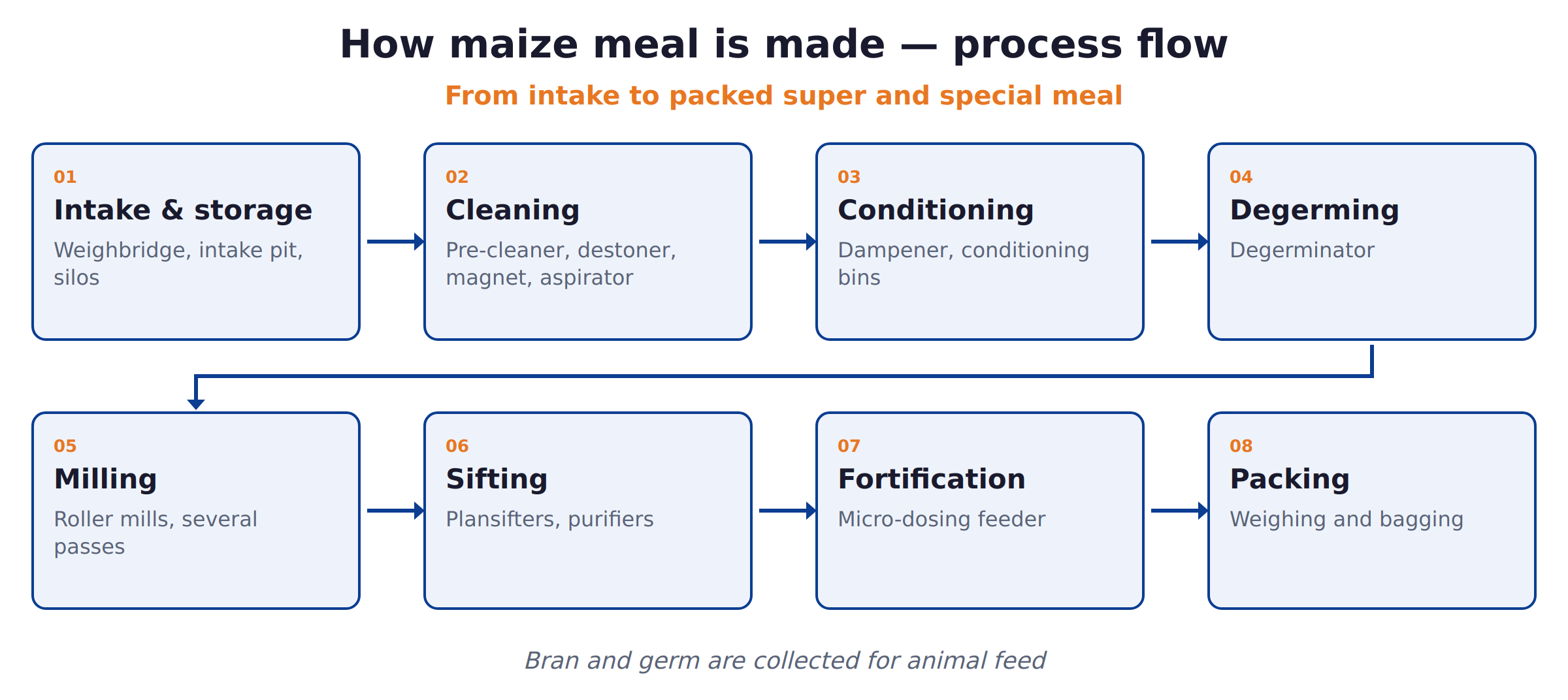
Step by step
1–2. Intake and cleaning
Maize arrives by truck, is weighed and sampled for moisture, foreign matter and grade, and stored in silos or bins. Cleaning then removes stones, dust, cob pieces, metal and broken grain. Clean maize protects the rollers and keeps the meal white.
3. Conditioning
Water is added to the maize and it rests for a set time. Conditioning toughens the bran and loosens the germ so they come off in large pieces, which raises the yield of clean endosperm.
4. Degerming
A degerminator strips the germ and bran from the kernel. The germ is rich in oil, which shortens shelf life and raises fat content; removing it is what separates super and special meal from unsifted meal.
5–6. Roller milling and sifting
The endosperm passes through a series of roller mills, each followed by sifting. Plansifters separate the stock into meal of different grades, grits and samp, and send coarse stock back for further milling. The number of passes and sieves decides how much super or special meal a mill can make from each tonne of maize.
7. Fortification
Maize meal sold in South Africa must be fortified with a prescribed premix of vitamins and minerals. A micro-dosing feeder adds the premix at a set rate as the meal flows to packing.
8–9. Packing and by-products
Meal is weighed and packed, typically in retail bags from about 1 kg to 10 kg and in larger bags for wholesale. Bran and germ are collected and sold to feed mills, which adds income.
Maize meal grades in South Africa
The maize products regulations (GN R.63 of 2016) define each grade by fat and fibre content and fineness:
| Grade | Fat content (% by mass) | Fibre content (% by mass) | What it means for the mill |
|---|---|---|---|
| Super maize meal | Below 2.0 | Up to 0.8 | Most germ and bran removed; degerming and fine sifting |
| Special maize meal | 2.0 to below 3.0 | Up to 1.2 | Less refined; higher yield |
| Sifted maize meal | 3.0 to below 4.0 | Up to 1.2 | Some bran removed by sifting |
| Unsifted maize meal | 3.5 to below 4.5 | Above 1.2, up to 2.5 | Whole meal; a hammer mill can make it |
For super maize meal, at least 90% must pass through a 1.4 mm sieve and less than 90% through a 0.3 mm sieve. Super fine, super, special, sifted and unsifted meal must all be fortified.
Hammer mill or roller mill?
| Hammer mill | Roller-mill plant | |
|---|---|---|
| Product | Unsifted (whole) meal | Super, special and sifted meal, plus samp, grits and bran |
| Degerming | Usually none | Yes |
| Shelf life | Shorter, because the germ oil stays in | Longer |
| Capital | Low | High |
| Fits | Service milling and local unsifted meal | Brands selling to retailers |
From process to mill
| Mill size | Typical set-up | Indicative price (2026) |
|---|---|---|
| About 30 t/day | 1 to 1.5 shifts, about 150–250 m², 3–6 people | About US$250,000–400,000 with packing |
| About 60 t/day | 2 to 3 shifts, about 400–600 m², 8–14 people | About US$700,000–1.1 million |
| 240 t/day | Large industrial plant | Quoted per configuration |
These figures come from our maize mill sizing guide.
Extraction: how much meal from a tonne of maize
Extraction rate is the share of the maize that leaves the mill as saleable meal of a given grade. It decides a mill's profit more than its tonnes per day, because maize is by far the largest cost.
- The more refined the grade, the lower the extraction. Super maize meal removes more germ and bran than special or sifted meal, so each tonne of maize gives less super meal and more by-product.
- Product mix matters. Many mills make super and special meal side by side, plus samp, grits and bran, and adjust the split to what buyers order.
- Maize quality matters. Broken, damp or dirty maize lowers extraction and darkens the meal.
When you compare mills, ask each supplier to state guaranteed extraction for each grade, measured on your maize during commissioning, rather than tonnes per day alone.
Worked example: a 30 tonne a day mill
An illustration only:
| Item | Assumption |
|---|---|
| Maize milled | About 30 t a day, white maize |
| Products | Super and special meal in 5 kg and 10 kg bags, plus bran |
| Shifts | 1 to 1.5 a day |
| Space | About 150–250 m² for the mill, plus maize and meal stores |
| People | About 3–6 per shift |
| Price | About US$250,000–400,000 with packing |
Food safety and rules
- Grades and labels. Meal must be graded, packed and marked under GN R.63 of 2016.
- Fortification. Maize meal must be fortified under the fortification regulations (R504 of 2003, amended in 2005); keep premix dosing records.
- Food premises. The mill must meet R638 of 2018 and hold a Certificate of Acceptability.
- VAT. Maize meal is zero-rated for VAT, which affects your pricing but not your right to claim input VAT.
- Industry body. The National Chamber of Milling represents millers and is a source of industry information.
From a delivered project: On a delivered 60 t/day super-fine maize mill more than six hours from the nearest engineering hub, the mill itself was the easy part: extra pre-cleaning for maize at 11–16% moisture, an on-site critical-spares buffer and a year of support took the plant to about 85% of nameplate by month four. Read the maize mill case study.
Common mistakes
- Skipping conditioning. Bran and germ break up and the meal darkens.
- Selling hammer-milled meal as super. It cannot meet the fat and fibre limits.
- Poor cleaning. Rollers wear and meal quality drops.
- No premix records. Fortification cannot be proven.
- Ignoring by-products. Bran and germ are income.
Where CISH fits
CISH supplies, installs and commissions complete maize mills from audited factories in China: intake, cleaning, conditioning, degerming, roller milling, sifting, fortification and packing, with the mill commissioned on your maize, extraction for your grades demonstrated, and your operators trained.
Frequently asked questions
How is maize meal made?
Maize is cleaned, conditioned with water, degermed to remove germ and bran, ground on roller mills in several passes, sifted into grades, fortified with a vitamin and mineral premix, and packed.
What is the difference between super and special maize meal?
Super maize meal has less fat (below 2.0%) and fibre (up to 0.8%) because more germ and bran are removed. Special meal has 2.0 to below 3.0% fat and up to 1.2% fibre.
Can a hammer mill make super maize meal?
No. A hammer mill makes whole, unsifted meal. Super and special meal need degerming and roller milling with sifting.
Does maize meal have to be fortified?
Yes. Super fine, super, special, sifted and unsifted maize meal must be fortified under the fortification regulations.
What happens to the bran and germ?
They are collected and usually sold to feed mills as by-products, adding income to the mill.
How much does a maize mill cost?
A complete 30 tonne a day mill with packing costs about US$250,000–400,000 in 2026, and a 60 tonne a day mill about US$700,000–1.1 million.
What is a good extraction rate for maize meal?
It depends on the grade and the maize. Super meal gives lower extraction than special or sifted meal. Ask each supplier to guarantee extraction for each grade on your maize.