Paraffin wax is the main raw material for household candles and enters duty-free under 2712.20, while imported candles under 3406 carry a 20% general duty, free from the EU, UK, EFTA and SADC. Household candle demand rose during load shedding and falls when the grid is stable, so plan sales that do not depend on power cuts. Packs must show net weight or count, and hot wax is a burn and fire risk. CISH supplies, installs and commissions complete candle lines.
Step 1: choose your product
| Household white candles | Scented and decorative candles | |
|---|---|---|
| Wax | Paraffin | Paraffin, soy, other vegetable waxes, blends |
| Process | Extrusion or automatic moulding | Pouring into jars, tins or moulds |
| Volume | High | Low to medium |
| Price per candle | Low | High |
| Buyers | Spaza shops, wholesalers, supermarkets, churches, households | Gift shops, décor stores, hotels, spas, online, corporate gifts |
| Main risk | Wax price, competition from imports | Fragrance cost, design, marketing |
Step 2: wax and materials
Paraffin wax is bought from local refiners or importers. Under Schedule 1, paraffin wax with less than 0.75% oil (2712.20) is duty-free when imported. Scented candles often use soy or blended waxes, fragrance oils, dyes, wicks with sustainers, and jars or tins. Buy fragrances made for candles and follow the supplier's maximum load. Keep wax stock for several weeks, because prices follow oil markets.
Step 3: equipment
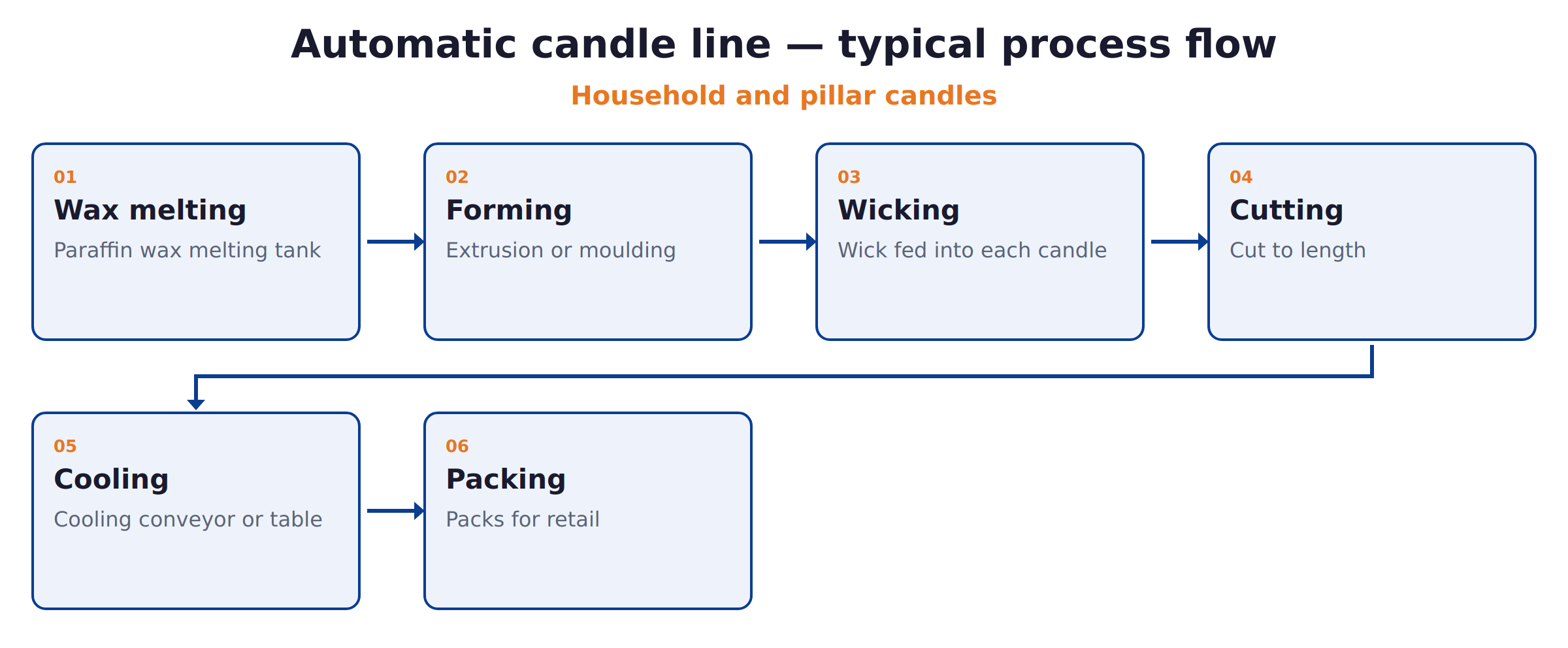
| Purchase | Use | Indicative price (2026) |
|---|---|---|
| Melting tanks and hand moulds | Small batches and scented candles | Small |
| Single tea light or mould machine | One candle type | Small |
| Automatic candle line | Extrusion or moulding of household candles, thousands an hour | About US$10,000–70,000 ex-works |
| Jar filling line | Dosing wax into jars with wicks, cooling, lids, labels | Quoted per configuration |
| Packing | Flow wrap, shrink packs, cartons | Priced per configuration |
Our candle making machine price guide shows the machine options. Candle machinery under 8479.89.90 enters duty-free.
Step 4: safety and premises
Hot wax causes serious burns, and wax vapours and spills are a fire risk. Use thermostatically controlled melting tanks, keep fire extinguishers and fire blankets close, train staff, and store fragrances and wax safely, in line with your duties under the OHS Act. The building needs good ventilation, three-phase power for melting and lines, a cool area for curing and storage, and space for cartons.
Step 5: labels and packaging
Prepackaged candles must show net quantity under the Legal Metrology markings rules (SANS 289), as weight or count. Add burning instructions and safety warnings: never leave a burning candle unattended, keep away from children and flammable materials, trim the wick. For scented candles, list fragrance allergens if your fragrance supplier advises it. Packaging may carry EPR obligations under the EPR regulations; check whether you or your retailer carries them.
Step 6: the numbers
For household candles, the cost per candle is mostly wax, then wick, packaging, power, labour and delivery. A small difference in candle weight across thousands of candles changes the margin, so check weights. For scented candles, the jar, fragrance and packaging often cost more than the wax; price on design and brand.
Step 7: sell
Household candles sell through spaza shops, wholesalers, supermarkets and churches, and in bulk to institutions. Plan for steady demand from religious and cultural use, households without reliable power and emergency stock, and less from load shedding when the grid is stable. Scented candles sell through gift and décor shops, markets, online stores, hotels and spas, and corporate gift orders, with peaks before Mother's Day and the festive season.
Worked example: two product lines
A small business in Gqeberha makes scented soy candles by hand for gift shops. A wholesaler asks it to supply white household candles in six-packs. It installs an automatic moulding line for household candles, buys paraffin wax in bulk, and keeps the scented range on hand-pouring with a semi-automatic jar filler. The household line runs every day for wholesalers and spaza shops; the scented range runs in batches for gift orders. The figures are illustrative.
Common mistakes
- Relying on load shedding demand.
- Uncontrolled melting: overheated wax and fire risk.
- Too much fragrance: sweating candles and poor burning.
- Underweight candles in packs.
- No safety warnings on labels.
Product range ideas
Household candle makers usually offer white candles in two or three sizes and pack counts, plus tea lights and emergency candles. Scented candle makers build ranges by fragrance families and seasons: fresh scents in summer, warm and spicy scents for winter and the festive season. Church and ceremonial candles, birthday candles and outdoor citronella candles are further niches. Choose a small range you can make well before adding more.
Testing your candles
Burn-test every new wax, wick and fragrance combination: check that the flame is steady, the melt pool reaches the edge without tunnelling, the candle does not smoke, and the jar does not get too hot. Record wick sizes, wax blend, fragrance load and pouring temperature for each product, and test again when you change any supplier. Keep a sample from each batch.
Seasonality and stock
Scented candle sales peak before Mother's Day, Valentine's Day and the festive season, so build stock in the months before. Household candle demand is steadier but rises with power interruptions and winter. Plan wax buying and production to match, and keep finished stock in a cool, dry store away from sunlight so candles do not bend or fade.
Staff and space
A small scented candle business can run with a few people pouring, finishing and packing; an automatic household candle line needs one or two operators plus packers per shift. Keep pouring and packing areas separate from wax storage, and plan cooling space, because candles need time to set before packing.
Wholesale and retail pricing
Decide early whether you will sell mainly to wholesalers, to shops or directly to customers, because each takes a different margin. Wholesalers and spaza shops need a low price per pack and steady supply; gift shops need a margin of their own and attractive displays; direct sales earn the most per candle but cost time and marketing.
Insurance and fire
Wax and finished candles are flammable stock. Insure stock and equipment, keep fire extinguishers and blankets near melting areas, store wax away from heat sources, and check that your premises meets municipal fire requirements before you start production.
Where CISH fits
We supply complete candle lines, melting, extrusion or moulding, cooling, jar filling and packing, from audited factories in China, sized to your candles and output. CISH ships, clears, installs and commissions the line on your wax, and trains your team. For a single tea light machine or hand moulds, a local supplier is usually the better buy.
Frequently asked questions
How much does it cost to start a candle making business?
Scented candles can start by hand at low cost. An automatic household candle line costs about US$10,000–70,000 ex-works as an indication for 2026.
What wax is used for household candles?
Paraffin wax, which is duty-free when imported under 2712.20.
Is candle making profitable in South Africa?
Household candles are a low-margin volume business; scented candles earn more per candle but need design and marketing.
Is there import duty on candles?
Candles under 3406 carry a 20% general duty, free from the EU, UK, EFTA and SADC.
What labels do candles need?
Net quantity as weight or count, your details, burning instructions and safety warnings.
Does CISH supply candle lines?
Yes, complete candle lines with commissioning and training.