Choose the line by the candles your buyers want (household candles for retail, tealights, pillars or scented jar candles), and check wax melting capacity, wick feeding and packing before speed.
Candle equipment prices, 2026
| What you buy | Typical output | Indicative price (2026) | Note |
|---|---|---|---|
| Single tealight, taper or moulding machine | Hundreds of pieces an hour | Low; a few thousand dollars or less | Manual or semi-automatic |
| Automatic candle line (extrusion or moulding) | Thousands of candles an hour | About US$10,000–70,000 ex-works China | Low end: rod and pillar moulding lines; high end: fully automatic lines. Check whether wicking, cutting and packing are included |
| Scented jar candle filling line | Depends on jar and wax | Quoted per configuration | Wax melting, fragrance dosing, filling, curing, lidding |
How we got this range. These are public marketplace listing prices, not quotes, checked on 12 November 2026: two rod or pillar lines at about US$10,400–12,000, one extruder set at about US$30,000, and three fully automatic lines at about US$65,000–68,500. Configurations differ between listings, so use the range to place a line in its tier, and compare quotes only on the same candle size, output, wicking, cutting and packing scope. Prices are before freight, duty, VAT and installation.
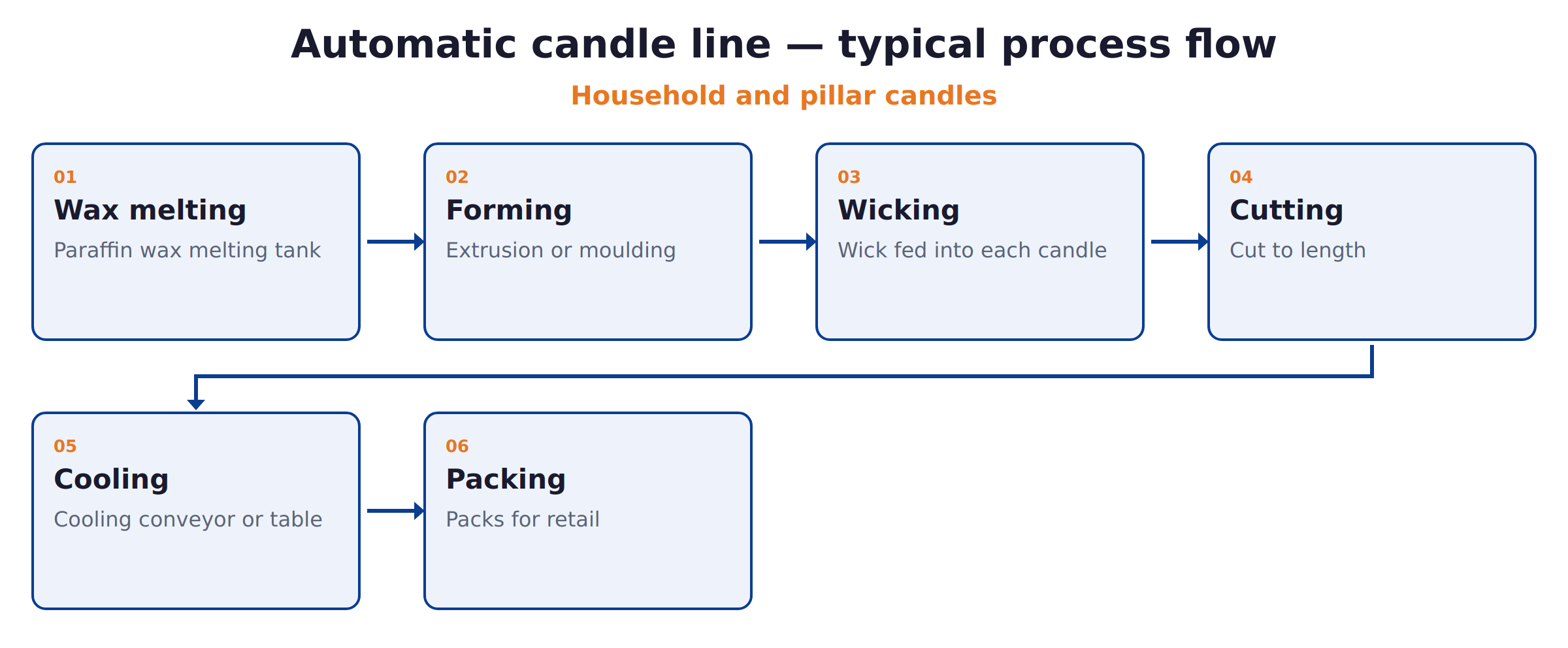
What a candle line contains
- Wax melting and conditioning: tanks sized to output, with temperature control.
- Additive and colour dosing, and fragrance for scented candles.
- Forming: extrusion (household candles and rods), compression (tealights and pillars) or moulding and filling (jars and shaped candles).
- Wicking: wick feeding, centring and tabbing.
- Cutting and finishing: length cutting, tip forming, polishing.
- Cooling and curing.
- Packing: wrapping, boxing, labelling.
Wax melting capacity and wick handling cause more lost output than the forming machine does.
Who sells candle equipment, and why prices differ
Craft and hobby suppliers sell pots, moulds and wick for small makers. Local engineering firms make melting tanks and simple moulding tables. Chinese factories sell tealight presses, extrusion lines and automatic moulding lines. Turnkey companies supply the line with melting, packing and installation. Prices differ on the forming method, automation of wicking and packing, and output.
The machine versus the business that sells candles
A candle machine makes candles. A candle business that sells to supermarkets and hardware stores also needs a consistent wax supply, candles that burn evenly without smoking, packs with correct net content, and a price that beats imports. The forming machine is one part; wax, wick selection, quality checks and packing decide whether buyers come back.
What moves the price
- Candle type: household and emergency candles, tealights, pillars, tapers or jar candles.
- Output in candles per hour.
- Automation of wick feeding, cutting and packing.
- Wax handling: melting tank size and heating.
- Moulds or dies for each candle size.
Where the money goes
On a small automatic line, the machine is often the largest single item, but melting tanks, cooling, packing, the building, electrical supply for heating, freight, installation and training are a large share. Electricity for melting wax is a recurring cost; Eskom's standard tariffs rose 8.76% from April 2026.
Choose by scenario
| Situation | Usual choice |
|---|---|
| Small maker starting out | Semi-automatic moulding or tealight machine, manual packing |
| Supplier of household candles to retailers | Automatic extrusion line with cutting and packing |
| Gift and scented candle brand | Jar filling line with fragrance dosing and curing |
| Existing maker adding volume (expansion) | Automatic line beside existing moulds, sized to peak orders |
How to compare candle line quotes
Ask each supplier for: output per hour by candle size, forming method, wax melting capacity, wick feeding and centring, cutting accuracy, cooling, packing, power and heating needs, moulds or dies included, installation and commissioning with your wax, and warranty. Add what is missing before comparing.
For who sells candle machines, see candle making machine suppliers in South Africa.
For products, wax and channels, see how to start a candle making business.
Ten questions to ask a candle line supplier
- Which candle types and sizes will the line make?
- What output per hour will you guarantee for each?
- How much wax can the melting system handle per hour?
- How is the wick fed and centred?
- Can the line run paraffin, soy or blended wax?
- What packing is included?
- How long does a size change take?
- What power does the line need for heating and drives?
- Who installs and commissions the line, with my wax?
- Which maker runs your line, and may I see it?
Wax, wick and margin
Wax is most of the cost of a candle, so the margin is decided at purchase. Paraffin wax is sold by grade and oil content; lower oil content gives harder candles that burn cleanly, and the tariff treats wax with less than 0.75% oil as duty-free. Soy and blended waxes suit scented and container candles but need different temperatures and curing. Wicks must match the candle diameter and wax: too small and the candle tunnels, too large and it smokes. Agree wax and wick specifications with your suppliers in writing, and test burn every new batch.
Common mistakes
- Buying speed before wax supply. A fast line idle for lack of wax earns nothing.
- Undersized melting tanks. Forming waits for melted wax.
- No burn testing. Candles that smoke or drip lose retail buyers quickly.
- Hand packing at line speed. Packing becomes the bottleneck.
- Ignoring heat and fire safety. Hot wax areas need ventilation, guarding and fire equipment.
South African rules and costs that shape a candle business
- Duty protects local candles. Candles and tapers (3406.00) carry 20% general duty in SARS's 2026 tariff, but enter free from the EU and UK, EFTA and SADC.
- Duty-free wax and machinery. Paraffin wax with less than 0.75% oil (2712.20) and the machinery under 8479.89.90 are free of general duty; import VAT of 15% applies on the customs value plus 10% plus duty, and VAT vendors reclaim it. See the import duty guide.
- Net content. Packed candles declare their contents under the Legal Metrology Act, with markings to SANS 289.
- Packaging. Packaging you place on the market falls under the extended producer responsibility regulations (GN 1184 of 2020).
- Worker safety. Hot wax and heated tanks are burn and fire risks under the Occupational Health and Safety Act; plan guarding, ventilation and fire protection.
The landed cost chain, line by line
How a China-built candle line reaches a factory in Gauteng. Tariff rates are taken from SARS Schedule 1 Part 1 as amended to 12 November 2026; port, road and installation figures are estimates for one container.
| Cost item | Basis | Typical amount |
|---|---|---|
| Candle line, ex-works China | Per configuration | About US$10,000–70,000 |
| Sea freight, China to Durban | 2026 market rates | 20ft about US$2,100–3,300; 40ft about US$2,500–3,800 |
| Customs duty on the machine | SARS Schedule 1, heading 8479.89.90 | Free |
| Import VAT | 15% on the customs value plus a 10% uplift plus duty | Claimed back by VAT vendors; a cash-flow cost |
| Port charges and clearing agent | Per container | About R8,000–15,000 (CISH estimate) |
| Road freight, Durban to Gauteng | About 570 km plus tolls | About R15,000–30,000 a container (CISH estimate; get a haulier quote) |
| NRCS and SABS | Machinery for industrial use is outside the VC 8055 Letter of Authority; loose motors may fall under VC 9113 | No certification cost for the machine itself in most cases |
| Installation, commissioning and training | Per configuration | Typically 8–15% of the project |
The duty on what you will sell
| Product | SARS heading | General rate | EU and UK, EFTA, SADC | AfCFTA |
|---|---|---|---|---|
| Candles and tapers | 3406.00 | 20% | Free | 20% |
| Paraffin wax, less than 0.75% oil (your raw material) | 2712.20 | Free | Free | Free |
The 20% general duty on candles is the margin a local maker works with against imports from outside the EU, UK, EFTA and SADC; wax and machinery come in duty-free.
Configurations and lead times
Automatic candle lines are built to order and shipped by sea, about 22–30 days to Durban. Plan electrical supply for melting tanks and a cool, ventilated area for curing and storage. Commission with your own wax and wicks before acceptance, since wax blends behave differently.
Where CISH fits
CISH supplies, installs and commissions complete candle lines from audited factories in China, with wax melting, forming, wicking, cutting and packing matched to your candles and commissioning with your wax. We suit makers moving to automatic production for retail. For moulds and craft equipment, a craft supplier is the better choice.
Frequently asked questions
How much does a candle making machine cost?
Automatic candle lines are listed at about US$10,000–70,000 ex-works China in 2026: about US$10,000–12,000 for a rod or pillar moulding line and about US$65,000–70,000 for a fully automatic line. Single tealight or moulding machines cost much less.
What equipment do I need to start a candle factory?
Wax melting tanks, a forming machine (extrusion, compression or moulding), wick feeding, cutting and finishing, cooling space and packing, plus a safe, ventilated building.
Is there import duty on candles?
Yes. Candles (3406.00) carry 20% general duty in SARS's 2026 tariff, free from the EU and UK, EFTA and SADC.
Is there import duty on paraffin wax?
Paraffin wax with less than 0.75% oil (2712.20) is free of general duty.
Which candle line is best for supermarket candles?
Household candles for supermarkets are usually made on extrusion lines with automatic cutting and packing; tealights on compression presses.
Can one line make tealights and household candles?
Usually not efficiently. Tealights are made on compression presses with cups and wick tabs, while household candles are extruded or moulded. Plan separate forming for each, sharing wax melting and packing where possible.
Does CISH sell single candle moulds?
No. We supply complete candle lines. For moulds and craft equipment, a craft supplier is the right choice.