Security, farm and boundary fencing are steady markets in South Africa, from homeowners and estates to farms, schools, factories, mines and municipal tenders. Wire is your largest running cost. Supply changed after South Africa's main long-steel producer placed its long products business in care and maintenance at the end of 2025; wire rod now comes from local scrap-based mini-mills and imports, so get rod or drawn-wire quotes before you size the plant. Products should meet the standards buyers use, such as SANS 675 for zinc-coated fencing wire and SANS 1580 for gabions. CISH supplies, installs and commissions wire and mesh plants.
Step 1: choose your product mix
| Product | Machine | Buyers |
|---|---|---|
| Diamond mesh (chain-link) | Diamond-mesh weaver | Homeowners, farms, schools, sports fields |
| Razor wire (concertina, flat wrap) | Razor blade press and coiling machine | Security for homes, businesses, prisons, substations |
| Barbed wire | Barbed wire machine | Farms, boundaries |
| Welded mesh panels (3–6 mm) | Panel welding machine | Security fencing for estates, factories, schools |
| Gabions and revet mattresses | Hexagonal mesh machine | Civils contractors, road and river works |
| Brick force | Brick force welder | Builders |
Start with two or three products that sell together in your area, such as diamond mesh, razor wire and line wire for security and farm fences.
Step 2: wire supply
Wire is most of the cost of every product. You can buy galvanised wire ready for your machines, or buy wire rod and draw it to the sizes you need, then galvanise it through a licensed galvaniser. South Africa's main integrated long-steel producer announced in January 2025 that it would wind down its long products business; it reported in February 2026 that the business had been placed in care and maintenance by the end of 2025. Rod now comes from local scrap-based mini-mills and imports. Get at least two written quotes for rod or drawn wire, ask about lead times and payment terms, and model your business at more than one wire price.
Step 3: galvanising
Fencing wire must resist rust, so most products use galvanised or zinc-aluminium coated wire, sometimes with PVC coating. Most new yards buy galvanised wire or send drawn wire to a galvaniser. Galvanising in-house is a large step: a continuous wire galvanising line is a major investment, and hot dip galvanizing is a listed activity under GN 893 of 2013 (Subcategory 4.22), needing an Atmospheric Emission Licence for every installation, plus handling of acids and zinc waste.
Step 4: machines and costs
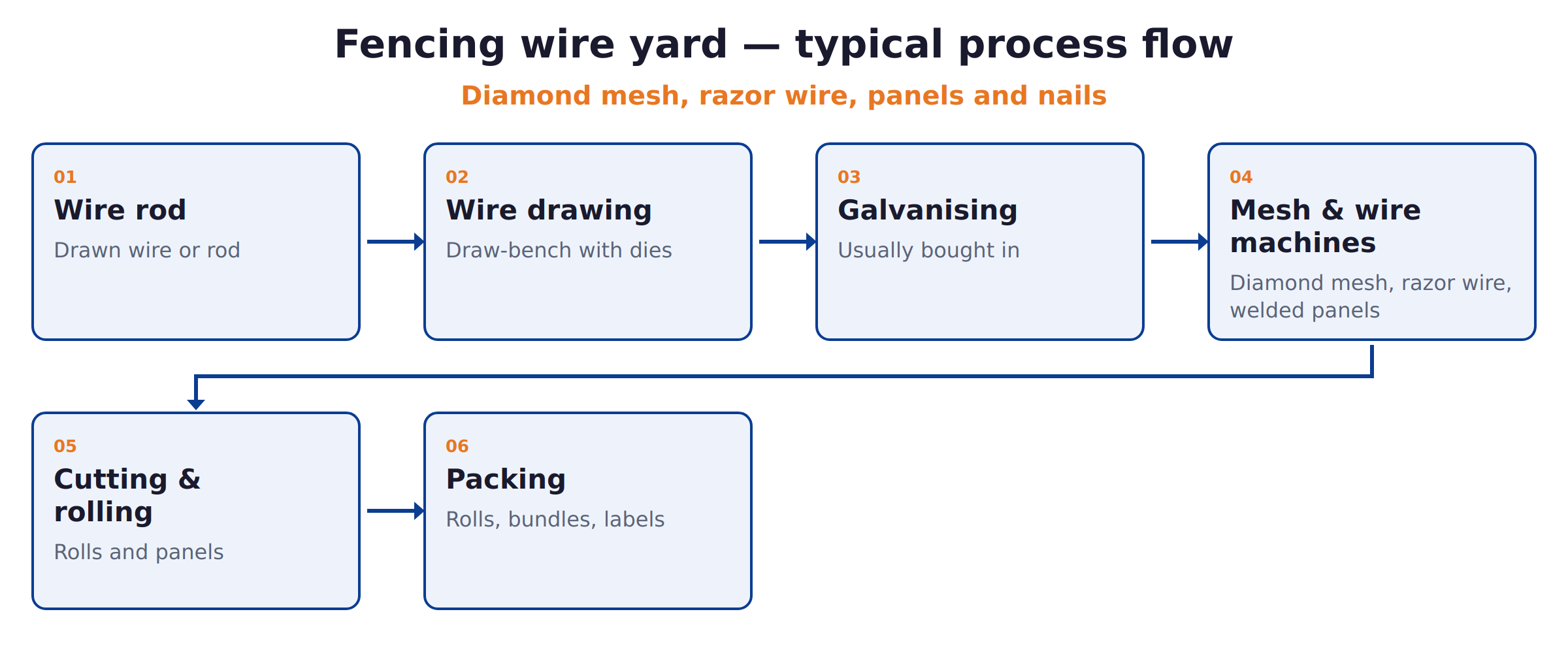
| What you buy | Indicative price (2026) |
|---|---|
| Single light machine (diamond mesh, brick force, one nail range) | About US$2,000–15,000 each |
| Single heavy machine (razor wire, 3–6 mm panels, gabion mesh) | About US$10,000–70,000 each |
| Wire-products yard with drawing and several machines, landed | About US$150,000–350,000 |
| Yard with in-house wire galvanising | Quoted per configuration |
Machines for working wire (8463.30), wire draw-benches (8463.10) and automatic resistance welders (8515.21 and 8515.31) carry no general import duty in the SARS tariff, though import VAT applies. Our wire and fencing machine price guide shows what each tier covers.
Step 5: standards and quality
- SANS 675:2011 for zinc-coated fencing wire: wire diameter, tensile strength and zinc coating mass.
- SANS 1580:2010 for hexagonal wire mesh gabions and revet mattresses, usually called for in civils tenders.
- SANS 121:2024 for hot dip galvanized coatings on fabricated items such as posts and gates.
Test wire as it arrives, check mesh sizes and coatings, and keep certificates. Contractors and tender buyers will ask for them.
Step 6: selling and installing
Fencing sells through hardware stores and builders' merchants, farm co-operatives, security companies and fencing contractors, and directly to estates, schools, factories and farms. Many fencing businesses also install fences, which adds margin and keeps the plant busy. Government and municipal tenders for fencing and gabions are large; register on the Central Supplier Database and read each tender for specification, standards and any local content requirements. Our Central Supplier Database guide explains the registration.
The numbers
Margin per tonne or per roll is the selling price less wire cost, power, labour, packaging, delivery and finance. Because wire dominates cost, buying well matters most. Products with more value added, such as razor wire and welded panels, usually earn more per tonne than simple mesh. Installation earns per metre and keeps customers loyal.
Worked example: a security fencing plant in Gauteng
A fencing contractor in Pretoria buys diamond mesh and razor wire from merchants for its installation jobs. It sets up a yard with a diamond-mesh weaver, a razor wire line and a panel welding machine, buys galvanised wire from a mini-mill and an importer, and sells its products to other contractors as well as using them on its own jobs. With certificates for its wire to SANS 675, it begins tendering for school and municipal fencing. The figures are illustrative.
Power, space and safety
Wire machines need three-phase power, a dry store for wire coils, space for finished rolls and panels, and crane or forklift handling. Razor blade presses and welding machines must be guarded; staff need gloves, eye protection and training. Keep the yard tidy, because wire offcuts and coils cause injuries.
Working capital
Wire is paid for long before customers pay, and tender payments can be slow. Plan for several months of wire stock and debtors, and set credit limits.
Common mistakes
- No wire supply plan after the long-steel closure.
- In-house galvanising without an emission licence.
- Too many products at the start.
- Wire without certificates for tender buyers.
- Underestimating working capital.
Posts, gates and accessories
Customers buying a fence also need posts (Y-standards, round or square tubes), gates, straining equipment, droppers, binding wire and clips. Stocking these, or making some of them, turns a mesh sale into a complete fence order and raises the value of each sale. Contractors also value a supplier who can deliver every item for a job on one truck, on the day the installation team needs it, so plan stock and delivery around complete fence orders.
Where CISH fits
We supply wire and mesh plants, rod drawing, diamond mesh, razor and barbed wire, welded panels, gabion mesh and brick force, from audited factories in China, sized to your product mix and wire supply. CISH ships, clears, installs and commissions the machines on your wire, and trains your team. South Africa also has local wire machine builders; for a single machine close by, they are a serious option.
Frequently asked questions
How do I start a fencing business?
Choose a product mix your area buys, secure wire supply, set up a yard with the right machines, and sell to merchants, contractors and direct customers, or install fences yourself.
How much does a fencing machine cost?
As an indication for 2026, a diamond-mesh weaver costs about US$2,000–15,000, and heavy machines for razor wire or welded panels about US$10,000–70,000 each.
Where do I buy wire after the long-steel closure?
From local scrap-based mini-mills and importers; get at least two quotes.
Which standard applies to fencing wire?
SANS 675:2011 for zinc-coated fencing wire, and SANS 1580:2010 for gabions.
Should I galvanise my own wire?
Usually not at the start; hot dip galvanizing needs an Atmospheric Emission Licence and a large investment.
Does CISH supply fencing plants?
Yes, complete wire and mesh plants with commissioning and training.