Choose the supplier who will commit to kilograms of nails per shift on your wire, include wire drawing and polishing, and support dies and punches locally.
Who sells nail making machines
Hardware suppliers, steel merchants and entrepreneurs looking for a nail manufacturing business all search for nail making machines. The offers come from four kinds of company.
| Supplier type | What they sell | Price | Who answers for output | Best fit |
|---|---|---|---|---|
| Local wire-machinery builder | Nail, mesh welding, barbed wire, wire drawing and straightening machines built locally | Higher per machine than imports | The builder, with local service | Businesses that value nearby service and parts |
| Dealer of imported machines | Imported nail and mesh machines from stock or order | Moderate | The dealer, machine by machine | Small workshops starting with one or two machines |
| Chinese factory, direct | Nail machines by size class, wire drawing, polishing drums, mesh and razor wire machines | Lowest on the quote | You, after delivery | Buyers who can install and set machines themselves |
| Turnkey yard company | Wire drawing, nail making, polishing, packing and mesh lines, laid out and commissioned | Between local and direct | The turnkey company, at agreed output | Merchants building a wire-products yard |
The nail machine is the easy part
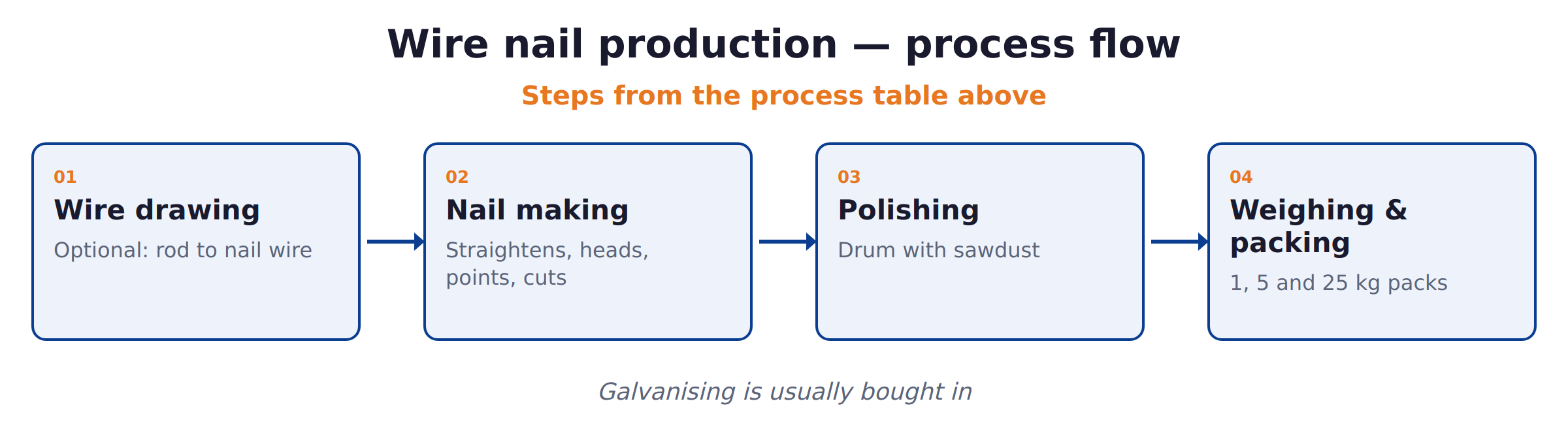
A nail machine cuts and heads wire. A nail business also needs wire of the right diameter, which usually means a wire drawing machine to draw down from rod, a polishing drum to clean and finish nails, and weighing and packing. Many buyers find that wire supply, not the nail machine, decides output and margin.
Ask any supplier three things:
- Which nail sizes each machine makes, and how many machines you need to cover your range.
- What wire it needs, and whether the quote includes drawing equipment to make that wire from rod.
- Output per shift in kilograms at each size, not nails per minute.
As a guide, a common machine class makes about 500–1,500 kg of nails per eight-hour shift, depending on the size.
What to check in the supplier
Dies, punches and tooling
Nail machines wear dies and punches constantly. Ask what tooling is supplied, how long it lasts, and whether you can get replacements quickly. Without tooling the machine stops.
Wire drawing and power
A wire drawing line and mesh welders draw far more power than nail machines. Heavier mesh welding machines need well over 100 kVA. Check your site's supply before choosing the yard layout.
Galvanising is a separate decision
Galvanised nails, fencing wire and mesh need zinc coating. Hot-dip galvanising in-house is a listed activity under the Air Quality Act for all installations, which means an atmospheric emission licence, so most small yards buy galvanised wire or send product out for coating.
Where to find nail machine suppliers
- The South African Iron and Steel Institute represents steel producers and is a starting point for wire rod and wire supply.
- Hardware and building materials trade shows in Johannesburg and Cape Town feature wire products and machinery; check current dates with organisers.
- Existing wire yards: visit one running the machine classes you are considering.
- China: most nail and mesh machines sold in Africa are made in China. Use our supplier audit checklist before paying a deposit.
We do not name or rate suppliers on this page.
How to choose: a 10-point checklist
- Size range covered, with the number of machines needed.
- Output per shift in kilograms for each size, demonstrated at handover.
- Wire supply: rod drawing included or a reliable wire source arranged.
- Tooling: dies, punches and cutters supplied, with replacement lead times.
- Polishing and packing: drums, weighing and packing included.
- Power and foundations: electrical load for drawing and welding; foundations for heavy machines.
- Galvanising plan: buy coated wire, outsource coating, or licence a line.
- Safety: guarding and noise control for driven machinery under the OHS Act.
- Installation, setting and training in the price.
- Support: who resets machines and supplies tooling after year one.
Moving into fencing? See how to start a fencing business with a wire and mesh plant.
Ten questions to ask
- Which nail sizes does each machine make?
- How many kilograms per shift will each machine produce at each size?
- What wire diameter and grade does it need, and is drawing equipment included?
- What dies and punches are supplied, and how long do they last?
- What power does the whole yard need?
- Is polishing and packing included?
- Is installation, setting and training included?
- What does the warranty cover?
- How quickly can I get tooling and spare parts?
- Which yard in South Africa runs these machines, and may I visit?
Comparing wire yard quotes
| Section | What each quote should state |
|---|---|
| Wire drawing | Rod pay-off, drawing passes, finished diameters, capacity |
| Nail making | Number of machines, size range, kg per shift each |
| Polishing and packing | Drums, sieving, weighing, packing |
| Mesh, brick force, razor wire | Machines, widths and gauges, output |
| Tooling | Dies, punches, cutters supplied, and their price |
| Power and foundations | Electrical load, foundations, compressed air |
| Freight, installation, setting | Incoterm, clearance, engineer days |
| Training and documents | Days, manuals |
| Owner's scope | Building, power connection, galvanising route |
Add what each quote leaves out before comparing. Our same-scope comparison shows how.
Common mistakes
- One machine for every nail. Each machine covers a size band; a range needs several.
- No wire plan. Buying drawn wire at retail price kills the margin.
- Forgetting tooling. A machine without spare dies stops within weeks.
- Underestimating power. Wire drawing and mesh welding loads can exceed the site supply.
- Planning a galvanising bath without the licence. Hot-dip galvanising needs an emission licence whatever the size.
Nail and wire machine prices in 2026
Indicative, in USD, from our nail and fencing machine price guide:
| Purchase | Capacity | Indicative price (2026) |
|---|---|---|
| Single light machine | One nail size range, one mesh or one brick force width | US$2,000–15,000 per machine |
| Single heavy machine | Razor wire, 3–6 mm fence panels, gabion mesh | US$10,000–70,000 per machine |
| Starter nail workshop | 2–4 machines, about 0.5–1.5 t of nails per shift each | US$15,000–50,000 |
| Wire-products yard | Rod drawing plus nails, mesh, brick force and razor wire | US$150,000–350,000 |
| Yard with in-house galvanising | Continuous hot-dip wire line added | Quoted per configuration |
South African facts that shape the decision
- Imports to replace. The Steel and Metal Fabrication Master Plan recorded 2019 imports of nails, tacks and staples (HS 7317) of about 10,032 tonnes, worth about R141.6 million, and put the wire industry at about 26% of the steel industry by volume.
- Product standards. Zinc-coated fencing wire is made to SANS 675 and gabions and revet mattresses to SANS 1580, which matter for tenders.
- Galvanising licence. Under GN 893 of 2013, hot-dip galvanising is a listed activity for all installations, requiring an atmospheric emission licence.
- Machine safety. Wire drawing and nail machines are driven machinery under the Occupational Health and Safety Act and its regulations, including guarding, noise and operator training.
- Import duty. Machines for working wire (8463.30), wire draw-benches (8463.10) and automatic resistance and arc welding machines (8515.21, 8515.31) are free of general duty in SARS's 2026 tariff. Import VAT of 15% applies and is claimable by VAT vendors; see our import duty guide.
Where CISH fits
CISH is a turnkey yard company. We specify wire drawing, nail, mesh and brick force lines from audited factories in China against your product range and wire supply, ship and clear them, and install and commission the yard with output per shift demonstrated on your wire, and your operators trained. We suit merchants and manufacturers building a wire-products yard. For one nail machine, a local dealer or builder is often the better choice.
Frequently asked questions
Who sells nail making machines in South Africa?
Local wire-machinery builders, dealers of imported machines, Chinese factories selling direct, and turnkey companies that set up wire-products yards. Small workshops often start with a dealer; yards with wire drawing and several product lines are usually imported as a set.
How much does a nail making machine cost?
As an indication for 2026, a single light nail machine costs about US$2,000–15,000, and a starter workshop of two to four machines about US$15,000–50,000, before freight and installation.
How many nails can one machine make a day?
A common machine class produces about 500–1,500 kg of nails per eight-hour shift, depending on nail size. Ask the supplier for kilograms per shift at each size you plan to make.
Do I need a wire drawing machine?
Usually yes, if you want a margin. Drawing your own wire from rod is cheaper than buying wire at each diameter, and lets you cover more nail sizes.
Can I galvanise nails and wire myself?
Hot-dip galvanising is a listed activity under the Air Quality Act for all installations, so it needs an atmospheric emission licence. Most small yards buy galvanised wire or outsource the coating.
Is there import duty on nail making machines?
Machines for working wire (8463.30) and wire draw-benches (8463.10) are free of general duty in SARS's 2026 tariff. Import VAT of 15% applies.
Does CISH sell single nail machines?
We supply complete wire-products yards, installed and commissioned. For a single nail machine, a local dealer or builder is usually the better route.