Every product you sell must first be registered under the Fertilizers, Farm Feeds, Agricultural Remedies and Stock Remedies Act 36 of 1947, as a Group 1 (inorganic, such as NPK blends) or Group 2 (organic) fertilizer, with a certificate of analysis from an accredited laboratory; the government services page gives three to six months for processing. Composting more than 10 tonnes a day brings in national composting norms. As an indication for 2026, a powder compost line costs about US$10,000–45,000 ex-works, a 3–5 t/h organic granulation line about US$30,000–170,000, a complete poultry-litter granulation plant about US$200,000–500,000 landed, and NPK blending equipment about US$10,000–200,000 by capacity.
Step 1: choose blending or organic
| NPK bulk blending | Organic compost and granules | |
|---|---|---|
| Raw materials | Imported granular straights: urea, MAP, DAP, KCl and others | Poultry litter, manure, crop residues, food waste |
| Equipment | Hoppers, weighing, blender, bagging | Composting turner, crusher, granulator, dryer, cooler, screen, bagging |
| Investment | Lower for equipment; high for stock and credit | Higher for equipment; feedstock may be cheap or free |
| Registration | Group 1 under Act 36 | Group 2 under Act 36 |
| Main risk | Price swings in imported fertilizer, farmer credit | Feedstock quality, odour, composting rules |
| Buyers | Commercial grain and fruit farmers, co-operatives | Vegetable growers, nurseries, landscapers, home gardeners, organic farms |
Blending suits traders with capital and farmer relationships; organic granulation suits poultry farms, feedlots and waste processors with their own feedstock.
Step 2: understand the market
South Africa depends heavily on imported fertilizer. In an analysis published in SA Grain in September 2025, BFAP and Stellenbosch University authors reported fertilizer imports worth US$824 million in 2023, after a peak above US$1.5 billion in 2022, with nitrogen products making up most of the value. NPK mixtures and organic fertilizers were only a small share of imports, which is where local blenders and organic producers find their place. Imported fertilizers under 3101 and 3105.20 enter duty-free, so your advantage comes from local supply, service, agronomic advice and price, not from tariffs.
Step 3: register your products under Act 36
To manufacture or sell a fertilizer you must register each product with the Registrar of Act 36. Inorganic products with more than 100 g/kg of nitrogen, phosphorus or potassium as main ingredients, such as NPK blends, are Group 1; organic products with less are Group 2. The application needs a declared composition and a certificate of analysis from an accredited laboratory. Allow three to six months, and remember that Group 2 registrations must be renewed every three years. Your label must match the registered composition. Our Act 36 registration guide explains the steps.
Step 4: composting rules for organic plants
The National Norms and Standards for Organic Waste Composting (Notice 561 of 2021) apply in full to facilities that can process more than 10 tonnes a day of compostable organic waste. They cover site location, a hard-standing pad with drainage, leachate control, odour management, record keeping and monitoring. A 3–5 t/h granulation plant's composting yard will normally be above that threshold. Dryer burners and dust stacks may also bring in air quality requirements depending on fuel and size. Talk to your municipality and the provincial environmental department early, and check zoning before buying land.
Step 5: equipment and costs
| What you buy | Capacity | Indicative price (2026) |
|---|---|---|
| Powder compost line | 1–10 t/h | About US$10,000–45,000 ex-works |
| Organic granulation line | 3–5 t/h | About US$30,000–170,000 ex-works |
| Poultry-litter granulation plant, landed | 3–5 t/h | About US$200,000–500,000 |
| NPK bulk-blending equipment | 5–80 t/h | About US$10,000–200,000 |
| Blending depot with storage, landed | 20 t/h and above | Quoted per configuration |
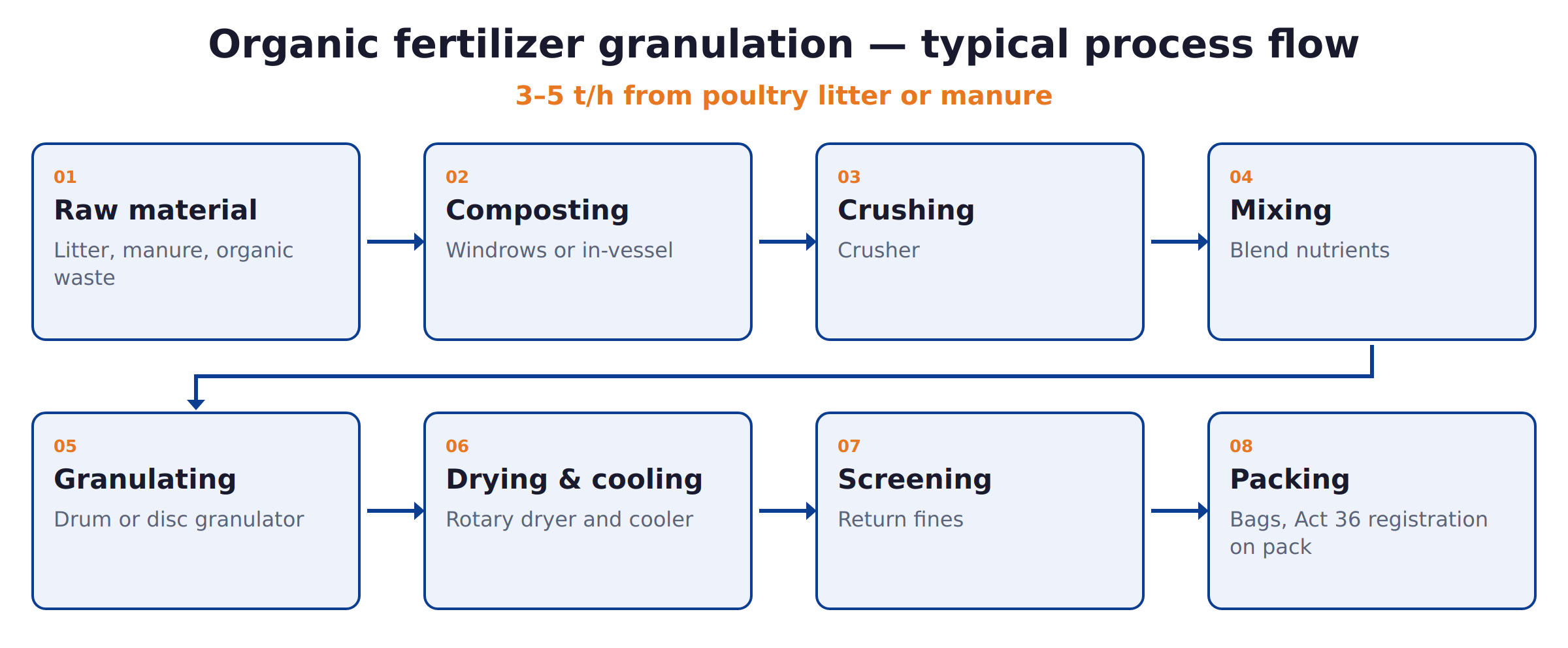
The lower end of the granulation band usually leaves out the dryer and coating. A complete organic plant includes composting turners, crushing, mixing, granulating, rotary drying and cooling, screening, coating, bagging and dust control. Our fertilizer plant cost guide sets out what each band covers.
Step 6: raw materials and quality
For blending, the raw materials must have similar granule size so the blend does not separate in the bag or spreader. Buy from reliable importers, store straights dry and separately, and weigh accurately. For organic fertilizer, feedstock quality decides product quality: litter with too much sawdust or moisture composts poorly, and contaminants such as plastic and stones must be removed. Test nutrient content, moisture and pathogens regularly, and keep batch records that link each bag to its compost batch and laboratory result.
Step 7: buyers and seasons
Commercial farmers buy most fertilizer before planting, so sales are seasonal and often on credit. Co-operatives, agri-dealers and farm stores are the main channels. Organic fertilizer sells to vegetable and fruit growers, nurseries, landscapers, golf courses, municipalities and home gardeners through garden centres. Plan stock and cash for the busy season, and build agronomic advice into your offer: farmers buy from people who help them get yield.
The numbers
For blending, margin is the difference between what you pay for straights, landed and stored, and what farmers pay for blends, less bagging, transport, finance and bad debt. Margins are thin per tonne, so volume and credit control matter. For organic granules, feedstock may be free or even paid for by farms that need to dispose of it, but energy for drying, labour, bags and transport are real costs. Bagged organic products for gardeners earn more per tonne than bulk sales to farmers.
Worked example: a broiler farm turns litter into granules
A broiler producer in the North West produces thousands of tonnes of litter a year and sells it cheaply in bulk. It registers a Group 2 organic fertilizer under Act 36, builds a composting pad with drainage, and installs a 3 t/h granulation line with a rotary dryer, cooler, screen and bagging. It sells 25 kg bags to vegetable farmers and 5 kg bags to garden centres. Because the yard processes more than 10 tonnes a day, it follows the composting norms and keeps the records. The figures are illustrative.
Storage, dust and safety
Fertilizer plants handle dusty materials and some products that need careful storage. Store ammonium nitrate-based products according to their safety data sheets and the rules that apply to them, keep incompatible materials apart, and control dust at transfer points with extraction and covers. Provide protective equipment, keep conveyors guarded, and train staff in safe handling. Organic plants also need odour and fly control on the composting pad.
Common mistakes
- Selling before registration under Act 36.
- Ignoring composting norms above 10 tonnes a day.
- Blending straights of different sizes that separate.
- No dryer in an organic line, giving soft, dusty granules.
- Selling on credit without a credit policy.
Where CISH fits
We supply fertilizer blending stations and organic granulation plants, from composting turners to drying, screening, coating and bagging, from audited factories in China, sized to your feedstock and tonnes. CISH ships, clears, installs and commissions the plant on your own material, and trains your team. Registration under Act 36 and environmental approvals stay with you as the operator. For a single small compost screen or bagging scale, a local supplier is usually the better buy.
Frequently asked questions
Do I need to register fertilizer in South Africa?
Yes. Every fertilizer manufactured or sold must be registered under Act 36 of 1947, as a Group 1 or Group 2 product.
How long does fertilizer registration take?
The government services page gives three to six months for processing.
What is the difference between blending and granulation?
Blending mixes granular straights into NPK blends; granulation turns powder, often composted organic material, into granules.
How much does an organic fertilizer plant cost?
As an indication for 2026, a 3–5 t/h organic granulation line costs about US$30,000–170,000 ex-works, and a complete poultry-litter plant about US$200,000–500,000 landed.
Do composting rules apply to me?
The national composting norms apply in full above 10 tonnes a day of compostable organic waste.
Does CISH supply fertilizer plants?
Yes, blending stations and organic granulation plants with commissioning and training.