Fertilizer blending and granulation plants in South Africa are supplied by local bulk-handling and bagging builders, Chinese factories selling blenders, granulators and dryers direct, dealers of compost equipment, and turnkey companies that design and commission a complete plant. Choose the supplier who designs for your raw materials and dust, not only the blender.
Who sells fertilizer plants
Fertilizer traders, co-ops, poultry farmers with litter, compost makers and regional distributors in neighbouring countries all ask for blending or granulation plants. Four supplier types meet that demand.
| Supplier type | What they sell | Price | Who answers for output | Best fit |
|---|---|---|---|---|
| Local bulk-handling and bagging builder | Hoppers, conveyors, weigh batching, bagging, structural steel | Moderate to high | The builder, for its scope | Blending depots and bagging upgrades |
| Compost equipment dealer | Windrow turners, screens, shredders | Moderate | The dealer, per machine | Compost makers |
| Chinese factory, direct | Blenders, pan and drum granulators, dryers, coolers, screens, coating drums | Lowest on the quote | You, after delivery | Buyers with process and mechanical skills |
| Turnkey fertilizer plant company | Intake to palletised bags, with dust control and utilities, commissioned | Between direct and local | The turnkey company, at agreed tonnes per hour | New plants and first granulation lines |
Blending, organic granulation or compost?
| NPK bulk blending | Organic granulation | Powder compost | |
|---|---|---|---|
| Raw materials | Granular urea, MAP, DAP, KCl and others | Poultry litter, manure, compost, sometimes with mineral additions | Organic waste and manure |
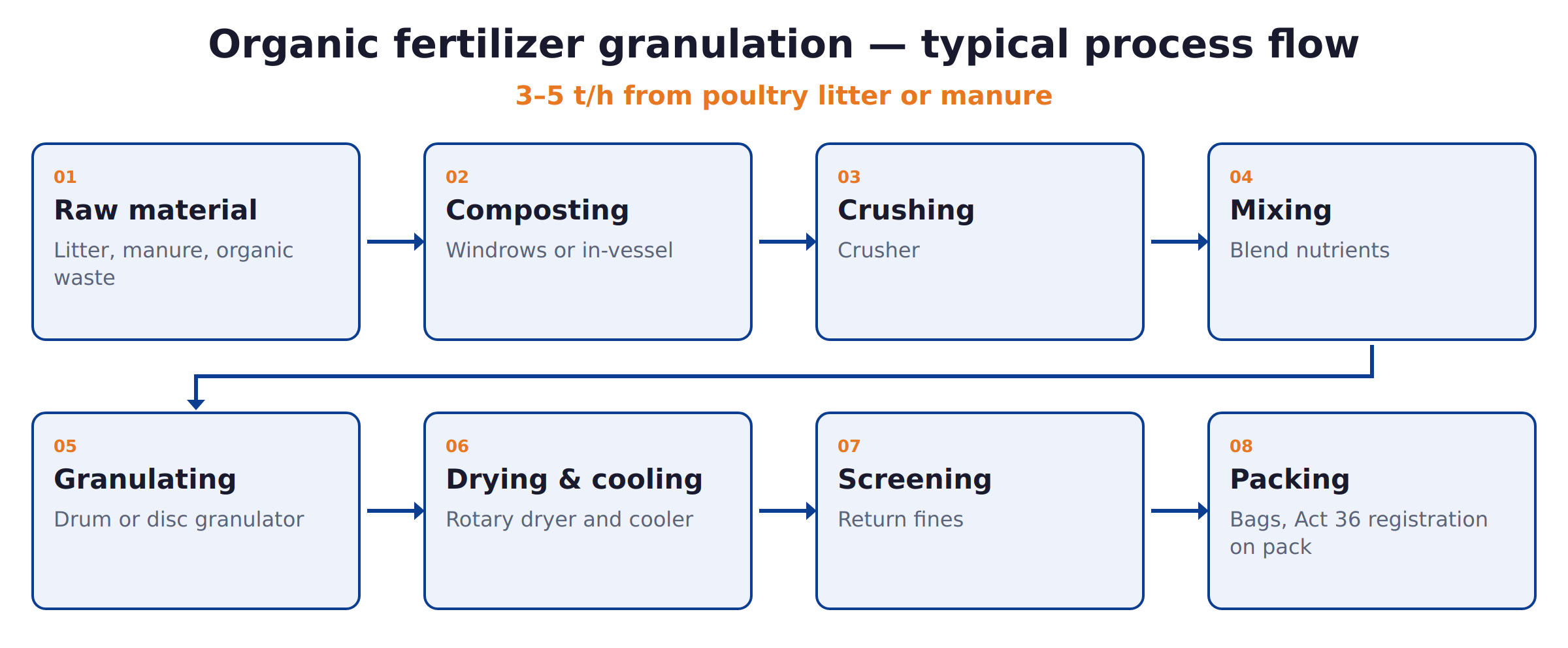
| Process | Weigh, blend, bag | Crush, mix, granulate, dry, cool, screen, coat, bag | Compost, turn, screen, bag |
| Capital | Lowest per tonne | Higher, because of the dryer | Lowest |
| Product | Custom NPK blends for farmers | Granular organic fertilizer | Powdered compost |
| Key risk | Raw material prices and segregation | Moisture, odour and dryer fuel | Space, odour and approvals |
Many traders start with blending because it needs no dryer. Granulation makes sense when you have a steady organic raw material, such as poultry litter.
What to check in the supplier
Segregation and accuracy
A blend is only as good as its weighing and mixing. Ask for weighing accuracy per component and how the plant avoids segregation between blender and bag.
Dryer and dust
Granulation lines dry wet granules, often with a coal, gas or biomass burner. Ask about fuel use per tonne, dust collection and how odour is handled. Fertilizer dust is corrosive and abrasive.
Corrosion
Fertilizers attack mild steel. Ask which parts are stainless or coated, and what wears out first.
Where to find fertilizer plant suppliers
- The Registrar under Act 36 of 1947 explains product registration and the lab analysis you will need.
- Fertilizer and agricultural shows bring together traders and equipment makers; confirm dates with the organisers.
- Running plants: visit a blending depot or granulation line handling raw materials like yours.
- China: most granulators, dryers and blenders sold in Africa are built in China. Audit the factory with our supplier audit checklist first.
Fertilizer plant suppliers are left unnamed here.
How to choose: a 10-point checklist
- Products and raw materials listed: blends, organic granules, compost.
- Tonnes per hour for each product, demonstrated at handover.
- Weighing accuracy and segregation control for blends.
- Granulation: granulator type, dryer, cooler, screens, recycle loop.
- Fuel and burner for drying, with use per tonne.
- Dust and odour control.
- Corrosion protection for contact parts.
- Bagging: 50 kg and bulk bags, palletising, weighbridge if needed.
- Installation, commissioning on your raw materials, and training.
- Support for granulator liners, screens, bearings and burners.
Deciding between blending and organic granules? Read how to start a fertilizer business in South Africa.
Ten questions to ask
- What tonnes per hour does the plant give for each product?
- How accurate is weighing for each component?
- How does the plant prevent segregation?
- What granulator and dryer does it use, and what fuel per tonne?
- What dust and odour control is included?
- Which parts are corrosion protected?
- What bagging equipment is included?
- Is installation, commissioning and training included?
- What wear parts come with the plant?
- Where can I see a plant like this running on similar raw materials?
Comparing fertilizer plant quotes
| Section | What each quote should state |
|---|---|
| Intake and storage | Bays, hoppers, conveyors |
| Weighing and blending | Weigh hoppers, blender, accuracy |
| Crushing and mixing | Crusher, mixer for organic lines |
| Granulation | Pan or drum granulator, capacity |
| Drying and cooling | Dryer, burner, fuel, cooler |
| Screening and coating | Screens, recycle, coating drum |
| Bagging | 50 kg and bulk bags, palletising |
| Dust and odour | Cyclones, bag filters, scrubbers |
| Installation and training | Engineer days, trials |
| Owner's scope | Building, civils, power, approvals |
A total means little until the scopes match; the same-scope comparison shows how to get there.
Common mistakes
- Buying a granulator without a dryer. Wet granules cake in the bag.
- Ignoring segregation. Bags contain different blends than the label.
- Mild steel everywhere. Corrosion shortens plant life.
- No dust control. Product, health and neighbours suffer.
- Selling before registration. Every product needs Act 36 registration.
Fertilizer plant prices in 2026
Indicative, in USD, from our fertilizer plant cost guide:
| Purchase | Capacity | Indicative price (2026) |
|---|---|---|
| Powder compost line | 1–10 t/h | About US$10,000–45,000 ex-works |
| Organic granulation line | 3–5 t/h | About US$30,000–170,000 ex-works |
| Poultry-litter granulation plant, landed | 3–5 t/h | About US$200,000–500,000 |
| NPK bulk-blending equipment | 5–80 t/h | About US$10,000–200,000 ex-works |
| Blending depot, landed | 20 t/h and above | Quoted per configuration |
Registration, market and duty in South Africa
- Product registration. Fertilizers are registered with the Registrar under Act 36 of 1947: Group 1 for products above 100 g/kg of N, P or K, Group 2 for those below. A certificate of analysis from an accredited lab is required, registration is renewed every three years, and processing takes about three to six months.
- Composting rules. The national norms and standards for organic waste composting (Notice 561 of 2021) apply to facilities treating more than 10 tonnes a day; smaller facilities register and follow local by-laws.
- An import-heavy market. BFAP analysis published by SA Grain put fertilizer imports at about US$824 million in 2023, after a peak above US$1.5 billion in 2022, with nitrogen making up 56% of import value.
- Regional demand. Zambia, Zimbabwe, Namibia, Botswana and Eswatini took 78% of South Africa's fertilizer export value.
- Raw material for organics. Poultry farms produce litter at scale, which is the usual feedstock for granular organic fertilizer.
- Duty-free plant. Mixing and granulating machinery (8474.39, 8479.82) and dryers (8419.39) are free of general duty, as are many fertilizers themselves. VAT vendors reclaim the 15% import VAT; read the import duty guide for the method.
Where CISH fits
CISH is a turnkey fertilizer plant company. We specify blending and organic granulation plants from audited factories in China against your products and raw materials, with dust control and bagging, ship and clear them, and install and commission the plant with tonnes per hour demonstrated, and your team trained. For a single mixer or bagging scale, a local supplier is often the better choice.
Frequently asked questions
Who sells fertilizer blending plants in South Africa?
Local bulk-handling and bagging builders, compost equipment dealers, Chinese factories selling direct, and turnkey companies that supply complete blending and granulation plants.
How much does a fertilizer blending plant cost?
As an indication for 2026, NPK bulk-blending equipment costs about US$10,000–200,000 ex-works depending on throughput, and a landed poultry-litter granulation plant about US$200,000–500,000.
Do I need to register my fertilizer?
Yes. Every fertilizer sold must be registered under Act 36 of 1947, with a certificate of analysis from an accredited lab. Registration takes about three to six months.
What is the difference between Group 1 and Group 2 fertilizers?
Group 1 fertilizers contain more than 100 g/kg of N, P or K; Group 2 fertilizers, including most organics, contain less.
Is fertilizer plant machinery duty-free?
Mixing, granulating and drying machinery is free of general duty in SARS's 2026 tariff. Import VAT of 15% applies.
Does CISH sell single blenders?
No. We supply complete blending and granulation plants, installed and commissioned. For a single mixer, a local supplier is usually the better route.