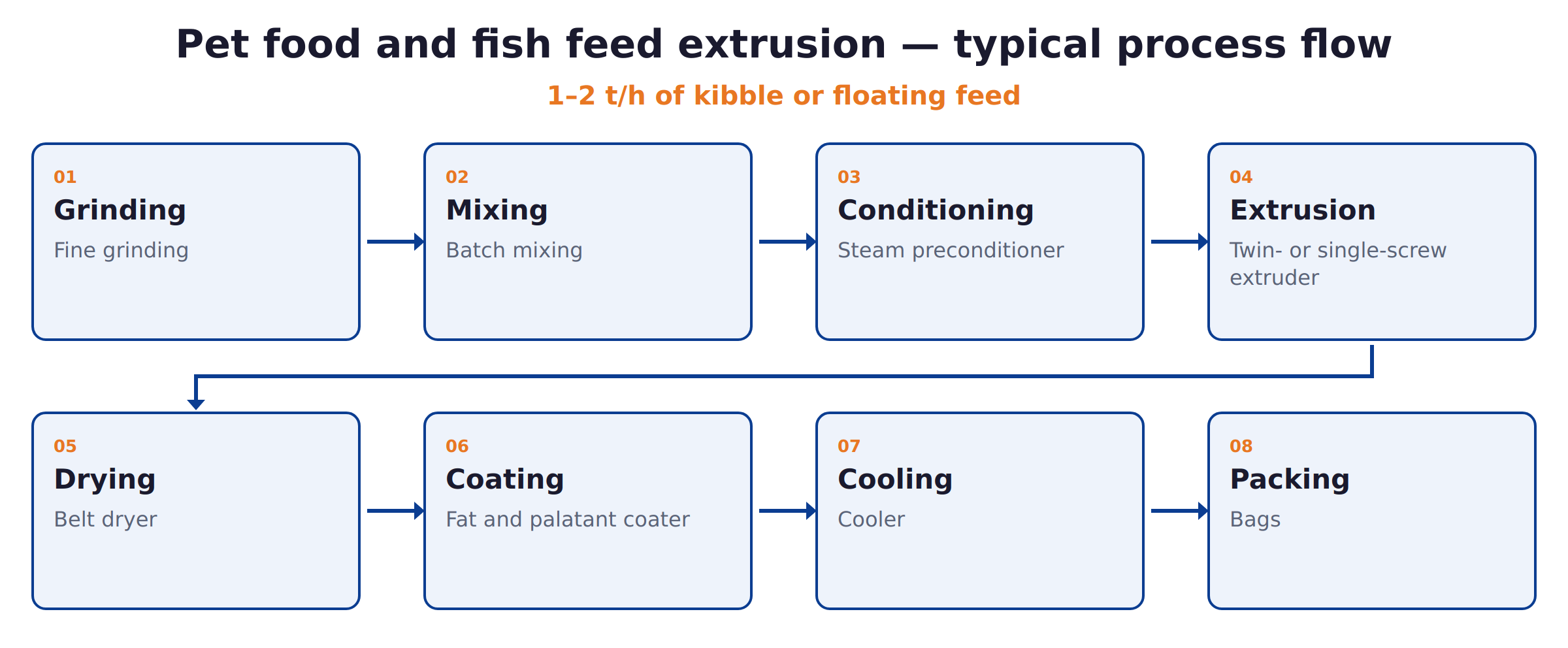
Most dry dog and cat food is kibble made by grinding and mixing ingredients such as maize, soya, meat meal, poultry by-products, fats and vitamins, cooking and shaping the mix in an extruder, drying it, and coating it with fat and flavour. As an indication for 2026, single extruders of about 40–1,200 kg an hour cost about US$2,000–60,000, and complete extrusion lines of 1–2 tonnes an hour for kibble about US$75,000–500,000. Retail cat and dog food imported under 2309.10.90 carries a 20% general duty, free from the EU and SADC, which helps local makers compete with imports from elsewhere. Raw materials, especially protein sources, are most of the cost.
Step 1: brand or manufacturer?
| Own brand, contract-made | Own factory | |
|---|---|---|
| What you do | Formulate, brand, sell; a manufacturer makes it | Make, pack and sell |
| Investment | Low | High: extrusion line, building, utilities |
| Registration | Products registered under Act 36; check who holds the registration | You register your products |
| Control | Less over production schedule | Full |
| Margin | Lower per bag | Higher at volume |
| Fits | New brands testing the market | Brands with steady volume, or contract manufacturing for others |
Many brands start contract-made, then build a factory when volumes justify an extrusion line.
Step 2: register under Act 36
Pet foods are registered with the Registrar under Act 36 of 1947. You submit product details and analysis by an approved laboratory; registered products carry their registration number and a reference to Act 36 on the label. Registration is valid for three years. Imported pet foods need an import permit as well as registration. A draft Feeds and Pet Food Bill was published in 2019 to replace the feed parts of Act 36; check its status. Our Act 36 guide explains the process.
Step 3: products
- Dry kibble for dogs and cats: the largest category, made on extrusion lines.
- Treats and chews: baked, extruded or dried products.
- Wet food: canned or pouched, needing retorts and a different line.
- Fish and bird food: extruded floating pellets, seed mixes.
Start with one category, usually dry dog food in a few life stages and pack sizes.
Step 4: raw materials and formulation
Pet foods need balanced protein, fat, carbohydrate, minerals and vitamins for each species and life stage. A nutritionist sets formulas. Main ingredients include maize, wheat, soya, meat and bone meal, poultry meal, fish meal, fats and premixes. The Crop Estimates Committee's September 2026 forecast put soybeans at about 3.01 million tonnes, but protein prices still move with the market. Test raw materials for moisture, protein and mycotoxins.
Step 5: equipment and costs
| What you buy | Capacity | Indicative price (2026) |
|---|---|---|
| Single extruder | About 40–1,200 kg/h | About US$2,000–60,000 by size |
| Complete kibble extrusion line | 1–2 t/h | About US$75,000–500,000 |
| Industrial plant | 3–10 t/h | Quoted per configuration |
A complete line includes grinding, batching and mixing, preconditioning, the extruder, a dryer, a fat and flavour coater, a cooler and a packing machine. Our pet food extrusion plant guide shows the bands. Machinery under 8436.10 and 8438.80 enters duty-free.
Step 6: packaging and labels
Pet food bags need a good grease and moisture barrier, a zip for larger bags, and labels showing the product, species and life stage, ingredients, guaranteed analysis, feeding guide, net weight, registration number with "Act 36 of 1947", batch, dates and your details.
Step 7: channels
Pet shops and vets, supermarkets, agricultural co-operatives and farm stores, online and subscription sales, and breeders and kennels in bulk. Pet owners are loyal to a food that suits their animal, so consistency matters.
The numbers
Cost per bag is raw materials (most of it), energy for extrusion and drying, packaging, labour, registration and testing, distribution and finance. Compare with shelf prices by channel, and leave margin for retailers and distributors.
Worked example: a regional dog food brand
A feed mill owner in the Free State sells farm feeds and sees demand for affordable dog food from farmers and town pet shops. He registers three dog food products under Act 36, starts with contract manufacturing to test the market, then installs a 1 t/h extrusion line with a dryer, coater and bagging machine beside his feed mill, sharing grinding and raw material storage. The figures are illustrative.
Common mistakes
- Selling unregistered pet food.
- No nutritionist for formulas.
- Weak packaging that lets fat seep through.
- An extrusion line before the brand has steady sales.
- Inconsistent kibble between batches.
Quality control in a pet food plant
Pet owners notice changes in kibble size, colour, smell and how their animal eats, so consistency is the core of the business. Check every raw material lot for moisture and protein, test for mycotoxins in maize and other grains, and keep samples. During production, check the kibble's size, density, moisture after drying and the amount of fat coating. Test finished products against the guaranteed analysis on the label, and keep retention samples from every batch for the product's shelf life.
Moisture after drying is especially important: kibble that is too wet goes mouldy, and kibble that is too dry is costly and may break. Fat coating must be even and the fat must be fresh, or the food goes rancid. Packaging with a good barrier and a clean filling area protect the product until it is opened.
Building a brand
Pet food is a brand business. Owners choose foods based on what they trust, what vets and breeders recommend, and how their animals do. Start with a clear position: affordable, premium, working dog, puppy or senior. Give breeders, vets and pet shops samples and information, and collect feedback. Keep the same formulas and quality once you have loyal buyers, because frequent changes lose them.
Contract manufacturing for others
Once you have a line, contract manufacturing for other brands can use spare capacity, but agree clearly who owns the formulas, who holds the registrations and who pays for testing and recalls.
Utilities for an extrusion plant
Extrusion lines need steam for preconditioning, a strong power supply for the extruder, dryer and grinders, clean water, and compressed air. Plan for a boiler or steam generator, check your electricity supply capacity and tariff, and ventilate the drying and coating areas. Dust from grinding must be controlled for safety and hygiene.
Where CISH fits
We supply complete pet food extrusion lines, grinding, mixing, preconditioning, extrusion, drying, coating, cooling and packing, from audited factories in China, sized to your products and tonnes. CISH ships, clears, installs and commissions the line on your formulas, and trains your team. Registration under Act 36 is done by the brand owner. For a single small extruder for trials, a local supplier is usually the better buy.
Frequently asked questions
Do I need to register pet food in South Africa?
Yes. Pet foods manufactured, imported or sold must be registered under Act 36 of 1947.
How long is pet food registration valid?
Three years.
How is dry pet food made?
Ingredients are ground, mixed, cooked and shaped in an extruder, then dried, coated with fat and flavour, cooled and packed.
How much does a pet food extrusion line cost?
As an indication for 2026, a complete 1–2 t/h kibble line costs about US$75,000–500,000.
Can I start a pet food brand without a factory?
Yes, with a contract manufacturer; check who registers the products under Act 36.
Does CISH supply pet food lines?
Yes, complete extrusion lines with commissioning and training.