Pet food and fish feed extrusion lines in South Africa come from feed equipment dealers, local feed mill builders, Chinese factories that sell extruders and complete lines direct, and turnkey companies that commission the whole plant. Choose the supplier who commits to tonnes per hour of dried, coated product on your recipe.
Who sells pet food lines
Pet food brands, feed millers, fish farmers and co-manufacturers ask for extrusion lines. Their options sit in four groups.
| Supplier type | What they sell | Price | Who answers for output | Best fit |
|---|---|---|---|---|
| Feed equipment dealer | Single extruders, pellet mills, hammer mills | Moderate | The dealer, per machine | Farms and small feed makers |
| Local feed mill builder | Intake, conveyors, bins, mixing and bagging | Moderate to high | The builder, for its scope | Upgrading a feed mill |
| Chinese factory, direct | Single- and twin-screw extruders, dryers, coaters, complete lines | Lowest on the quote | You, after delivery | Buyers with extrusion experience |
| Turnkey extrusion line company | Grinding to bagging, with steam and dust control, commissioned | Between direct and dealer | The turnkey company, at agreed tonnes per hour | New pet food and fish feed plants |
An extruder is not a pet food plant
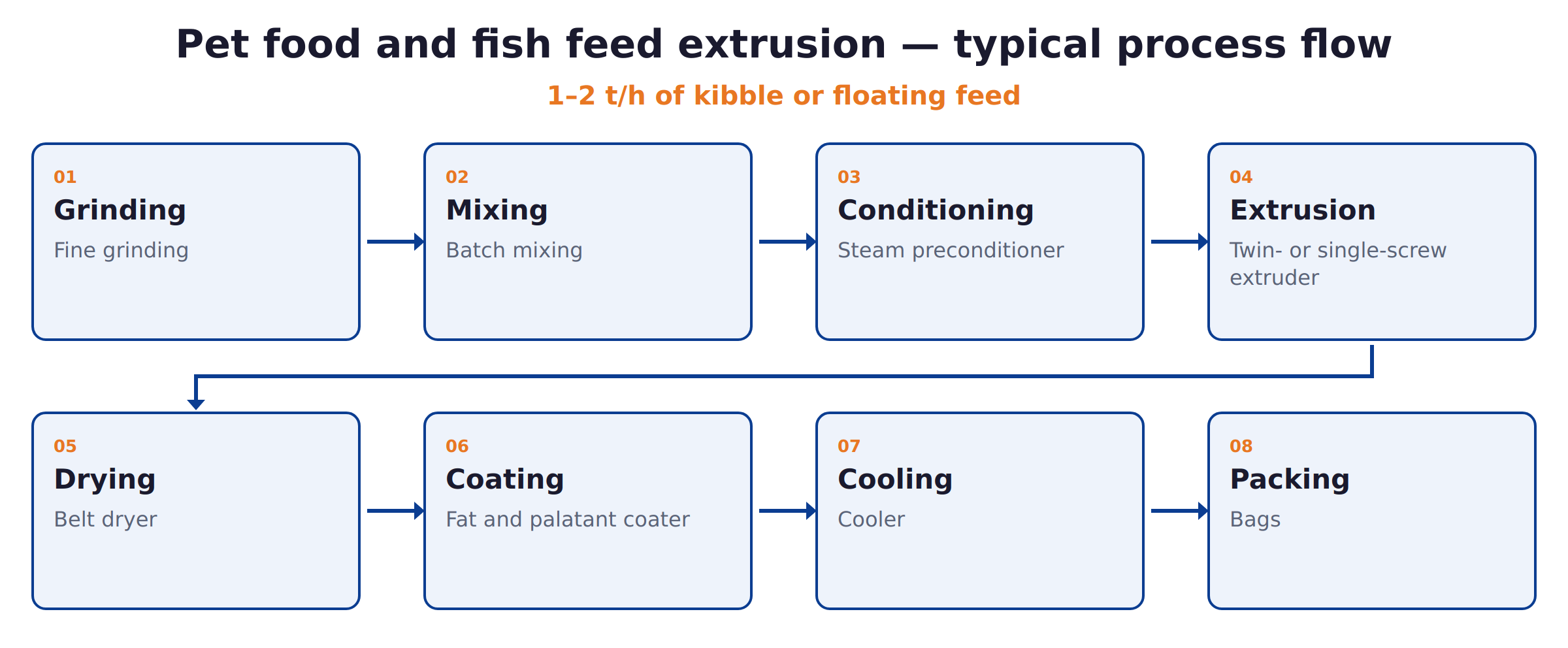
Kibble and floating fish feed are made by grinding raw materials fine, mixing them, conditioning with steam, extruding, then drying, coating with oil and palatants, cooling and sifting. The extruder sits in the middle. A plant without a dryer and coater makes product that goes mouldy or rancid.
Ask any supplier three things:
- Which product: dog and cat kibble, floating or sinking fish feed, or treats, and at what tonnes per hour of finished, dried product.
- Single- or twin-screw, and why for your recipe; high-fat and high-meat recipes usually need more.
- How drying and coating are controlled, because moisture and fat levels decide shelf life.
What to check in the supplier
Grinding and preconditioning
Fine grinding and good steam conditioning give even expansion and a stable product. Ask for the screen size, the preconditioner's retention time and steam demand.
Dies and wear parts
Screws, barrels and dies wear, and different shapes need different dies. Ask what dies are supplied, how long screws last, and the price of replacements.
Dryer and coater
The dryer often costs as much as the extruder. Ask for drying capacity at your moisture targets, and how oil and palatant coating are dosed.
Where to find pet food line suppliers
- The Animal Feed Manufacturers Association (AFMA) represents feed makers and is a source of industry contacts.
- The Registrar under Act 36 of 1947 explains product registration and import permits.
- Working plants: visit a line making a product like yours, ideally on similar raw materials.
- China: many extrusion lines sold in Africa are built in China. Use the supplier audit checklist before you commit.
This page does not name extrusion line suppliers.
How to choose: a 10-point checklist
- Products and recipes defined, with fat and meat content.
- Tonnes per hour of finished product, demonstrated at handover.
- Grinding to the fineness your product needs.
- Preconditioning with steam.
- Extruder type, screws and dies for each shape.
- Dryer and cooler sized for your moisture targets.
- Coating for oil and palatants.
- Utilities: steam boiler, power, compressed air.
- Dust control, bagging, installation, commissioning and training.
- Support for screws, dies and knives.
Planning the business first? See how to start a pet food business in South Africa, including Act 36 registration.
Ten questions to ask
- What tonnes per hour of dried, coated product does the line make?
- Single- or twin-screw, and why for my recipe?
- What grinding fineness does the line achieve?
- What steam does the preconditioner and dryer need?
- What dies come with the line, and for which shapes?
- How is fat and palatant coating dosed?
- What moisture does the product leave the cooler at?
- Is installation, commissioning and training included?
- How long do screws and dies last, and what do they cost?
- Which pet food or fish feed plant runs this line, and may I visit?
Comparing extrusion line quotes
| Section | What each quote should state |
|---|---|
| Intake and grinding | Bins, hammer mill, screen size |
| Batching and mixing | Scales, mixer, liquids |
| Preconditioning | Retention time, steam demand |
| Extrusion | Screw type, motor, dies, cutter |
| Drying and cooling | Dryer capacity, cooler |
| Coating | Fat and palatant coater, dosing |
| Sifting and bagging | Sifter, bagging, palletising |
| Utilities | Boiler, compressor, power |
| Installation and training | Engineer days, recipe trials |
| Owner's scope | Building, civils, power, registration |
Match the scopes line by line, then compare; the same-scope comparison has a worked example.
Common mistakes
- Buying an extruder without a dryer. Product moulds in the bag.
- Coarse grinding. Expansion is uneven and kibble breaks.
- No steam. Starch does not cook properly.
- One die for every shape.
- Selling before Act 36 registration.
Pet food line prices in 2026
Indicative, in USD, from our pet food and fish feed extrusion guide:
| Purchase | Capacity | Indicative price (2026) |
|---|---|---|
| Single extruder | About 40–1,200 kg/h | About US$2,000–60,000 ex-works |
| Complete extrusion line | 1–2 t/h kibble or floating fish feed | About US$75,000–500,000 ex-works |
| Landed and commissioned plant | 1–2 t/h | Quoted per configuration |
| Industrial plant | 3–10 t/h, several lines | Quoted per configuration |
Registration, raw materials and duty
- Registration first. Making, importing or selling farm feed or pet food requires registration under Act 36 of 1947, with accredited lab analysis and approved labels; product registrations last three years.
- Imports need a permit. Imported feed and pet food need an import permit and a registration certificate from the Registrar.
- The V number. Registered pet food carries its registration number and "Act 36 of 1947" on the pack.
- Law reform pending. A draft Feeds and Pet Food Bill was published for comment in 2019; until a new law passes, Act 36 still applies.
- Local protein. The Crop Estimates Committee's September 2026 forecast put the soybean crop at about 3.01 million tonnes, up from 2.8 million tonnes in 2025, which supports local soya meal for kibble and fish feed.
- Fish feed demand north of the Limpopo. A 50,000 tonne a year fish feed factory was built on Lake Kariba in Zambia, and Zimbabwe aims to raise tilapia output to 14,000 tonnes by 2032.
- Duty. Animal feed machinery (8436.10) and food preparation machinery (8438.80) are free of general duty, while retail dog and cat food (2309.10.90) carries 20%. The 15% import VAT can be claimed back by VAT vendors; the import duty guide has worked figures.
Where CISH fits
CISH is a turnkey extrusion line company. We specify complete pet food and fish feed lines from audited factories in China against your recipes and products, ship and clear them, and install and commission the line with tonnes per hour of finished product demonstrated, and your operators trained. We suit pet food brands and feed makers building an extrusion plant. For a single small extruder, a local dealer is often the better choice.
Frequently asked questions
Who sells pet food production lines in South Africa?
Feed equipment dealers, local feed mill builders, Chinese factories selling direct, and turnkey companies that supply complete extrusion lines.
How much does a pet food extrusion line cost?
As an indication for 2026, a complete line for 1–2 tonnes an hour costs about US$75,000–500,000 ex-works. A single extruder costs about US$2,000–60,000.
Do I need to register pet food in South Africa?
Yes. Pet food must be registered under Act 36 of 1947 before it is made, imported or sold, with lab analysis and approved labels.
Single-screw or twin-screw extruder?
Single-screw extruders suit many standard kibble and fish feed recipes. Twin-screw extruders handle higher fat and meat contents and more complex shapes, at a higher price.
Can the same line make fish feed and pet food?
Often, with the right dies, drying and coating. Floating fish feed needs controlled expansion; confirm with the supplier on both recipes.
Does CISH sell single extruders?
No. We supply complete extrusion lines, installed and commissioned. For a single small extruder, a local dealer is usually the better route.