As an indication for 2026, industrial injection moulding machines of 150–300 tonnes cost about US$30,000–75,000 ex-works and 400–500 tonne machines from about US$100,000; semi-automatic PET blow moulders cost about US$3,500–15,000 and fully automatic 2–6 cavity machines about US$20,000–95,000; HDPE extrusion blow moulders for 1–20 litre containers about US$13,000–50,000; and pipe extrusion lines from about US$20,000 for single-screw lines to US$200,000 and more for multi-layer lines. Moulds are priced separately and can cost as much as a machine. Resin supply, electricity, skilled setters and buyers who reorder decide whether the factory earns.
Step 1: start from the product
| Process | Typical products | Buyers |
|---|---|---|
| Injection moulding | Crates, buckets, caps and closures, chairs, housings, household goods, technical parts | Food and drink makers, retailers, farmers, manufacturers |
| Blow moulding | PET water and juice bottles, HDPE milk, chemical and oil containers | Bottlers, dairies, chemical and oil companies |
| Extrusion | PVC and HDPE pipe, profiles, sheet, film, irrigation tubing | Builders, merchants, farms, municipalities, packers |
List the products you want to make, their volumes and buyers, then choose the process. Our comparison of extrusion, injection and blow moulding sets out the differences.
Step 2: find buyers first
Plastic products are often sold to businesses on contract: closures to bottlers, crates to dairies and farms, pipe to merchants and contractors, containers to chemical makers. Talk to target buyers before you buy machines. Ask what they buy now, in what volumes, at what price, and what quality and certification they require. Some products, such as pipe, need SANS marks before merchants will stock them; others, such as food containers, need food-contact material and clean production.
Step 3: machines and costs
| What you buy | Indicative price (2026) |
|---|---|
| Injection moulding machine, 150–300 t | About US$30,000–75,000 ex-works |
| Injection moulding machine, 400–500 t | From about US$100,000 |
| Semi-automatic PET blow moulder | About US$3,500–15,000 |
| Fully automatic PET blow moulder, 2–6 cavities | About US$20,000–95,000 |
| HDPE extrusion blow moulder, 1–20 L | About US$13,000–50,000 |
| Pipe extrusion line | From about US$20,000 single-screw; US$200,000 and more multi-layer |
| Moulds, chillers, compressors, dryers | Priced separately |
Size injection machines by clamp force for your largest part; our injection moulding tonnage guide shows how. PET blow moulding needs high-pressure air compressors; check that cost with the machine. Our blow moulding price guide covers the bands.
Step 4: moulds and dies
Every injection product needs a mould, every bottle shape a blow mould, and every pipe or profile size a die and calibration set. A good multi-cavity injection mould can cost as much as a small machine. Budget moulds for every product in your first two years, check the steel grade, cooling and expected life, and agree who owns the moulds. Plan for mould storage, cleaning and repair, and for a technician who can set up and change moulds.
Step 5: resin supply
Main resins include polypropylene (PP), high-density and low-density polyethylene (HDPE, LDPE, LLDPE), PET, PVC and others. Some are made locally and some are imported, and prices follow world oil and petrochemical markets and the exchange rate. Agree supply with more than one distributor, keep a few weeks of stock, and store resin dry. Recycled resin can cut costs for some products but varies in quality; plastic carrier and flat bags must now contain post-consumer recyclate, and other buyers increasingly ask for recycled content.
Step 6: power, building and utilities
Plastics machines are heavy users of electricity for heating, motors and hydraulics, and Eskom's standard tariff rose 8.76% for 2026/27. Servo-driven injection machines use less energy than older fixed pumps. You also need cooling water from chillers or a cooling tower, compressed air, a strong floor, crane access for moulds, and space for resin, regrind and finished goods. Check your supply capacity before choosing machines.
Step 7: people and skills
You need setters who can change moulds and adjust temperatures, pressures and cycle times, operators for each shift, a maintenance technician for hydraulics, heaters and electrics, and quality staff. Training at commissioning matters, and so does keeping good setters. Follow the OHS Act: machines must be guarded, with interlocks and emergency stops, and staff trained in safe operation.
The numbers
Cost per part is resin (often the largest share), electricity, labour, mould depreciation, scrap and regrind, packaging, delivery and finance. Cycle time and cavities set output, so a faster cycle or more cavities cut cost per part. Run the numbers per product, then for the machine's full year, counting changeovers and downtime.
Worked example: a closure maker in KwaZulu-Natal
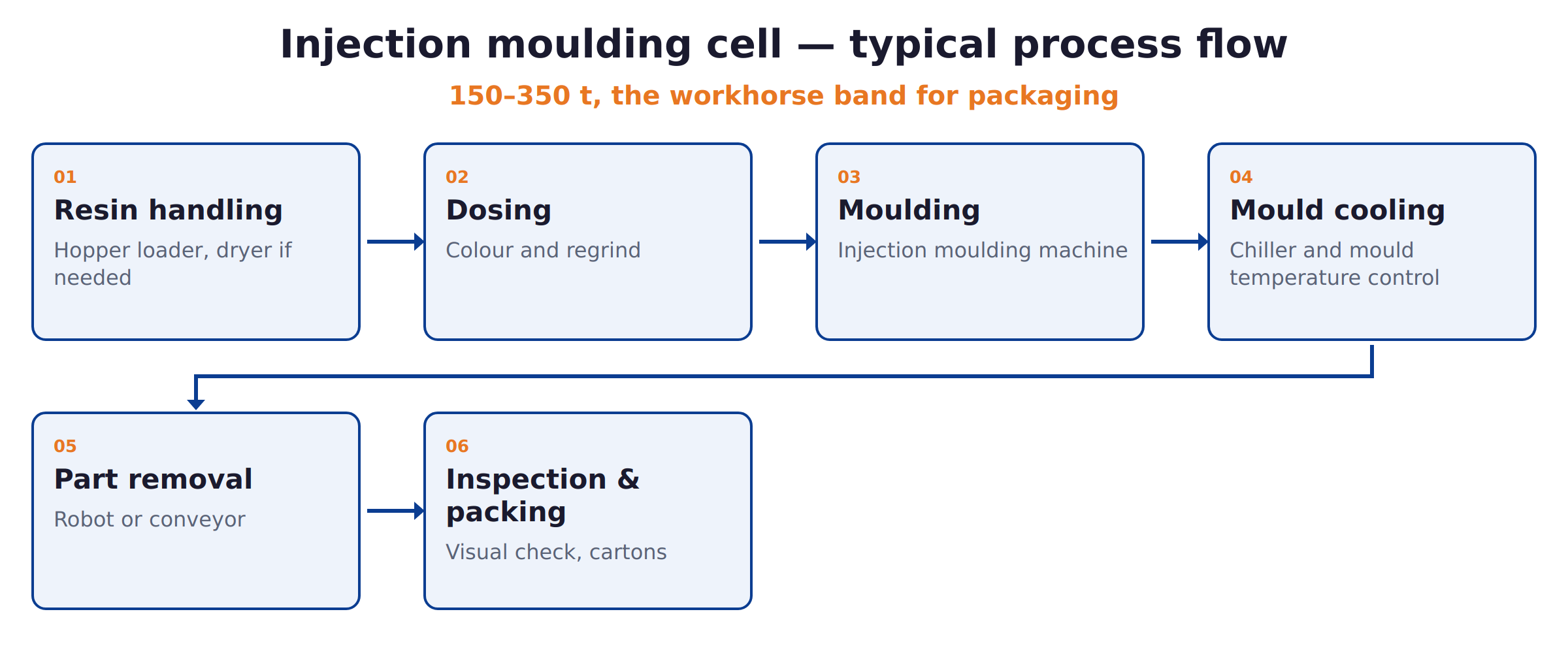
A bottler in Durban buys caps from a distant supplier and suffers delays. A local entrepreneur agrees a supply contract, installs a 250 tonne servo injection machine with a 24-cavity cap mould, a chiller, a dryer and a cap lining machine, and buys PP and HDPE from two distributors. After a year, he adds a second machine and mould for another cap size and supplies two more bottlers. The figures are illustrative.
Quality and certification
Measure parts against drawings, check weights and dimensions on each shift, and record resin lots and machine settings. Buyers of food packaging will ask for food-contact compliance and a clean production area; pipe buyers will ask for SANS marks and test reports. Keep samples from each production run.
From a delivered project: A Johannesburg injection moulding cell about to buy a fifth machine first spent about R280,000 on a three-week visibility retrofit; the data showed scrap on two products, night-shift cycle drift and one mould running 14% slow, and fixing them recovered about 17 points of OEE, so the fifth machine was deferred. Read the OEE retrofit case study.
Common mistakes
- Buying a machine before finding buyers.
- Forgetting mould costs.
- Undersizing clamp force or chillers.
- No backup resin supplier.
- No skilled setter.
Your first year
In the first months, output is usually lower than the brochure figure while setters learn the moulds and machines and you sort out resin settings and scrap. Plan for it. Keep one or two buyers you can supply well rather than chasing many. Track output per shift, scrap rate, energy and cycle times every day, and fix the biggest losses first. Keep spares for heaters, thermocouples, seals and hydraulic parts, and agree a service plan with your supplier. Once one product line runs reliably, add a second machine or mould for the next product.
Regrind and scrap
Every process makes scrap: runners, sprues, start-up purges, rejected parts and trim. A granulator beside each machine lets you regrind clean scrap and add it back in a controlled ratio, which cuts resin cost. Keep regrind clean and dry, label it by resin type and colour, and never mix materials. Buyers may limit the share of regrind in their parts, so agree it in writing.
Where CISH fits
We supply complete injection moulding, blow moulding and extrusion lines, with moulds, chillers, compressors and auxiliaries sized together, from audited factories in China. CISH ships, clears, installs and commissions the line on your resin and products, and trains your team. For a single used machine, a local dealer is usually the better buy.
Frequently asked questions
How do I start a plastic manufacturing business?
Choose products and buyers first, then the process, machines and moulds, and secure resin supply, power and skilled staff.
Which plastic process should I choose?
Injection moulding for solid parts, blow moulding for hollow containers, extrusion for pipe, profiles, sheet and film.
What does an injection moulding machine cost to buy?
As an indication for 2026, 150–300 tonne machines cost about US$30,000–75,000 ex-works.
Are moulds included in the machine price?
Usually not; moulds are priced separately and can cost as much as a machine.
Where do I buy plastic resin?
From local producers and distributors and from importers; agree supply with more than one.
Does CISH supply plastics lines?
Yes, complete lines with moulds and auxiliaries, commissioning and training.