Producer responsibility organisations, funded under the EPR regulations, buy and support collection. A plastic washing line of 300–1,000 kg an hour costs about US$120,000–350,000. CISH supplies, installs and commissions complete recycling lines; for balers and scales, a local dealer is the better choice.
Step 1: Choose your place in the chain
| Model | What you do | What you sell | Capital | Main risk |
|---|---|---|---|---|
| Buy-back centre | Buy sorted recyclables from collectors by weight | Material to balers or processors | Low: scale, storage, transport | Price swings and theft |
| Sorting and baling yard | Sort mixed recyclables, bale by material | Bales of PET, HDPE, film, paper, cans | Moderate: baler, conveyor, forklift | Contamination and space |
| Processing plant | Wash, grind and pelletise, or make crumb rubber | Flakes, pellets, crumb, secondary raw material | High: processing line, water treatment | Output quality and buyers |
Most recyclers start in collection and baling, learn the material flows, then add processing for the material they handle best.
Step 2: Pick your materials
| Material | Typical buyers | Notes |
|---|---|---|
| PET bottles | Flake and fibre makers, bottle-to-bottle recyclers | Needs sorting by colour and removing caps and labels |
| HDPE and PP containers | Moulders and pipe makers (non-pressure) | Pressure pipe makers use virgin material |
| Film (LDPE) | Bag makers | Demand rising as bags move to 100% recycled content |
| Paper and cardboard | Paper mills | Paper PROs support collection |
| Metals and cans | Scrap merchants and smelters | Separate rules apply to scrap metal dealers |
| Tyres | Crumb rubber and moulded product makers | Waste tyre regulations apply |
Step 3: Check the waste licence before the site
The National Environmental Management: Waste Act lists waste activities that need a licence or must follow norms and standards. Under GN 921 of 2013:
- Recycling general waste at a facility with more than 500 m² of operational area is a Category A activity, needing a basic assessment and a waste management licence. Recycling that is part of a manufacturing process on the same premises is excluded.
- Sorting, shredding, grinding, crushing, screening or baling of general waste at a facility of 1,000 m² or more is a Category C activity, which must comply with the 2017 national norms and standards.
- Storing more than 100 m³ of general waste at any one time must follow the norms and standards for storage of waste.
Hazardous waste has lower thresholds and stricter categories. Ask your provincial environmental department or a licensed environmental assessment practitioner before you sign a lease.
Step 4: Work with producer responsibility organisations
The Extended Producer Responsibility Regulations of 2020 make producers of packaging, paper and some single-use products fund collection and recycling, usually through producer responsibility organisations (PROs). For a new recycler, PROs can mean:
- Buyers or offtake support for collected material.
- Grants or equipment support for collection and sorting.
- Data reporting requirements on tonnes collected.
Contact the PRO for each material stream you handle; the paper and packaging PRO, Fibre Circle, is one example.
Step 5: Plan the site and equipment
| Model | Equipment |
|---|---|
| Buy-back centre | Weighbridge or platform scales, cages, covered storage, a truck |
| Sorting and baling yard | Sorting conveyor, baler, forklift, scales, storage bays |
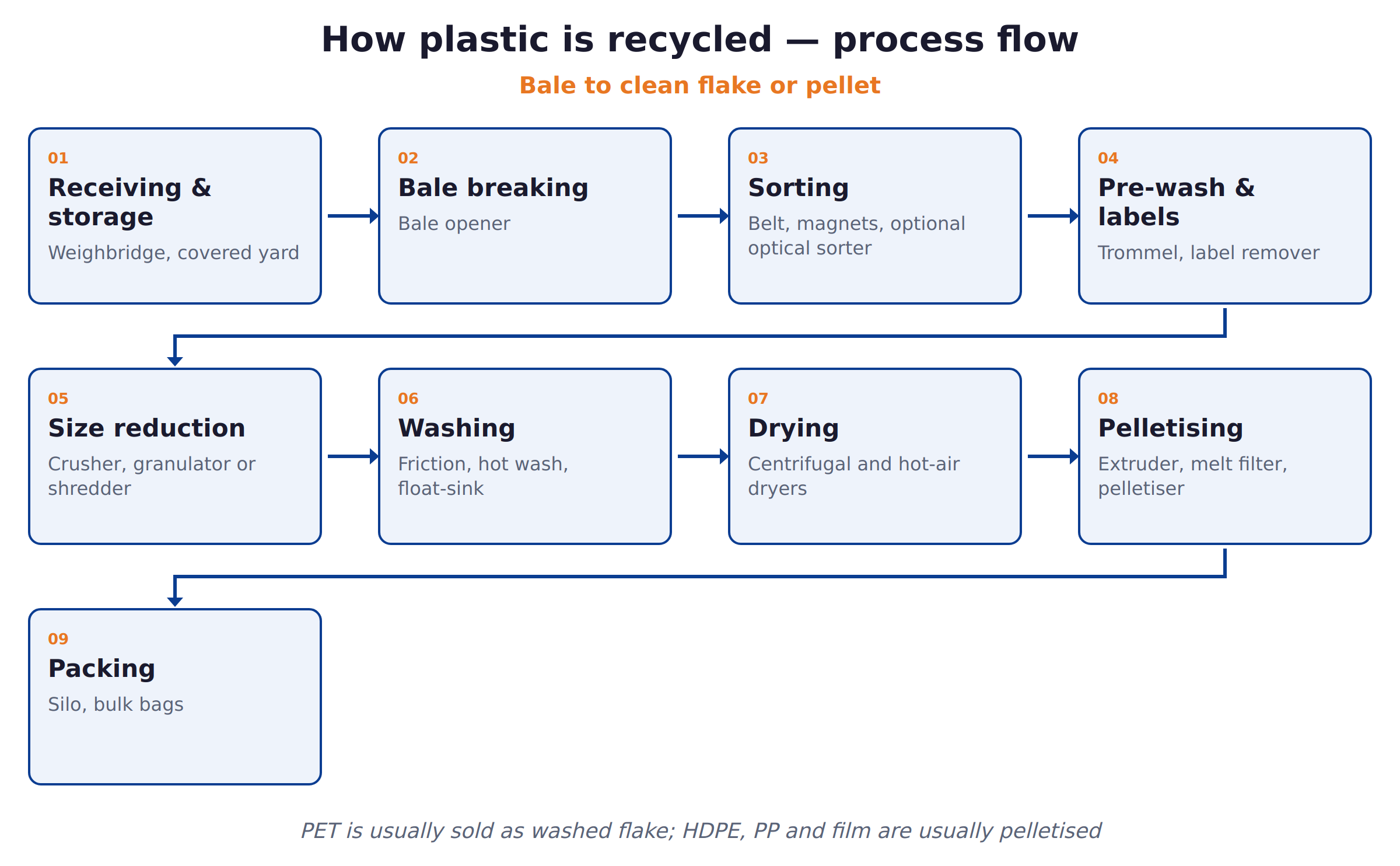
| Plastic processing plant | Bale breaker, sorting, shredder, wet granulator, washing, drying, pelletising, water treatment |
| Processing equipment | Capacity | Indicative price (2026) |
|---|---|---|
| Granulator or crusher | Size reduction only | Low tens of thousands of US dollars |
| Washing line | 300–1,000 kg/h | About US$120,000–350,000 |
| PET bottle washing line | About 500 kg/h | About US$150,000–200,000 |
| Pelletising add-on | Flakes to pellets | About US$80,000–120,000 more |
Landing costs typically add about 25–45% to ex-works prices. See our plastic recycling machine price guide.
Step 6: Secure buyers and price
Recyclate prices follow virgin resin, paper and metal prices. Before investing:
- Get written specifications from buyers: moisture, contamination, colour, bale size.
- Agree price formulas, not just a price, where you can.
- Diversify across materials so one price fall does not stop the business.
Step 7: Register and run the business
- Register the company and for tax, and for VAT once turnover passes the threshold.
- Keep weighbridge records and supplier records for every purchase.
- Train staff on safety: balers, shredders and forklifts are serious hazards under the OHS Act.
- Report tonnages to PROs and authorities where required.
What makes recyclers profitable
| Driver | What to do about it |
|---|---|
| Clean input | Pay collectors more for clean, sorted material; reject contaminated loads |
| Route density | Collect from many sources close together to cut transport cost per tonne |
| Bale quality | Dense, well-tied bales of one material fetch better prices and cost less to move |
| Yield | In processing, every per cent of contamination lost is a per cent of revenue lost |
| Several buyers | Sell each material to more than one buyer to manage price swings |
| Records | Track tonnes in and out, by material and supplier, every day |
A realistic timeline
| Stage | What happens |
|---|---|
| Months 1–2 | Choose model and materials, talk to buyers and PROs |
| Months 2–4 | Find a site, check licence thresholds, start any assessment |
| Months 3–6 | Equipment for collection and baling; start trading |
| Months 6–18 | Add processing for the strongest material, once licences and buyers are in place |
Worked example: from baling to washing
An illustration only:
| Item | Assumption |
|---|---|
| Today | Sorting and baling yard handling PET and HDPE |
| Plan | Add a washing line for PET at about 500 kg an hour |
| Equipment | About US$150,000–200,000, plus water treatment and installation |
| Licence | Operational area above 500 m², so a basic assessment and waste management licence |
| Buyers | Flake buyers with written specifications |
Common mistakes
- Signing a lease before checking the licence threshold.
- Buying a granulator and expecting buyers to pay for dirty flakes.
- No water treatment on a washing line.
- Relying on one material and one buyer.
- Poor records. Weighbridge and supplier records protect you against stolen material.
Where CISH fits
CISH supplies, installs and commissions complete recycling lines from audited factories in China, such as plastic washing and pelletising lines and crumb rubber lines, with water treatment and installation, commissioned on your material and with your operators trained. For balers, scales and collection equipment, a local dealer is the better choice, and we will say so.
Frequently asked questions
How do I start a recycling business in South Africa?
Choose a model (buy-back, sorting and baling, or processing), pick your materials, check the waste licence thresholds before choosing a site, work with producer responsibility organisations, and secure buyers before investing in processing.
Do I need a licence to start recycling?
Recycling general waste at a facility with more than 500 m² of operational area needs a basic assessment and a waste management licence. Sorting and baling sites of 1,000 m² or more must follow national norms and standards.
How much does a plastic recycling line cost?
As an indication for 2026, a washing line for 300–1,000 kg an hour costs about US$120,000–350,000, and pelletising adds about US$80,000–120,000.
Which material is easiest to start with?
Many recyclers start with PET bottles, cardboard or cans because buyers are established. Film demand is rising as plastic bags move to 100% recycled content in 2027.
What is EPR?
Extended producer responsibility. Producers of packaging and some products fund collection and recycling, usually through producer responsibility organisations.
Does CISH sell balers?
No. We supply complete processing lines. For balers and scales, a local dealer is the better choice.