Plastic recycling machines in South Africa come from local dealers of granulators and balers, local fabricators of conveyors, tanks and dryers, Chinese factories that make washing and pelletising lines, and turnkey companies that design and commission a complete recycling plant. A recycling facility with more than 500 m² of operational area needs a waste management licence after a basic assessment, so the site and licence come before the machines.
Who sells plastic recycling machines
Buy-back centres, waste collectors, converters recycling their own scrap and investors entering the recycling business all look for machines. Four kinds of supplier serve them.
| Supplier type | What they sell | Price | Who answers for output | Best fit |
|---|---|---|---|---|
| Local dealer | Granulators, balers, shredders, small agglomerators | Moderate | The dealer, per machine | Collectors and converters with scrap |
| Local fabricator | Conveyors, float tanks, simple dryers, platforms | Lower for simple items | The fabricator, for its items | Adding to or repairing a line |
| Chinese washing-line maker, direct | Washing lines, friction washers, hot washers, dryers, pelletisers | Lowest on the quote | You, after delivery | Recyclers with process engineers |
| Turnkey recycling plant company | Bale breaking to bagged flake or pellets, with water treatment, commissioned | Between direct and dealer | The turnkey company, at agreed tonnes per hour and quality | New plants and first washing lines |
Size reduction is not recycling
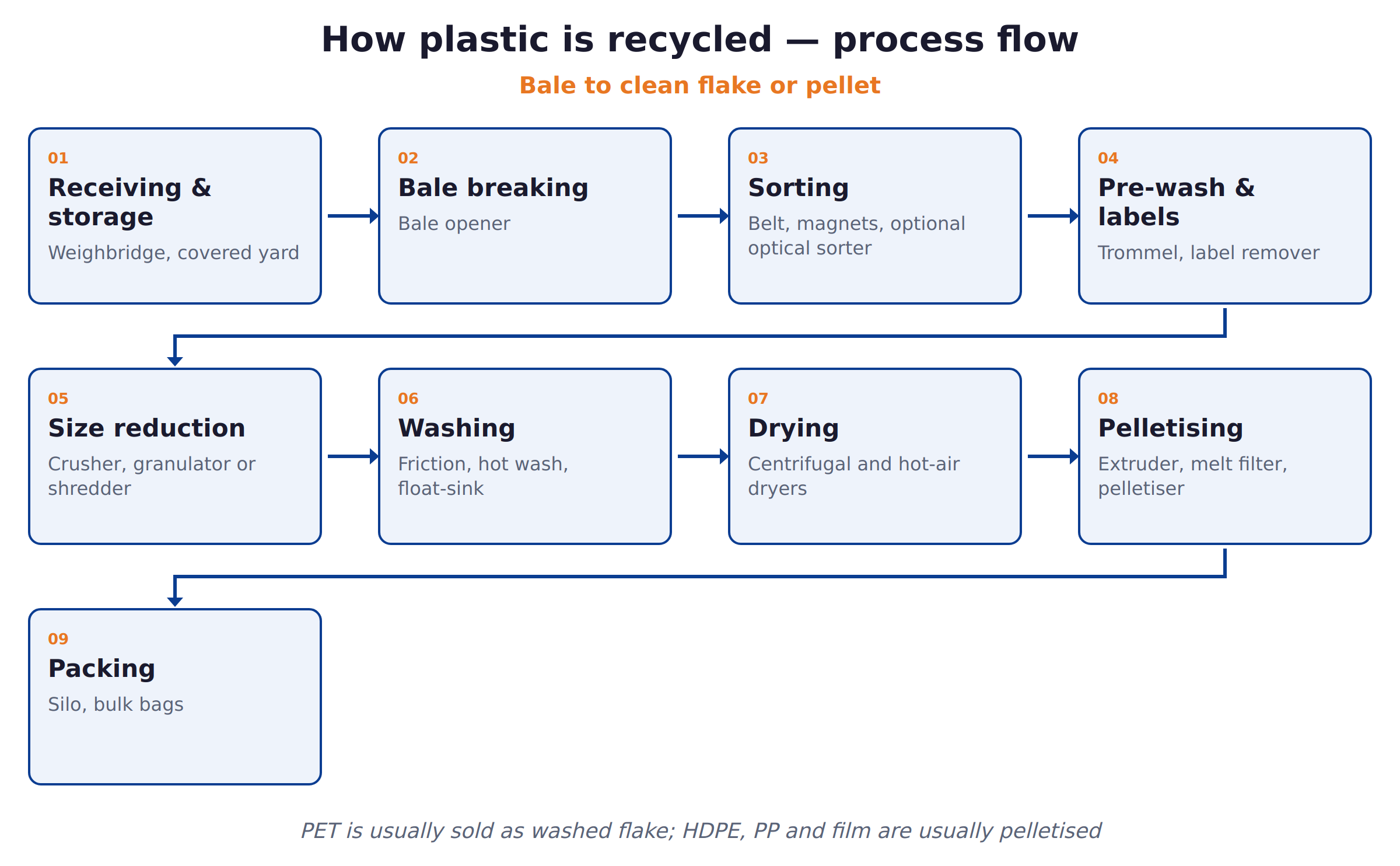
A granulator cuts plastic into pieces. Buyers pay for clean, sorted, dry flake or pellets of one polymer. Between the two sit bale breaking, sorting, label removal, float-sink separation, hot and friction washing, drying and, often, pelletising. The washing and drying sections cost most and decide quality.
Ask any supplier three things:
- Which plastic the line is designed for: PET bottles, HDPE containers, LDPE film or mixed rigid plastics.
- What quality comes out: moisture, contamination and colour of the flake or pellet, measured how.
- How much water and power each tonne needs, and how wash water is treated.
What to check in the supplier
Washing performance
Ask for contamination and moisture figures from a line running on bales like yours, not on clean factory scrap.
Wear parts
Knives, screens and screws wear fast on dirty post-consumer plastic. Ask the life and price of knives and screens, and whether they can be sharpened locally.
Water treatment
Washing lines use a lot of water. A plant without water treatment and recirculation will struggle with cost and its licence. Ask what is included.
Where to find recycling machine suppliers
- Producer responsibility organisations for each packaging stream know the recyclers and the equipment they run.
- Waste and recycling trade events feature balers, granulators and washing lines; confirm dates with the organisers.
- Working plants: visit a line processing bales like the ones you will buy.
- China: most washing and pelletising lines sold in Africa are made in China. Our supplier audit checklist covers the factory checks.
We do not name recycling machine suppliers on this page.
How to choose: a 10-point checklist
- Polymer and source defined: PET bottles, HDPE, film, mixed.
- Tonnes per hour of clean output, demonstrated at handover.
- Bale breaking and sorting before washing.
- Washing: float-sink, hot wash, friction wash, as the polymer needs.
- Drying to the moisture buyers accept.
- Pelletising if you sell pellets.
- Water treatment and recirculation.
- Power supply and electricity per tonne.
- Installation, commissioning on your bales, and training.
- Support for knives, screens, screws and filters.
Not sure which line your material needs? See how to choose a plastic recycling machine by material.
Ten questions to ask
- What tonnes per hour of clean flake or pellet does the line produce?
- Which polymers and sources is it designed for?
- What moisture and contamination will the output have?
- How much water and power does each tonne use?
- Is water treatment included?
- What knives, screens and wear parts are supplied?
- What does pelletising add, and what melt filtration is included?
- Is installation, commissioning and training included?
- How quickly can I get replacement knives and screens?
- Which recycler runs this line, and may I see it on dirty bales?
Comparing recycling line quotes
| Section | What each quote should state |
|---|---|
| Pre-treatment | Bale breaker, trommel, sorting conveyor |
| Size reduction | Shredder, wet granulator, knives |
| Washing | Float-sink, hot wash, friction washers |
| Drying | Centrifugal and thermal dryers, moisture |
| Pelletising | Extruder, melt filter, pelletiser |
| Water | Treatment, recirculation, sludge |
| Power | Installed kW, kWh per tonne |
| Installation and training | Engineer days, trials on your bales |
| Owner's scope | Building, licence, water supply, effluent |
Equal scopes first, then compare; the same-scope comparison works through an example.
Common mistakes
- Buying a granulator and calling it a recycling plant.
- Testing on clean scrap. Post-consumer bales are much dirtier.
- No water treatment. Costs and licence problems follow.
- Choosing a site before checking the licence threshold.
- Assuming any buyer will take recycled pellets. Some products, such as pressure pipes, do not allow bought-in recycled material.
Plastic recycling machine prices in 2026
Indicative, in USD, from our plastic recycling machine price guide:
| Purchase | Capacity | Indicative price (2026) |
|---|---|---|
| Granulator or crusher | Size reduction only | Low tens of thousands of US dollars |
| Washing line | 300–1,000 kg/h | About US$120,000–350,000 |
| PET bottle washing line | About 500 kg/h | About US$150,000–200,000 |
| Pelletising add-on | Flakes to pellets | About US$80,000–120,000 more |
Landing costs usually add about 25–45% to the ex-works price.
Licences, markets and duty in South Africa
- Waste management licence. Under GN 921 of 2013, recycling general waste at a facility with more than 500 m² of operational area is a Category A activity, needing a basic assessment and a waste management licence; recycling built into a manufacturing process on the same premises is excluded.
- Sorting and baling yards. Sorting, shredding, grinding, crushing, screening or baling general waste at a facility of 1,000 m² or more must comply with the 2017 national norms and standards.
- Storage. Storing more than 100 m³ of general waste at any one time brings in the norms and standards for storage of waste.
- Demand for recyclate. Plastic carrier and flat bags must contain 50% post-consumer recyclate from 2023, 75% from 2025 and 100% from 1 January 2027.
- EPR. The Extended Producer Responsibility Regulations of 2020 make packaging producers fund collection and recycling through producer responsibility organisations.
- Market limits. Industry procurement guidance for HDPE and uPVC pressure pipes calls for virgin raw material and no bought-in recyclate, so pipe makers are not a market for recycled pellets.
- Duty. Most recycling machinery under Chapter 84 carries no general duty. VAT vendors reclaim the 15% import VAT; the import duty guide explains the calculation.
Where CISH fits
CISH is a turnkey recycling plant company. We specify washing and pelletising lines from audited factories in China against your polymer and bale quality, with water treatment, ship and clear them, and install and commission the line with tonnes per hour of clean output demonstrated on your bales, and your operators trained. For a single granulator or baler, a local dealer is often the better choice.
Frequently asked questions
Who sells plastic recycling machines in South Africa?
Local dealers of granulators and balers, local fabricators, Chinese washing-line makers selling direct, and turnkey companies that supply complete recycling plants.
How much does a plastic recycling line cost?
As an indication for 2026, a washing line for 300–1,000 kg an hour costs about US$120,000–350,000, and pelletising adds about US$80,000–120,000.
Do I need a waste licence to recycle plastic?
Recycling general waste at a facility with more than 500 m² of operational area needs a basic assessment and a waste management licence under GN 921 of 2013. Smaller sorting and baling sites follow norms and standards.
Can I sell recycled pellets to pipe makers?
Usually not for pressure pipes. Procurement guidance for HDPE and uPVC pressure pipes calls for virgin material and no bought-in recyclate.
Is recycling machinery duty-free?
Most recycling machinery under Chapter 84 has no general duty in SARS's 2026 tariff. Import VAT of 15% applies.
Does CISH sell single granulators?
No. We supply complete washing and pelletising lines, installed and commissioned. For a single granulator, a local dealer is usually the better route.