A sanitary pad business in South Africa has two markets: retail, through pharmacies, supermarkets and spaza shops, and government supply through the Sanitary Dignity Programme, which gave free pads to about 4 million learners in Quintile 1–3, farm and special schools in 2025/26, with a 2026/27 allocation of about R268.6 million. The programme's budget flows to the provinces, which procure through their own departments, and products delivered to schools must be SABS compliant, meaning they have been tested for safety, absorption and microbial contamination. Parliament heard in March 2026 that many current suppliers are distributors buying from large multinationals, and that the department wants more local manufacturers in the value chain. Most materials are imported. Pads are zero-rated for VAT. CISH supplies, installs and commissions complete sanitary pad lines.
Step 1: choose your market
| Retail | Government (Sanitary Dignity Programme) | |
|---|---|---|
| Buyers | Pharmacies, supermarkets, wholesalers, spaza shops | Provincial departments (education, social development) |
| What they want | Brand, packaging, price, consistent quality | SABS-compliant products, price, delivery to schools, local and developmental criteria |
| How you sell | Listings, distributors, marketing | Tenders and procurement panels; CSD registration |
| Payment | Retailer terms | Government payment cycles |
| Risk | Competition with large brands | Tender timing, budget changes, delays |
Many local manufacturers combine the two: tenders for volume and a retail brand for margin.
Step 2: understand the programme
The Sanitary Dignity Implementation Framework was approved by Cabinet and the programme has supplied free pads since 2019. In a briefing to Parliament on 17 March 2026, the Department of Women, Youth and Persons with Disabilities reported that about 4 million learners benefited in 2025/26, that provincial reach varied widely, and that the 2026/27 allocation was about R268.6 million. The budget goes directly to provinces, which choose their own procurement models; the number of suppliers differs from province to province. The department said it wants to bring in more local manufacturers and suggested clustering small businesses to reach scale. The framework is due for a five-year review in 2027/28. Watch provincial tender portals and the National Treasury eTenders portal, and register on the Central Supplier Database.
Step 3: meet the standard
SANS 1043 is the South African standard for disposable sanitary towels; the current edition on the SABS webstore is SANS 1043:2026. In March 2026 the SABS opened an amended draft for comment that strengthens product marking, including fibre composition and the declaration of substances, additives, treatments and cautionary statements. Plan for:
- Product testing at an accredited laboratory for absorption, safety and microbiology.
- SABS certification if your buyers ask for the mark.
- Material certificates from every supplier.
- Batch records linking each batch of pads to its materials and tests.
Our SANS 1043 guide covers the standard and how the mark works.
Step 4: materials
A pad is made of fluff pulp or airlaid paper, superabsorbent polymer (SAP), a non-woven top sheet, a PE back sheet, hot-melt glue, release paper and individual wrapping. Most of these are imported. Plan stock for several weeks, compare suppliers on quality and lead time, and include freight and duty in your cost per pad.
Step 5: equipment and premises
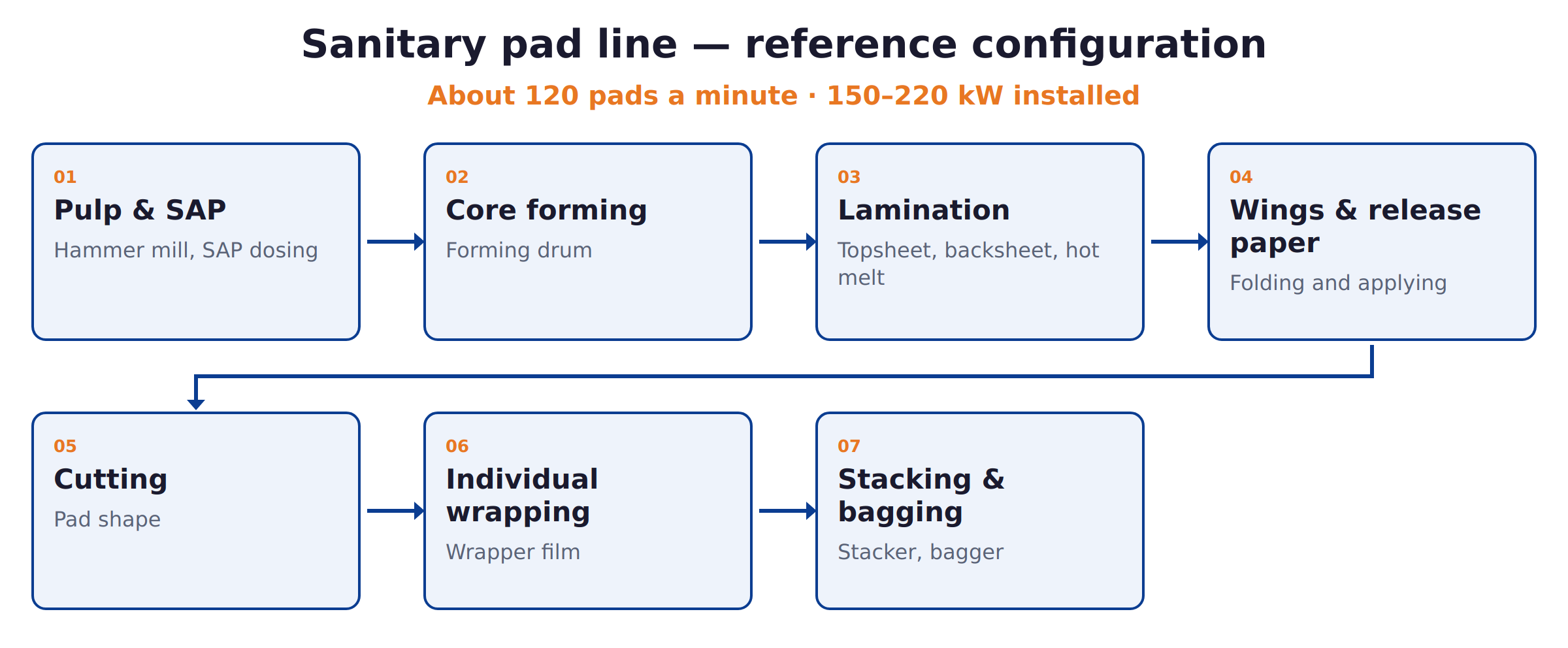
| Line | Pads per minute | Indicative price (2026) | Fits |
|---|---|---|---|
| Semi-automatic or tabletop | About 40–100 | About US$4,000–50,000 | Training and samples |
| Complete automatic line | About 60–150 | About US$150,000–400,000 | New manufacturers, tenders, retail |
| High-speed full-servo line | About 400–800+ | About US$230,000–550,000 ex-works | Large volumes |
The line needs a clean production room with washable walls and floors, controlled access, dust extraction for the pulp mill, three-phase power, compressed air and a dry store for materials and finished packs. Our pad machine selection guide explains why waste rate matters more than speed.
Step 6: the numbers
Cost per pad is mostly materials, then labour, power, packaging, testing, overheads and finance. A line that wastes material at start-ups and splices loses money on every shift. Price tenders carefully: include delivery to schools, storage and payment delays. Pads have been zero-rated for VAT since 1 April 2019, which affects your pricing and VAT returns. Preference points under the Preferential Procurement Regulations 2022 also count in tenders.
Worked example: a manufacturer for a provincial tender
A women-owned company in KwaZulu-Natal distributes pads to schools under a provincial contract, buying from a large brand. It sets up an automatic line of about 120 pads a minute in a leased clean room, with change parts for day pads, imports materials with a three-month stock, and has its pads tested at an accredited laboratory before the next tender cycle. It registers its own retail brand for pharmacies and spaza shops so that the line runs between tender deliveries. The figures are illustrative.
Common mistakes
- Bidding before products are tested.
- A semi-automatic machine for tender volumes.
- No material stock: a missing roll stops the line.
- Underpricing delivery and storage.
- No retail market between tender cycles.
Product range
Start with the products most buyers need: day pads with wings and night pads, then panty liners. Maternity pads and ultra-thin pads can follow once the line and testing are established. Each size needs change parts and its own test reports, so add products in steps.
Packaging and brand
Retail buyers choose on price, comfort and pack design; tender buyers on compliance and price. Use clear packs that show the pad type, count, size and the information required by the current edition of SANS 1043, with your company details and a batch code. A simple, consistent brand across sizes helps shoppers find you.
Partnerships and clustering
In its March 2026 briefing to Parliament, the department suggested grouping small businesses so that they can reach the scale needed to manufacture. In practice, a manufacturer can supply several small distributors, or partner with women-owned and youth-owned businesses for distribution and delivery to schools, sharing the work and the tender points.
Waste and the environment
A 2025 draft government strategy on absorbent hygiene products addresses their waste; producers are not yet in an EPR scheme for these products, but the direction is towards producer responsibility. Keep an eye on it when you plan materials and packaging.
Cash flow on government contracts
Government contracts pay after delivery and invoicing, and delays happen. Plan finance for materials, production and delivery before the first payment arrives, and keep a retail product line selling so the factory keeps cash coming in between deliveries.
Where CISH fits
We supply complete sanitary pad lines, core forming, lamination, wings, folding, wrapping and packing, from audited factories in China, sized to your packs. CISH ships, clears, installs and commissions the line on your materials, and trains your operators. Testing, certification and tender registration are done by the manufacturer.
Frequently asked questions
How do I start a sanitary pad business in South Africa?
Choose retail, tenders or both, set up a clean production room with an automatic line, test your pads to SANS 1043 and register on the Central Supplier Database for government work.
How do I supply the Sanitary Dignity Programme?
Through provincial procurement. Products delivered to schools must be SABS compliant, tested for safety, absorption and microorganisms.
How much is a sanitary pad machine?
As an indication for 2026, a complete automatic line costs about US$150,000–400,000; semi-automatic machines about US$4,000–50,000.
What standard applies to sanitary pads?
SANS 1043 for disposable sanitary towels; SANS 1812 covers washable, reusable pads.
Is VAT charged on sanitary pads?
No. Sanitary pads have been zero-rated for VAT since 1 April 2019.
Does CISH help with tenders?
No. We supply and commission the line; the manufacturer handles testing, certification and tenders.