A single 300 L/h continuous freezer alone is listed around US$15,000, and a stand-alone pasteurising unit can cost more than a whole basic line. CISH supplies, installs and commissions complete ice cream lines; soft-serve machines for shops are outside our scope.
Ice cream line prices, 2026
| What you buy | Capacity | Indicative price (2026) | Note |
|---|---|---|---|
| Small ice cream line | About 200–300 L/h | About US$8,000–80,000 ex-works China | Low end: mix and freeze only; high end: pasteurising, homogenising, ageing, continuous freezer, filling |
| Continuous freezer alone | About 300 L/h | About US$15,000 | The heart of the line |
| Pasteurising unit for ice cream mix | 300–1,200 L/h | Can cost about US$45,000 on its own | Prices vary widely by origin |
| Factory line with stick, cone or tub filling and hardening | 1,000 L/h and above | Quoted per configuration | Hardening tunnel and cold store dominate |
Prices are listing prices before freight, duty, VAT and installation. Hardening rooms and cold storage come on top; see our cold room price guide.
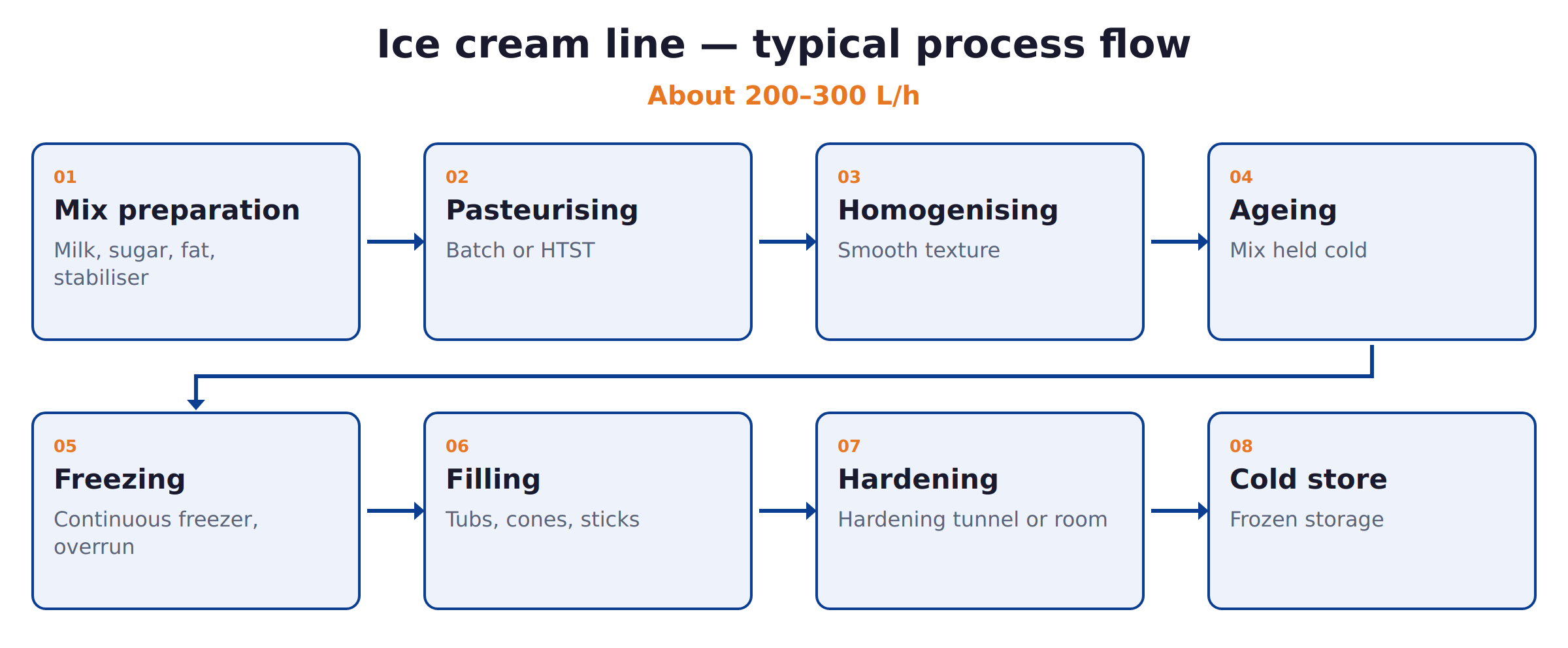
What an ice cream line contains
- Mix preparation: weighing, mixing tank, high-shear mixer for powders.
- Pasteurising: batch or plate pasteuriser with temperature recording.
- Homogenising: for a smooth texture.
- Ageing tanks: chilled tanks where the mix matures for several hours.
- Continuous freezer: freezes the mix and whips in air to the overrun you want.
- Filling: tubs, cones, cups or sticks; ingredient feeders for fruit and inclusions.
- Hardening: a blast freezer or hardening tunnel that takes product to storage temperature quickly.
- Cold storage and dispatch.
- Cleaning-in-place for tanks and pipework.
A cheap "line" is often steps 1 and 5 with a tub filler. The rest decides whether the product is safe, consistent and saleable.
Who sells ice cream equipment, and why prices differ
Shop and soft-serve machines are sold by catering dealers; this page is about factory lines. Factory lines come from agents of European ice cream equipment brands, Chinese factories selling complete small and medium lines, local dairy fabricators for tanks and mixing, and turnkey companies that deliver the whole plant. The same questions as for a dairy apply; our dairy equipment suppliers guide explains them.
Prices differ because of the freezer (capacity, overrun control, refrigerant), the pasteuriser and homogeniser, how much of the filling is automatic, and whether hardening and CIP are included.
The cheap line versus the line that sells
The listing price buys freezing. Selling ice cream to retailers needs a safe pasteurised mix, consistent overrun (air content), fast hardening so ice crystals stay small, a cold chain that never warms up, and labels that meet the regulations. Each of those is equipment and procedure, not a setting on the freezer.
What moves the price
- Capacity in litres per hour of finished ice cream at your overrun.
- Products: tubs only, or sticks, cones and moulded products.
- Automation: manual filling versus automatic fillers and packers.
- Hardening: a hardening tunnel or blast freezer, and the cold store.
- Utilities: chilled water, compressed air, refrigeration plant and electricity.
- Origin: European, Chinese or locally fabricated components.
Where the money goes
Expect the ice cream equipment to be well under half of a factory project. Refrigeration for hardening and storage, the building with its food-grade finishes, electrical supply, freight, installation and commissioning take most of the rest. Plants that save on hardening lose quality; plants that save on cold storage lose sales in summer.
Choose by scenario
| Situation | Usual choice |
|---|---|
| New small brand for local shops | Small 200–300 L/h line with tub filling and a hardening freezer |
| Dairy adding ice cream (expansion) | Mix preparation from existing dairy plant, new freezer, filling and hardening |
| Brand moving to retail chains | Line with automatic filling, coding and a hardening tunnel |
| Ice lolly and stick products | Moulding and stick lines, quoted per configuration |
How to compare ice cream line quotes
Ask each supplier for: output in litres per hour at a stated overrun, what is in mix preparation, pasteuriser type and recording, homogeniser, ageing tank volume, freezer model and refrigerant, filling formats, hardening capacity, CIP, utilities, installation and commissioning on your mix, and warranty. Add the missing items to each quote before comparing.
South African rules and costs that affect the line
- Import duty on the product. Ice cream containing cocoa or added sugar (2105.00.20) carries 25% general duty in SARS's 2026 tariff, and 25% from the EU and UK and EFTA too; it enters free only from SADC. Unsweetened ice cream (2105.00.10) carries 10%. That protection is unusually strong.
- Duty on equipment. Dairy machinery (8434.20) and industrial refrigerating equipment (8418.69.90) are free of general duty; but upright freezers up to 900 litres (8418.40.90) carry 25% and display freezers and cabinets (8418.50) 20%, which matters if you equip shops. Import VAT of 15% applies and VAT vendors reclaim it.
- Food premises and HACCP. The factory must meet R638 of 2018; the HACCP regulations (R908 of 2003) set out how a HACCP system is applied where it is required, and retail buyers expect one.
- Labels. Ice cream packs are labelled under R146 of 2010, including allergens such as milk and nuts.
- Dairy registration. Buyers and processors of raw milk must register with Milk SA under the 2017 statutory measure; if you make your mix from fresh milk, that includes you.
- Shelf monitoring. The Dairy Standard Agency monitors dairy products nationally.
Configurations and lead times
Small lines are usually built to order in a few weeks and shipped in one container; sea transit from China to Durban is typically about 22–30 days. Factory lines with hardening tunnels take longer and are planned with the building and refrigeration. Commission with your own mix and packaging before acceptance.
Where CISH fits
CISH supplies, installs and commissions complete ice cream lines from audited factories in China, with mix preparation, pasteurising, ageing, continuous freezing, filling, hardening and cold storage sized to your products, and commissioning on your mix. We suit new brands moving to factory production and dairies adding ice cream. We do not sell soft-serve or shop machines; catering dealers do.
Frequently asked questions
How much does an ice cream making machine cost?
For factory production, small 200–300 L/h lines are listed at about US$8,000–80,000 ex-works China in 2026, depending on what is included. A 300 L/h continuous freezer alone is about US$15,000. Larger plants are quoted per configuration.
What equipment do I need to start an ice cream factory?
Mix preparation, a pasteuriser, a homogeniser, ageing tanks, a continuous freezer, filling equipment, a hardening freezer, cold storage and a cleaning system, in a food-grade building.
What is overrun?
The amount of air whipped into ice cream during freezing, expressed as a percentage of the mix volume. It affects texture, cost per litre and what you can call the product, so state it when comparing output.
Is there import duty on ice cream in South Africa?
Ice cream containing cocoa or added sugar carries 25% general duty in SARS's 2026 tariff, including from the EU, UK and EFTA; it is free only from SADC.
Is there import duty on ice cream machines?
Dairy machinery and industrial refrigerating equipment are free of general duty. Upright freezers up to 900 litres carry 25% and display freezers 20%.
Does CISH sell soft-serve machines?
No. We supply complete ice cream production lines. For soft-serve or shop machines, a catering dealer is the right supplier.