Choose on the product you will sell (pasteurised, yoghurt, cheese, ESL or UHT), then on who will design the cleaning-in-place system, commission the line on your milk, and service the pasteuriser and filler.
Who supplies dairy processing equipment
A farmer bottling a few hundred litres a day and a processor packing UHT milk for a retailer will find themselves on the same supplier websites. They need different things. The useful split is by who is responsible for the product coming out safe, at the stated volume, after the supplier has left.
| Supplier type | What they sell | Price level | Lead time | Who commissions | Service | Best fit |
|---|---|---|---|---|---|---|
| Farm-dairy and small-dairy dealer | Vat pasteurisers, bulk milk coolers, small fillers, yoghurt and cheese vats, often imported or locally fabricated | Low to moderate | Short for stock items | The dealer, at the level of each machine | Local, mostly mechanical and refrigeration | Producer-distributors and farm processors up to a few thousand litres a day |
| Agent of a European processing brand | Engineered plants: plate pasteurisers, separators, homogenisers, UHT, aseptic fillers | Highest | Months | The brand's engineers | Strong on their own equipment | Large processors and UHT plants |
| Chinese factory, direct | Skid-mounted pasteurising, ESL and UHT systems, tanks, CIP units, fillers | Lowest on the quote | Build plus shipping and clearance | You, unless an engineer visit is bought | Remote | Processors with in-house process engineers |
| Turnkey line company | Reception to filling and cold store, including CIP and utilities, installed and commissioned under one contract | Between direct and European | One programme | The turnkey company, on your milk, at the agreed litres per hour | Contracted for the whole line | Farm processors moving to a plant, and processors adding a product |
Mixed solutions are common and often sensible: a European filler on a Chinese UHT skid, or a locally fabricated reception and storage tank farm with an imported pasteuriser. What matters is that someone takes responsibility for the whole line, especially the cleaning system that touches every part of it.
Decide the product before you choose the supplier
Dairy suppliers specialise. A company excellent at farm vat pasteurisers may never have commissioned a UHT plant, and a UHT specialist is overkill for a yoghurt start-up. Settle these first:
- Pasteurised fresh milk: short shelf life, a cold chain to the shop, the lowest entry cost.
- Cultured products: yoghurt, maas and amasi need fermentation tanks or cup incubation, and cup or bottle fillers.
- Cheese: vats, moulds, presses and a ripening room; labour and know-how matter as much as equipment.
- ESL (extended shelf life): higher heat treatment and cleaner filling, longer distribution.
- UHT: ambient shelf life, an aseptic filler, and a much bigger investment and skill requirement.
Our dairy processing line guide explains the pasteurised, ESL and UHT choice and how to size it in litres per hour.
What separates good dairy suppliers from the rest
They design the CIP, not just the process
Cleaning-in-place is where small dairy plants fail. Every tank, pipe and heat exchanger has to be cleaned and sanitised reliably, with the right chemical concentrations, temperatures and flow. A supplier who quotes the pasteuriser and filler but leaves CIP as an option is leaving out the part that keeps your product safe.
They commission on your milk
Milk varies by season and herd. A line that runs well on the factory test water is not commissioned. Ask that commissioning end with product made from your milk, at the agreed rate, passing your laboratory tests.
They can show a working plant
Ask for a dairy you can visit that runs the same equipment class, and ask the processor how the line handles cleaning, changeovers and the summer peak.
Where to find dairy equipment suppliers
- SAMPRO. The South African Milk Processors' Organisation represents processors and is a starting point for understanding who works in the sector.
- Milk SA and the MPO. The industry's umbrella body and the Milk Producers' Organisation publish industry data and run projects such as the Lacto Data statistics; producer-processors use their networks to share experience of suppliers.
- Food processing shows. FoodPro, with Propak Africa at the Johannesburg Expo Centre (7–10 March 2028), brings together processing and filling suppliers.
- Other processors. There are relatively few processors, so most suppliers have a South African reference you can visit. Ask for it.
- China. Skid-mounted dairy systems from Chinese factories are common in Africa; read our supplier audit checklist before paying.
This page does not name or rate suppliers. Use the checklist below on each one.
How to choose: a 10-point dairy equipment checklist
- Product and process: the supplier has commissioned your product type (pasteurised, cultured, cheese, ESL or UHT) before.
- Capacity in litres per hour: stated for the whole line, with the shift pattern and cleaning time included.
- Heat treatment control: temperature recording and automatic flow diversion on the pasteuriser.
- CIP: included, with the circuits, tanks and chemical dosing listed.
- Materials: stainless grades and gaskets suitable for food contact and for your cleaning chemicals.
- Utilities: steam or hot water, chilled water, compressed air and electrical load stated.
- Filling and packaging: bottle, pouch, cup or carton, with the filler's hygiene class matched to the product's shelf life.
- Commissioning on your milk: to an agreed rate and product test.
- Training: operators, cleaning staff and maintenance.
- Support: who services the separator, homogeniser and filler, and how parts are supplied.
Ten questions for a dairy equipment supplier
- Which dairies in South Africa run this equipment, and can I visit one?
- What output will you commit to, in litres per hour, for my product?
- How is the pasteurising temperature controlled and recorded, and what happens if it drops?
- What does the CIP system include, and how long does a cleaning cycle take?
- What utilities does the plant need, and what are the consumptions?
- Which parts are your own manufacture and which are bought in?
- Is installation and commissioning included, and does commissioning use my milk?
- What training is included?
- What does the warranty cover?
- Who services the line after year one, and where are they based?
Comparing dairy line quotes
| Part of the plant | Check in each quote |
|---|---|
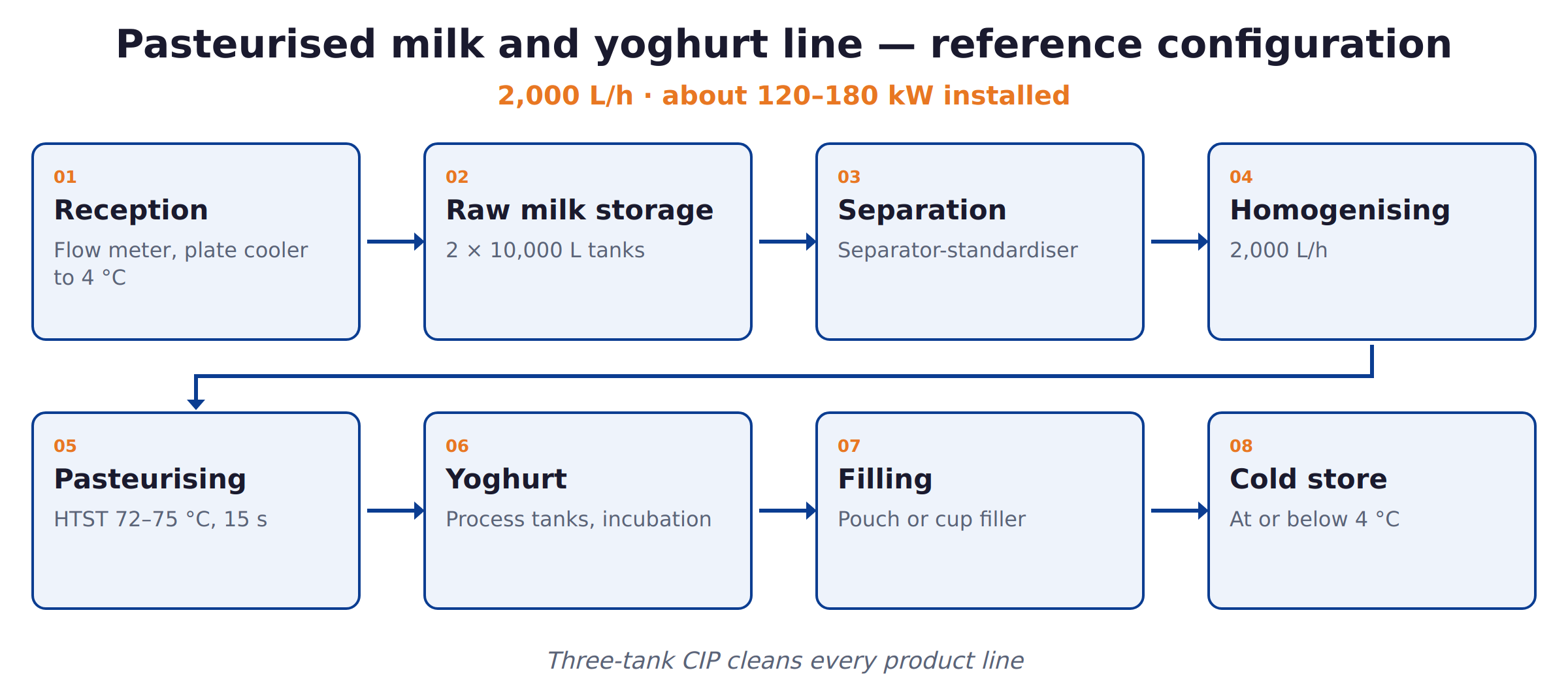
| Milk reception | Metering, filtration, cooling, raw-milk storage tanks |
| Separation and standardisation | Separator, standardisation, homogeniser if needed |
| Heat treatment | Pasteuriser, ESL or UHT system, holding tube, recording and flow diversion |
| Product processing | Fermentation tanks, cheese vats, buffer tanks |
| Filling and packaging | Filler type and speed, capping or sealing, coding, crating |
| CIP | Number of circuits, tanks, dosing, controls |
| Utilities | Boiler or hot water, chiller or ice bank, compressed air, water treatment |
| Cold storage | Finished-product cold room size and temperature |
| Installation and commissioning | Pipework, engineer days, commissioning on product |
| Training, documents, warranty | Days, manuals, electrical and P&ID drawings, warranty terms |
| Owner's scope | Building, drainage and effluent, power and water supply, laboratory |
Total each quote with everything it leaves out before comparing. Our page on comparing quotes on the same scope shows how.
From a delivered project: Extending an existing dairy rather than building new can be the faster route: a regional producer added a UHT skid, aseptic surge tank, aseptic filler and reworked CIP to its chilled line in about 18 weeks from order to SAT. Read the dairy UHT upgrade case study.
Common mistakes buying dairy equipment
- Leaving out CIP or buying a manual cleaning setup for a plant that runs every day.
- Oversizing the heat treatment. A pasteuriser running far below its rating wastes energy and complicates control.
- Under-sizing cooling. Milk reception and finished-product cooling decide quality as much as the pasteuriser.
- Ignoring effluent. Dairy wastewater is high in organic load; the municipality will want to know how it is treated.
- Choosing UHT before the market is there. UHT brings ambient distribution and national retail, but also a far larger investment; many processors start with pasteurised and cultured products.
Dairy line prices in 2026
Indicative equipment bands in USD, from our dairy line sizing and cost guide:
| Line | Indicative band (2026) |
|---|---|
| HTST pasteurised, small | US$50k–125k |
| HTST pasteurised, medium | US$125k–310k |
| HTST pasteurised, large | US$310k–875k |
| ESL line | US$250k–750k |
| UHT indirect, small | US$190k–500k |
| UHT indirect, medium | US$500k–1.1M |
| UHT direct (steam injection) | US$750k–1.9M |
South African facts that affect your choice
- Product rules. The regulations relating to milk and dairy products, R1555 of 1997, set the composition and labelling requirements for dairy products, so the line must make product that meets them.
- Milk collection. R961 of 2012 covers hygiene at milking sheds and the transport of milk, which affects what your reception and cooling must handle.
- Food premises. The processing plant is a food premises under R638 of 2018, inspected for hygiene, layout and cleanability.
- Registration with Milk SA. A statutory measure published in Government Gazette 41321 on 15 December 2017 requires buyers and processors of raw milk, and importers of dairy products, to register with Milk SA.
- Product monitoring. The Dairy Standard Agency runs national monitoring of milk and dairy products, so products are tested on the shelf, not only at your gate.
- Fewer, larger farms. Industry figures put South Africa at 879 milk producers in January 2026, against 1,253 in January 2020, with output per producer rising.
- Fewer processors. The number of milk processors fell from 131 in January 2020 to 119 in January 2026, and producer-distributors from 77 to 56 (Lacto Data, June 2026).
- Import duty. Dairy machinery classified under heading 8434 is free of general duty in SARS's 2026 tariff. Some heat exchange units classified under 8419.50 carry duty, so confirm how your pasteuriser and plate heat exchanger are classified with your clearing agent. See our import duty guide.
Where CISH fits
CISH is a turnkey dairy line company. We specify pasteurising, cultured, ESL and UHT lines from audited Chinese factories, with European components where they make sense, design the CIP and utilities around them, ship and clear the equipment, and install and commission the line on your milk at the agreed litres per hour, with your team trained. We suit farm processors moving to a proper plant and processors adding a product. For a vat pasteuriser and a small filler, a local dairy dealer will usually serve you better.
Adding yoghurt? See yoghurt making machine prices.
New to dairy? Our guide to starting a dairy processing business in South Africa covers milk supply, R1555 and Milk SA registration.
Frequently asked questions
Who sells dairy processing equipment in South Africa?
Farm-dairy and small-dairy dealers, agents of European processing brands, Chinese factories selling direct, and turnkey line companies. Small farm processors usually buy from dealers; plants processing several thousand litres an hour usually involve imported lines.
How much does a small milk processing plant cost?
As an indication for 2026, a small HTST pasteurised-milk line costs about US$50k–125k in equipment, and a small indirect UHT line about US$190k–500k. Building, utilities, installation and cold storage come on top.
Do I need to register to process milk?
Yes. A 2017 statutory measure requires buyers and processors of raw milk, and importers of dairy products, to register with Milk SA. Your plant must also meet the food premises and dairy product regulations.
Is CIP really necessary for a small dairy?
For any plant running daily, yes. Manual cleaning of pipes, tanks and heat exchangers is slow and unreliable, and cleaning failures are the most common cause of spoilage and safety problems in small dairies.
Should I start with UHT or pasteurised milk?
Most new processors start with pasteurised milk and cultured products, which need less capital and less specialist skill. UHT makes sense when you have ambient distribution and the volume to justify an aseptic filler.
Is there import duty on dairy machinery?
Dairy machinery under heading 8434 is free of general duty in SARS's 2026 tariff, but some heat exchange units under 8419.50 carry duty. Import VAT of 15% applies and VAT vendors can claim it back.
Does CISH supply single dairy machines?
No. We supply, install and commission complete dairy processing lines. For a single pasteuriser or cooler, a local dealer is usually the better route.