Cooling is usually the longest stage, so wall thickness and mould cooling decide most of the cycle time. The cost of each part is the resin it contains plus the machine time, labour and mould cost spread over the parts made.
The cycle at a glance
| Stage | What happens | What sets the time |
|---|---|---|
| 1. Clamp | Mould closes and the clamp locks it shut | Machine speed, mould size |
| 2. Inject | Screw pushes molten plastic into the cavities | Shot size, injection speed, gate design |
| 3. Hold (pack) | Pressure kept on so the part does not shrink away from the cavity | Material, wall thickness, gate freeze |
| 4. Cool | Part cools until it is rigid enough to eject; screw recovers the next shot | Wall thickness, mould cooling, material |
| 5. Open and eject | Mould opens, ejector pins push the part out, robot or operator removes it | Machine speed, part removal |
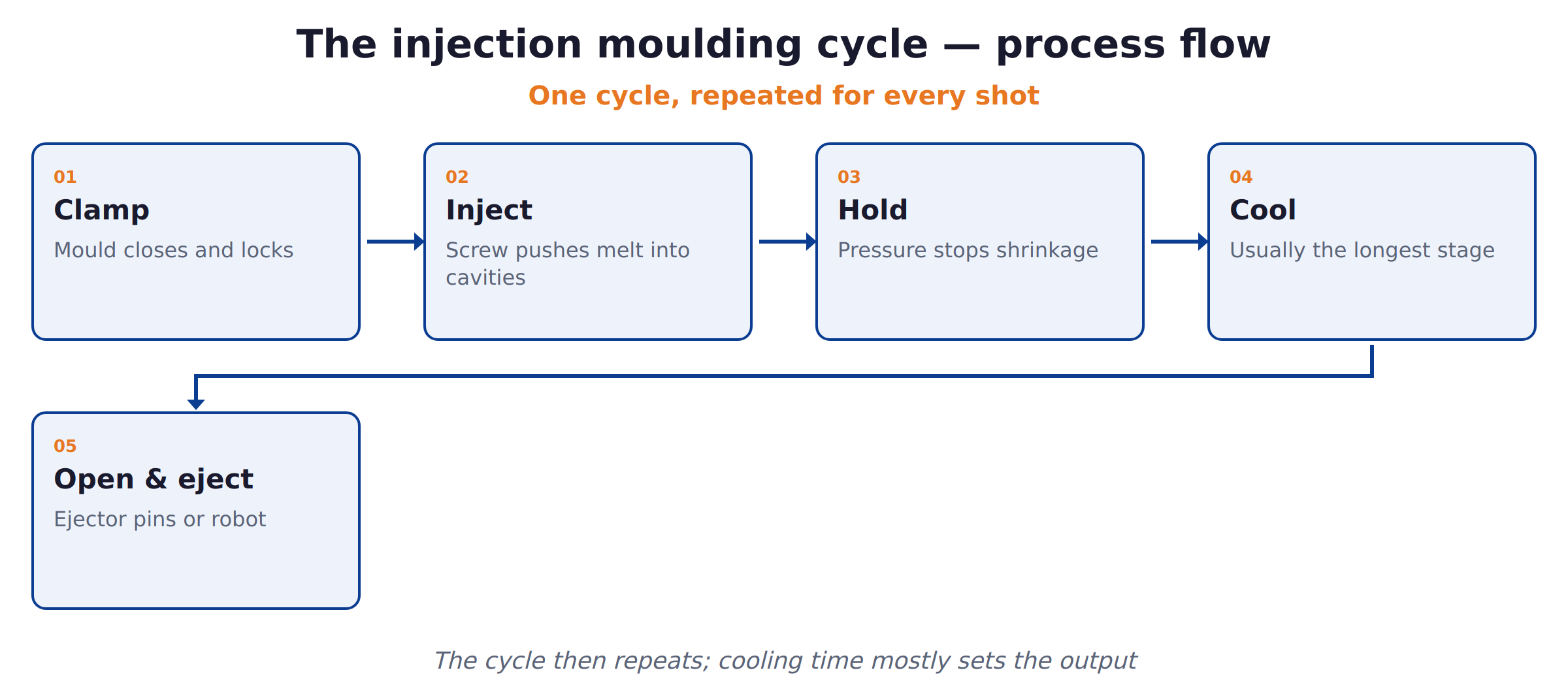
Stage by stage
Plasticising: before the cycle starts
Plastic pellets are dried if needed (PET, nylon and PC absorb water), fed from a hopper into the barrel, and melted by heater bands and the shearing of a rotating screw. The screw moves back as it rotates, building up a measured shot of melt in front of it. This happens during the cooling stage of the previous cycle.
Clamping
The clamp, hydraulic, toggle or electric, closes the two halves of the mould and holds them with enough force to resist the injection pressure. Clamp force, in tonnes, is how machines are sized; our tonnage guide explains how to work it out from the part's projected area.
Injection
The screw moves forward like a plunger and pushes melt through the nozzle, runner and gates into the cavities. Injection is fast, often a second or two. Too slow and the plastic freezes before the cavity fills; too fast and you get burn marks or flash.
Holding
Plastic shrinks as it cools. Holding pressure pushes in a little more melt to make up for it until the gate freezes. Too little holding gives sink marks and short parts; too much gives stress and flash.
Cooling
The part stays in the closed mould while water flowing through channels in the steel takes heat away. Cooling time rises steeply with wall thickness, roughly with its square, so a part with 4 mm walls needs far more cooling than one with 2 mm walls. Good mould cooling and a chiller are the cheapest ways to shorten cycles.
Ejection
The mould opens, ejector pins push the part off the core, and a sprue picker or robot removes it, or it drops onto a conveyor. Hot runner moulds avoid making a runner with every shot; cold runner moulds produce runners that are reground and fed back in a set proportion.
What a moulding cell includes
| Item | Why it matters |
|---|---|
| Injection moulding machine | Clamp force and shot size for your part |
| Mould | Cavities, cooling, hot or cold runner; usually the biggest single variable |
| Dryer and hopper loader | For hygroscopic materials and steady feeding |
| Mould temperature controller and chiller | Stable mould temperature, shorter cycles |
| Robot or sprue picker | Consistent cycles and less labour |
| Granulator | Regrind for runners and rejects |
| Conveyor and packing | Takes parts away and counts them |
| Compressed air and power | Sized for the whole cell |
Working out the cost of a part
The cost of a moulded part has four main pieces. The figures below are an example only; replace them with your own quotes and tariffs.
Example assumptions: a 20 g polypropylene part in a 4-cavity mould, a 20-second cycle, 85% of hours producing good parts, resin at R25 per kg, a machine-and-power rate of R180 per hour, one operator shared across two machines at R90 per hour, and a mould costing R250,000 written off over 2 million parts.
| Item | Calculation | Cost per part |
|---|---|---|
| Parts per hour | 3,600 s ÷ 20 s × 4 cavities × 85% | About 612 |
| Resin | 20 g × R25/kg, plus 3% scrap | About R0.52 |
| Machine and power | R180 ÷ 612 | About R0.29 |
| Labour | R45 (half an operator) ÷ 612 | About R0.07 |
| Mould | R250,000 ÷ 2,000,000 | About R0.13 |
| Total before overheads | About R1.01 |
Three things stand out in almost every calculation like this:
- Resin is usually the largest cost, so part weight and scrap rate matter most.
- Cavities and cycle time drive the machine cost per part, so a better mould often saves more than a cheaper machine.
- The mould has to pay for itself over the volume you will actually sell.
What machines and moulds cost
Indicative, in USD:
| Purchase | Indicative price (2026) |
|---|---|
| Industrial machine, 150–300 tonnes | About US$30,000–75,000 ex-works (a 180 t servo machine about US$44,000–52,000) |
| Larger machine, 400–500 tonnes | From about US$100,000 ex-works |
| Mould | Quoted per part; simple single-cavity moulds cost far less than multi-cavity hot runner moulds |
| Auxiliaries (dryer, chiller, robot, granulator) | Quoted with the cell |
Servo-driven hydraulic and all-electric machines use much less power than older fixed-pump machines. With Eskom's standard tariffs up 8.76% for 2026/27, energy belongs in every machine comparison.
Duty, permits and materials
- Machines and moulds. Injection moulding machines (8477.10) and injection moulds (8480.71) carry no general import duty; 15% import VAT applies.
- Used machines. Importing second-hand machinery needs an ITAC import permit before shipment.
- Material supply. Plastics SA reported domestic plastics consumption of 2.063 million tonnes in 2025 and 485,000 tonnes recycled; recycled pellets can cut resin cost for suitable parts.
Common defects and their usual causes
| Defect | Usual cause |
|---|---|
| Short shot | Not enough material, pressure or speed; cold mould |
| Flash | Clamp force too low, worn mould, too much pressure |
| Sink marks | Holding pressure or time too low; thick sections |
| Warping | Uneven cooling; ejecting too hot |
| Burn marks | Trapped air; injection too fast |
| Splay or silver streaks | Wet material; not dried |
From a delivered project: A Johannesburg injection moulding cell about to buy a fifth machine first spent about R280,000 on a three-week visibility retrofit; the data showed scrap on two products, night-shift cycle drift and one mould running 14% slow, and fixing them recovered about 17 points of OEE, so the fifth machine was deferred. Read the OEE retrofit case study.
Common mistakes
- Choosing the machine before the mould. The mould decides cycle and cavities.
- Ignoring cooling. A chiller and good mould cooling pay back quickly.
- No dryer for PET, nylon or PC.
- Writing off the mould over volume you will not sell.
- Pricing parts without scrap and downtime.
Where CISH fits
We specify complete moulding cells, machine, mould, auxiliaries and packing, from audited factories in China against your part, material and monthly volume. We ship and clear them, install and commission the cell with cycle time and part quality demonstrated, and train your setters and operators. For a single standard machine for an existing shop, a local dealer is often the better route.
Frequently asked questions
What are the stages of injection moulding?
Clamping, injection, holding, cooling and ejection. The screw melts the next shot during cooling.
What decides the cycle time in injection moulding?
Mostly cooling time, which rises steeply with wall thickness. Mould cooling, material and machine speed also matter.
How do I calculate the cost of an injection moulded part?
Add the resin in the part, including scrap, to the machine, power, labour and mould costs divided by the good parts made per hour or over the mould's life.
How much does an injection moulding machine cost?
As an indication for 2026, an industrial 150–300 tonne machine costs about US$30,000–75,000 ex-works. The mould is priced separately.
Is injection moulding machinery duty-free in South Africa?
Machines and injection moulds carry no general duty. Import VAT of 15% applies, and used machines need an ITAC import permit.
Does CISH make moulds?
We specify and supply moulds with the moulding cell from audited mould makers in China, matched to the machine and your part.