Choose on the part: the supplier should size clamp tonnage and shot size from your part and mould, quote the chiller, dryer and robot the cell needs, and show you local service for the hydraulics and controls.
Four routes to an injection moulding machine
| Route | What you get | Price | Delivery | Service | Who it suits |
|---|---|---|---|---|---|
| Local agent of a machine brand | New machines from one brand, local stock of some sizes, service engineers | Moderate to high | Stock to a few months | Usually the strongest locally | Moulders standardising on a brand |
| Used machine dealer | Refurbished machines of many brands | Lowest per tonne | Quick | Varies widely | Moulders adding capacity on a budget |
| Chinese factory, direct | New hydraulic or servo machines, often with auxiliaries offered | Low on the quote | Build plus shipping and clearance | Remote unless arranged | Moulders with their own maintenance team |
| Turnkey moulding cell company | Machine, mould, chiller, dryer, loader, robot and conveyor, installed and commissioned on your part | Depends on scope | One programme | Contracted for the cell | New moulding businesses and producers bringing moulding in-house |
Buying used? Second-hand machinery imported into South Africa needs an ITAC import permit, applied for before shipment; ITAC does not charge for it. Our customs clearance guide covers the paperwork.
Start from the part, not the machine
The size of an injection moulding machine follows from the part and the mould:
- Clamp tonnage from the projected area of the part and the plastic's pressure.
- Shot size from the part weight plus runners, with margin.
- Mould size from the tie-bar spacing and opening stroke the mould needs.
- Cycle time from wall thickness and cooling.
A supplier who recommends a tonnage before seeing your part drawing is guessing. Our tonnage guide walks through the calculation.
What to compare between suppliers
Hydraulic, servo-hydraulic or all-electric
Servo-hydraulic machines use noticeably less electricity than fixed-pump hydraulics; all-electric machines use less again and repeat more precisely, at a higher price. With Eskom's standard tariffs rising 8.76% from April 2026, power per kilogram moulded is a real line item in your costing.
Who makes the mould
The mould decides part quality and cycle time more than the machine. Ask who designs and makes the mould, from what steel, with how many cavities, and who maintains it. Moulds are often where a cheap project turns expensive.
The auxiliaries
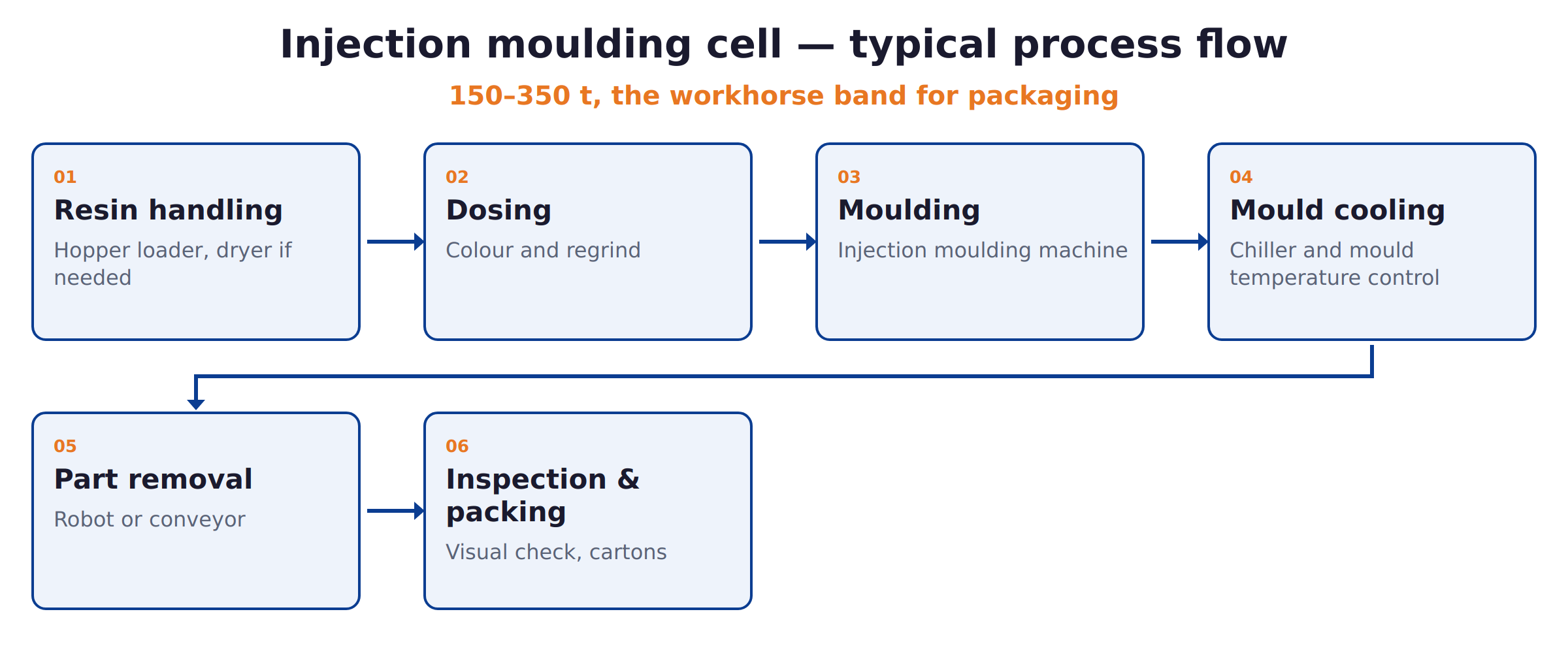
A moulding cell needs a chiller or cooling tower, a material dryer for hygroscopic plastics, loaders, sometimes a mould temperature controller, a robot or picker, and a granulator for runners. Many machine quotes include none of them.
Where to find injection moulding suppliers
- Pro-Plas, held with Propak Africa at the Johannesburg Expo Centre on 7–10 March 2028, is the main South African show for plastics machinery.
- Plastics SA, the industry's umbrella body, publishes consumption and recycling data and runs training for the sector.
- Polymer distributors know which moulders run which machines and materials.
- Other moulders: visit a plant running similar parts; ask about breakdowns and service response.
- China: most new mid-tonnage machines sold in Africa come from China; read our supplier audit checklist before ordering.
Company names are intentionally absent here; use the checklist below to judge any supplier.
Checklist: ten points before you order
- Part drawing and material supplied to every supplier.
- Tonnage and shot size calculated, with margin.
- Mould fit: tie-bar spacing, daylight and ejector stroke.
- Drive type: hydraulic, servo or electric, with power per kilogram stated.
- Mould: designer, steel, cavities, cooling, and trial shots before acceptance.
- Auxiliaries: chiller, dryer, loader, robot, granulator listed.
- Controls: process monitoring and recipe storage.
- Safety: guarding and interlocks under the OHS Act machinery rules.
- Installation, commissioning and training in the price.
- Local service: engineers, hydraulic and electronic spares, response arrangement.
Ten questions to put to a supplier
- What tonnage and shot size do you recommend for my part, and how did you calculate it?
- Will my mould fit between the tie bars and open fully?
- Is the machine hydraulic, servo or electric, and what does it use per kilogram?
- Who makes the mould, and what trial shots will I see?
- Which auxiliaries are included?
- What cycle time do you expect for my part?
- Who installs and commissions the cell?
- What training is included?
- What does the warranty exclude?
- Who services the machine locally, and how fast can they come?
What a complete moulding cell quote includes
| Item | What to check |
|---|---|
| Machine | Tonnage, shot size, tie-bar spacing, drive type, controller |
| Mould | Design, steel, cavities, hot runner or cold runner, trial shots |
| Cooling | Chiller or cooling tower, mould temperature controller |
| Material handling | Dryer, loader, mixer |
| Automation | Picker or robot, conveyor |
| Recycling | Granulator for runners and rejects |
| Installation and commissioning | Engineer days, first-article approval |
| Training and documents | Operators, setters, maintenance; manuals |
| Owner's scope | Floor loading, power supply, cooling water, compressed air |
Before comparing, add the cost of whatever each quote leaves out; our same-scope method explains it.
Where projects go wrong
- Tonnage chosen from the brochure, not the part.
- A cheap mould. It costs more in rejects and downtime than it saved.
- No dryer for nylon, PET or PC. Wet material gives brittle parts.
- Underestimating power. Large hydraulic machines are heavy electrical loads.
- Ignoring packaging rules. Packaging producers now carry extended producer responsibility obligations.
Injection moulding machine prices in 2026
Indicative, in USD, from our tonnage and price guide:
| Machine | Indicative price (2026) |
|---|---|
| 150–300 tonne industrial machine | US$30,000–75,000 (a 180 t servo machine about US$44,000–52,000) |
| 400–500 tonne machine | From about US$100,000 |
| Complete cell with mould and auxiliaries | Quoted per configuration |
The South African context
- A shrinking virgin market. Plastics SA reported that domestic plastics consumption fell from 2.114 million tonnes in 2024 to 2.063 million tonnes in 2025, with virgin polymer down from 1.656 to 1.610 million tonnes.
- More recycled content. Mechanical recycling rose to 485,000 tonnes in 2025 and the output recycling rate to 30.1%, so recycled material is a growing share of feedstock; choose machines and screws that can process it.
- Extended producer responsibility. The EPR Regulations, 2020 (GN 1184), in force since May 2021, place obligations on producers of packaging, which affects packaging moulders and their customers.
- Electricity. Eskom's standard tariffs rose 8.76% from 1 April 2026.
- Product versus machine duty. Imported plastic bottles (3923.30) and carrier bags (3923.21.07) carry 15% duty, while injection moulding machines (8477.10) and injection moulds (8480.71) are free of general duty in SARS's 2026 tariff, which favours local moulding. VAT-registered moulders reclaim the 15% import VAT.
From a delivered project: A Johannesburg injection moulding cell about to buy a fifth machine first spent about R280,000 on a three-week visibility retrofit; the data showed scrap on two products, night-shift cycle drift and one mould running 14% slow, and fixing them recovered about 17 points of OEE, so the fifth machine was deferred. Read the OEE retrofit case study.
Where CISH fits
CISH supplies, installs and commissions complete injection moulding cells and lines: the machine sized to your part, the mould, cooling, drying, handling and automation, built by audited factories in China and handed over after first-article approval on your part. We suit producers bringing moulding in-house and new moulding businesses. For one used machine, a local dealer is usually the quicker route.
New to plastics? Read how to start a plastic manufacturing business before choosing machines.
Making pipe rather than moulded parts? Our guide to PVC and HDPE pipe extrusion line suppliers covers the SANS tests the line must pass.
Frequently asked questions
Who sells injection moulding machines in South Africa?
Local agents of machine brands, used machine dealers, Chinese factories selling direct, and turnkey companies that supply complete moulding cells. Many moulders combine a new machine with local service.
How much does an injection moulding machine cost?
As an indication for 2026, a 150–300 tonne industrial machine costs about US$30,000–75,000; 400–500 tonne machines start above US$100,000. Moulds and auxiliaries are extra.
How do I choose the right tonnage?
From the projected area of the part and the plastic's moulding pressure, with margin, and checked against the mould's size. Our tonnage guide shows the method.
Is a servo machine worth the extra cost?
Usually, where machines run long hours. Servo-hydraulic drives cut electricity use compared with fixed pumps, and electricity tariffs keep rising.
Can I import a used injection moulding machine?
Yes, but second-hand machinery needs an ITAC import permit before it is shipped. New machines do not.
Is there import duty on injection moulding machines?
Injection moulding machines (8477.10) and injection moulds (8480.71) are free of general duty in SARS's 2026 tariff. Import VAT of 15% applies.
Does CISH sell single injection moulding machines?
We supply complete moulding cells and lines, installed and commissioned on your part. For a single machine, a local agent or dealer may suit you better.