Choose the supplier who will commit to whole-kernel recovery or output on your nuts, and who designs for the aflatoxin and export inspection rules.
Who supplies nut processing equipment
Three different businesses search for nut processing equipment: macadamia and pecan growers or co-operatives who want to crack, sort and dry their own crop, groundnut processors making roasted nuts and peanut butter, and snack makers adding a nut line. The suppliers below serve them differently.
| Supplier type | Typical offer | Price | Who answers for the result | Best fit |
|---|---|---|---|---|
| Local machinery builder | Dehuskers, silos and dryers, crackers adapted to local cultivars, conveyors | Moderate | The builder, machine by machine | Growers and co-ops near the orchards |
| Agent of an imported sorting or drying brand | Optical sorters, drying systems, packing machines | High per machine | The agent, for their brand | Large crackers and export packers |
| Chinese factory, direct | Crackers, shellers, roasters, blanchers, colloid mills, peanut butter lines | Lowest on the quote | You, once delivered | Buyers with their own engineers and a tested product |
| Turnkey line company | Receiving to packing, installed and commissioned under one contract | Between direct and imported | The turnkey company, at an agreed output or recovery | Groundnut processors and co-ops building a first plant |
Different nuts, different plants
A supplier strong in one nut may know little about another. Be clear which you are buying for:
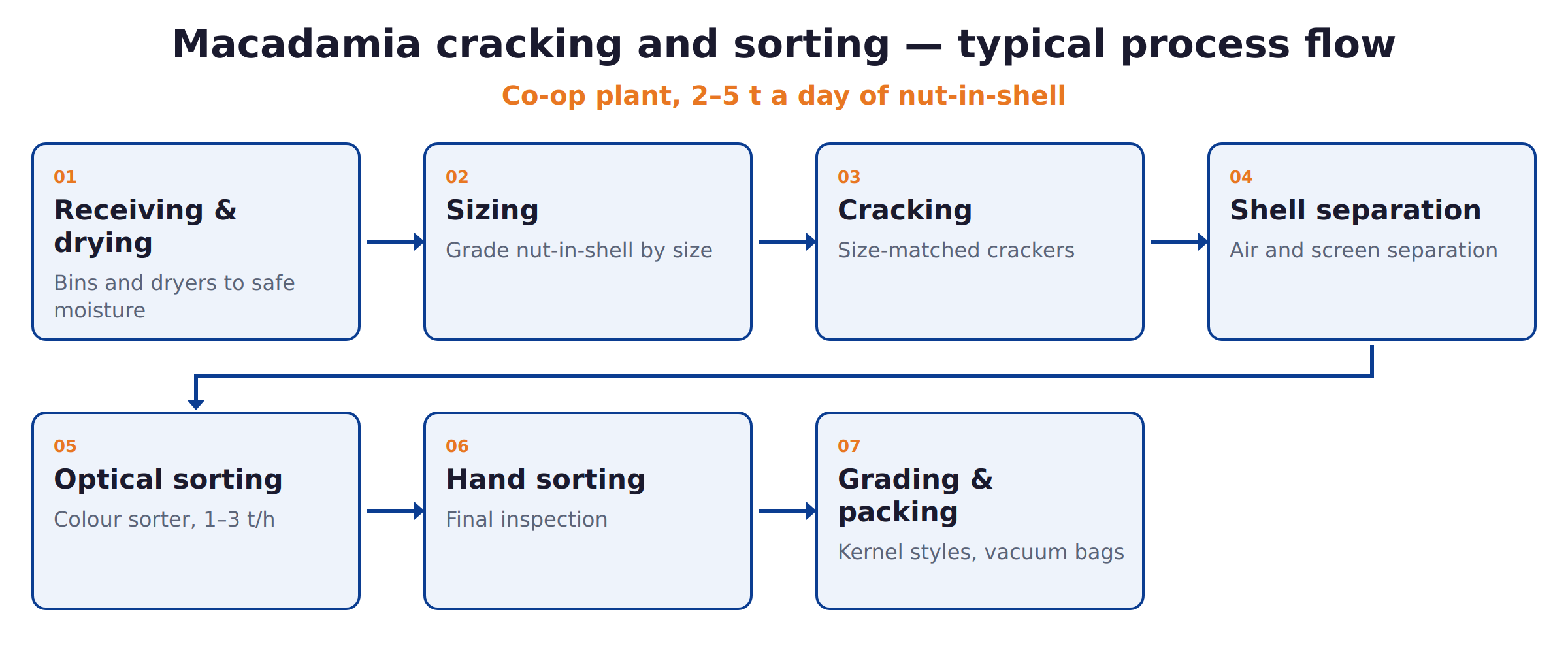
- Macadamia: dehusking, drying to low moisture in bins or silos, cracking, kernel sorting into styles, and vacuum or nitrogen packing. Whole-kernel recovery decides the price you get.
- Pecan: sizing, cracking and shelling, separating shell from kernel, grading by colour and size.
- Groundnuts: cleaning, shelling, blanching, roasting, then either packing roasted nuts or grinding peanut butter. Aflatoxin control runs through every step.
Three things to test before you buy
Whole-kernel recovery or output, on your nuts
Cracking machines are rated in kilograms per hour, but what matters for macadamia and pecan is the share of whole kernels. Ask for a trial on a sample of your own crop and for the result to be written into the contract. For groundnuts, ask for output in kilograms per hour of finished product at your roast and fineness.
Sorting and aflatoxin control
Optical sorting is where kernel value and food safety meet. Ask what the sorter rejects, how it is set, and how the line keeps contaminated product from reaching the pack. South Africa's new regulations on maximum levels of mycotoxins in foodstuffs (Notice 7091, published on 6 February 2026) start 24 months after publication and will replace the current aflatoxin limits, so design for the new rules now.
Drying and storage
Nuts that are cracked too wet or stored badly lose value fast. The drying system, bins and storage conditions are part of the plant, not an extra.
Where to find nut processing equipment suppliers
- SAMAC, the macadamia industry association, registers growers, processors and exporters and is the hub for the industry's technical information.
- SAPPA, the pecan producers' association, connects pecan growers and processors.
- The SA Groundnut Forum and grain industry publications cover the groundnut value chain and its processors.
- Trade shows: FoodPro with Propak Africa at the Johannesburg Expo Centre, 7–10 March 2028.
- Other processors: ask any supplier for a plant you can visit running the same nut.
- China: most groundnut and peanut butter lines sold in Africa are built in China; read our supplier audit checklist first.
We do not name or rate suppliers on this page.
How to choose: a 10-point checklist
- The nut: the supplier has processed your nut type and cultivar before.
- Recovery or output committed in writing, from a trial on your sample.
- Drying: moisture target, drying time and storage designed in.
- Sorting: optical or manual, reject rates and settings explained.
- Aflatoxin control: cleaning, sorting, roasting and testing points identified.
- Food-contact materials: stainless where the product is exposed; cleanable design.
- Packing: vacuum or nitrogen flushing for kernels; jars or tubs for peanut butter.
- Dust and shell handling: extraction, and a use for the shells as fuel where practical.
- Installation, commissioning and training in the price.
- Support for crackers, sorters and mills after year one.
Ten questions for any nut equipment supplier
- What whole-kernel recovery, or what output, will you guarantee on my nuts?
- Can you run a trial on my sample before I order?
- Which plants run this equipment, and can I visit one?
- How is moisture controlled from drying to packing?
- How does the sorter work, and what does it reject?
- Where in the line is aflatoxin controlled and tested?
- What does the line use in electricity and fuel per tonne?
- Is installation, commissioning and training included?
- What does the warranty cover?
- Who services the sorter and the cracker, and where are they based?
Comparing nut plant quotes
| Section | What to look for |
|---|---|
| Receiving and cleaning | Intake, pre-cleaning, destoning, dehusking |
| Drying and storage | Bins or silos, airflow and heat, moisture monitoring |
| Cracking or shelling | Machine type, capacity, recovery claim |
| Separation and sorting | Shell-kernel separation, optical sorting, manual sorting stations |
| Roasting and grinding | For groundnuts: blancher, roaster, cooler, colloid or stone mill |
| Packing | Weighing, vacuum or nitrogen packing, jar filling and capping |
| Utilities and dust | Compressed air, dust extraction, shell handling |
| Installation and commissioning | Engineer days, trial on your product |
| Training and documents | Days, manuals, settings for each product |
| Owner's scope | Building, power, drainage, laboratory |
Add what each quote leaves out before comparing totals. Our same-scope comparison explains the method.
Common mistakes
- Buying crackers before drying is solved. Wet nuts crack badly and spoil in store.
- Skipping the sorter. Manual sorting caps the plant and lets defects through.
- One line for every nut. Macadamia, pecan and groundnut equipment differs; a "universal" line usually suits none of them well.
- Ignoring the export rules. Export inspection requirements decide how and where product is checked before loading.
- Buying by machine rating. The line's speed is set by its slowest step, often sorting or packing.
Nut processing equipment prices in 2026
Indicative, in USD, from our nut processing plant cost guide:
| Purchase | Capacity | Indicative price (2026) |
|---|---|---|
| Single machine | 100–2,000 kg/h per machine | US$1,000–15,000 each |
| Optical colour sorter | 1–3 t/h per unit | US$10,000–35,000 per unit |
| Groundnut roast-and-butter core line | 300–700 kg/h | US$20,000–90,000 |
| Groundnut processing line, landed | 300–500 kg/h | US$120,000–300,000 |
| Co-op cracking and sorting plant | 2–5 t/day macadamia, or pecan equivalent | Quoted per configuration |
South African facts that shape the decision
- Macadamia volume. SAMAC forecast the 2026 crop at about 95,222 tonnes dry nut-in-shell, up about 17% on 2025.
- Export dependence. In 2024 South Africa exported about 44,104 tonnes of macadamia in shell and 18,508 tonnes of kernels, with about 95% of in-shell exports going to China; kernels are traded in 11 style categories. Local cracking adds value but needs sorting good enough for the kernel buyer.
- Industry levy and registration. SAMAC collects a statutory levy per kilogram of nut-in-shell and the industry's statutory measures require growers, processors and exporters to register.
- Pecans. South Africa is the world's third-largest pecan producer, with a 2026 harvest of about 53,000 tonnes in shell.
- Groundnuts. Average local crops of about 50,000–55,000 tonnes fall short of demand of about 84,000 tonnes a year; about 52% goes into peanut butter, and imports fill the gap.
- Aflatoxin rules. Current limits for peanuts are set in R1145 of 2004; the mycotoxin regulations in Notice 7091 of 2026 will replace them 24 months after publication.
- Export standards. Tree-nut exports are regulated under R.3484 of 2 June 2023, with inspection before export by the assignee; PPECB performs inspection services under the Agricultural Product Standards Act.
- Import duty. Nut processing machinery (8438.80), sorting machines (8433.60) and dryers (8419.34) are free of general duty in SARS's 2026 tariff. Import VAT of 15% applies and VAT vendors can claim it back; see our import duty guide.
Where CISH fits
CISH is a turnkey line company. We specify groundnut, peanut butter and nut cracking and sorting lines from audited factories in China, run trials on your sample before you order, ship and clear the equipment, and install and commission the line against an agreed output or recovery, with your team trained. We suit groundnut processors and co-operatives building a first plant. For a single cracker or a small roaster, a local builder or dealer is often the better choice.
Frequently asked questions
Who sells nut processing equipment in South Africa?
Local machinery builders serving the macadamia and pecan industry, agents of imported sorting and drying brands, Chinese factories selling crackers, roasters and peanut butter lines direct, and turnkey line companies. Which suits you depends on the nut and the scale.
How much does a peanut butter production line cost?
As an indication for 2026, a groundnut roast-and-butter core line of 300–700 kg/h costs about US$20,000–90,000 in equipment, and a landed groundnut processing line of 300–500 kg/h about US$120,000–300,000.
How much does a macadamia cracking plant cost?
A co-operative cracking and sorting plant for 2–5 tonnes a day is quoted per configuration, because drying, sorting and packing vary so much. Single crackers cost about US$1,000–15,000 and an optical sorter about US$10,000–35,000.
What is whole-kernel recovery?
The share of kernels that come out whole after cracking. For macadamia it largely decides the price you are paid, so ask a supplier to guarantee it from a trial on your nuts.
What aflatoxin rules apply in South Africa?
Current limits are in R1145 of 2004. New regulations on maximum levels of mycotoxins in foodstuffs were published as Notice 7091 on 6 February 2026 and take effect 24 months after publication.
Is there import duty on nut processing machines?
Nut processing machinery (8438.80), sorting machines (8433.60) and dryers (8419.34) are free of general duty in SARS's 2026 tariff. Import VAT of 15% applies.
Does CISH sell single nut crackers or roasters?
No. We supply, install and commission complete nut processing lines. For a single machine, a local builder or dealer is usually the better route.