Choose the supplier who will design to the Poultry Regulations, include chilling and effluent in the quote, and prove birds per hour at handover.
Who sells poultry abattoir equipment in South Africa
A search for abattoir equipment suppliers in South Africa mixes four businesses that do different jobs. A farmer adding a small slaughter room for 300 birds a day and a processor building a 2,000 bird-an-hour plant both see the same adverts, and the cheapest advert is rarely the right answer for either of them. Start by sorting your shortlist into these four groups.
| Supplier type | Typical offer | Price | Delivery | Design to the regulations | Installation and support | Suits |
|---|---|---|---|---|---|---|
| Local stainless fabricator | Killing cones, bleeding troughs, scald tanks, evisceration tables, washers, platforms; sometimes a plucker bought in | Moderate; strong on custom tables and steelwork | Weeks | Varies; some know the provincial approval process well | Close by, good for steelwork repairs; mechanical and refrigeration expertise varies | Rural and small low-throughput abattoirs, and steelwork for bigger plants |
| Agent of a European brand | Overhead lines, automatic evisceration, chilling, weighing and grading from one manufacturer | Highest | Months for an engineered line | Strong at high speed; the agent may rely on your consultant for local approvals | Factory-trained technicians for their own brand | Large plants running several thousand birds an hour |
| Chinese factory, direct | "Complete" lines quoted per set, from 300 to several thousand birds an hour | Lowest on the quote | Build plus shipping and clearance | Usually none; drawings and approval are your job | Remote; an engineer visit costs extra | Buyers with their own engineering and refrigeration team |
| Turnkey plant company | Slaughter line, chilling, cut-up, freezing, cold rooms, effluent pre-treatment, installation and training under one contract | Between direct and European | One programme from drawings to commissioning | Part of the scope: layout drawings prepared for submission | Contracted for the whole plant, against an agreed output | First commercial abattoirs and processors adding capacity |
Most real plants mix these. A local fabricator often supplies the stainless tables and platforms even when the line comes from abroad, and that is sensible. The question is who carries responsibility for the plant working as a whole.
Three questions that sort poultry equipment suppliers quickly
Do they know the Poultry Regulations?
In South Africa a poultry abattoir is registered under the Meat Safety Act, 2000, and the Poultry Regulations, 2006 require design drawings to be submitted to the provincial executive officer for evaluation and approval before the abattoir is erected. A supplier who sells machines but has never produced a layout for approval leaves that work to you. Ask to see a layout they prepared for another South African abattoir and how it went through the provincial process.
Is chilling and effluent in the quote?
Advertised "complete lines" often end at the evisceration trough. A plant needs a chiller, ice or refrigeration, cold storage for the product, and a way to deal with blood, feathers and wastewater that the municipality or your environmental authorisation will accept. If those are missing, you are not comparing like with like. Our poultry abattoir cost guide shows how much of the plant sits outside the slaughter machinery.
Can they prove birds per hour?
Line speed on a brochure is the shackle conveyor's speed, not the plant's output. The real output is set by the slowest step: evisceration labour, the chiller's capacity, or the packing room. Ask the supplier to state the output in birds per hour at your bird weight, with the number of people on the line, and to demonstrate it at handover. If they cannot show a running line at that speed, ask for the acceptance test to be written into the contract.
Size first: the regulations set the bands
The Poultry Regulations define the categories that most small and mid-sized buyers fall into, and the category decides which supplier makes sense:
| Category in the Poultry Regulations | Maximum throughput | What that means in equipment | Likely supplier |
|---|---|---|---|
| Rural poultry abattoir | 50 birds a day | Manual cones, scald pot, small plucker, tables | Local fabricator or dealer |
| Low-throughput poultry abattoir | 2,000 birds a day (the provincial executive officer may set a lower limit based on equipment and chilling) | A small line: shackles or cones, stunner, scalder, plucker, evisceration, spin chiller, cold room | Local fabricator, direct import or turnkey company |
| High-throughput abattoir | Above the low-throughput limit | An overhead line from 500 birds an hour upwards, mechanical chilling, freezing, cut-up and packing | Turnkey company or European agent |
One consequence surprises buyers. A 500 bird-an-hour line running an eight-hour shift kills 4,000 birds, twice the low-throughput limit. If you buy that line, you are building a high-throughput abattoir, with the layout and staffing that implies, even if you planned a small plant. Decide the registration category before you choose the line speed.
Where to find poultry equipment suppliers
- The South African Poultry Association. Established in 1904, SAPA represents the industry, including its broiler organisation, and lists allied members and accredited suppliers. It also runs AVI Africa, its poultry congress and exhibition, where processing equipment suppliers exhibit.
- Provincial veterinary services. The officials who approve abattoir designs see many plants. They do not recommend suppliers, but they can tell you what an approvable layout needs, which is the best test of a supplier's drawings.
- Other abattoir owners. Visit a plant of the size you want. Ask what the line does per hour on a normal day, how many people it takes, and what broke in the first year.
- Trade shows. FoodPro, held with Propak Africa at the Johannesburg Expo Centre (next edition 7–10 March 2028), covers food processing more broadly.
- China. Chinese factories build a large share of small and mid-sized poultry lines. Read our supplier audit checklist before you pay a deposit.
This page does not name or rate suppliers. Use the checklist below on each one you consider.
How to choose: a 10-point checklist for poultry equipment
- Output in writing: birds per hour at your live weight and staffing, demonstrated at handover.
- Layout for approval: drawings suitable for submission under the Poultry Regulations, with clean and dirty areas separated.
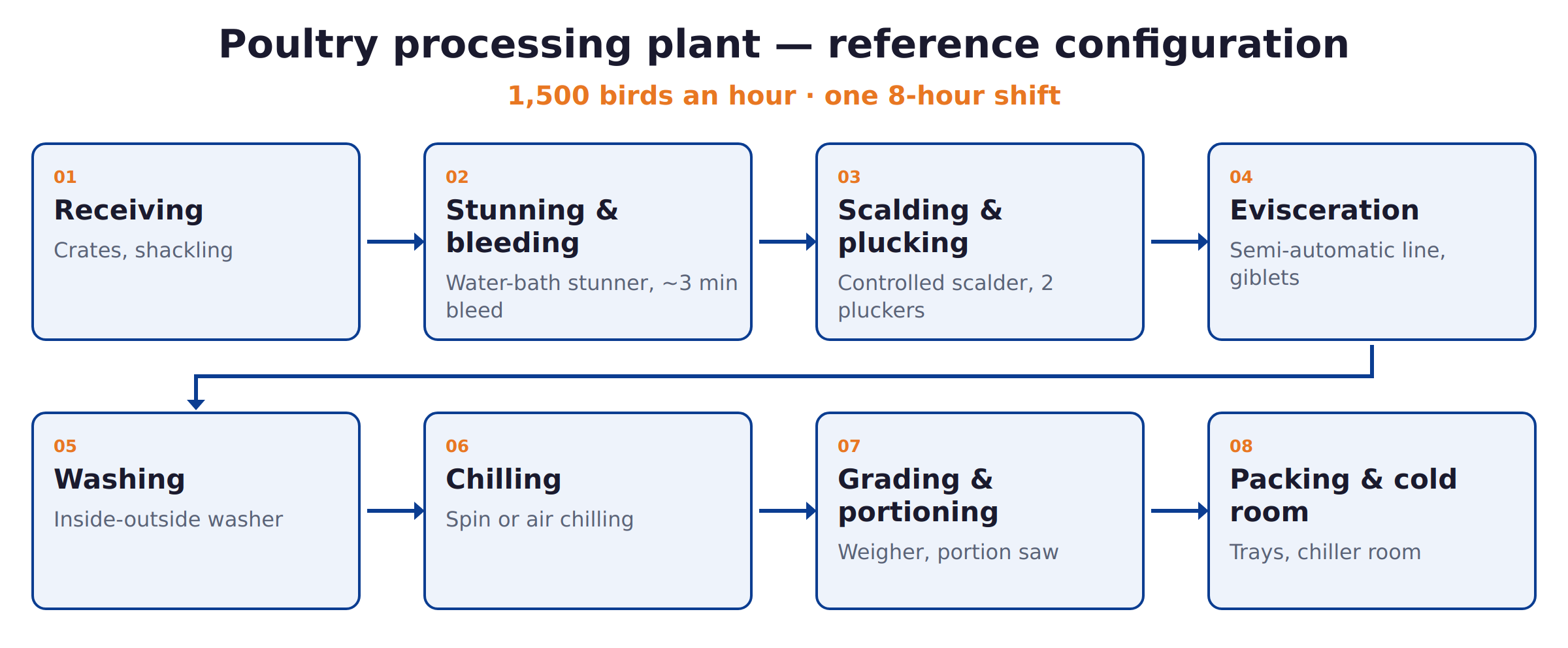
- The whole flow: receiving, stunning, bleeding, scalding, plucking, evisceration, washing, chilling, cut-up, packing, cold storage.
- Chilling and refrigeration: chiller capacity matched to line speed; flake ice, cold rooms and freezing sized for your product mix.
- Effluent and by-products: blood, feathers, offal and wastewater handling, and what your municipality requires before discharge.
- Hygiene design: stainless food-contact parts, cleanable surfaces, hand and boot wash, sterilisers for knives and tools.
- Utilities: hot water or steam for scalding, the electrical load, and potable water volume per bird.
- Installation and commissioning: named in the quote, with the engineer days and what "commissioned" means.
- Training: line staff and maintenance staff, with days and numbers stated.
- Warranty and support: who maintains the plucker, the chiller and the refrigeration plant after year one, and from where.
Ten questions to put to any abattoir equipment supplier
- What output will you guarantee, in birds per hour, at my bird weight and with how many people?
- Have you prepared layouts approved under the Poultry Regulations, and can I see one?
- Does your quote include chilling, ice, cold storage and freezing, or only the slaughter line?
- How do you deal with blood, feathers and wastewater in this design?
- How much water, hot water or steam and electricity does the plant use per hour at full output?
- Which parts of the line do you build, and which do you buy in?
- Who installs and commissions, and is that in this price?
- What training is included?
- What does the warranty cover, and who pays for an engineer to attend?
- Which plant in South Africa can I visit that runs your equipment?
Comparing abattoir quotes: what a full quote shows
| Section of the plant | What to look for in each quote |
|---|---|
| Live receiving and stunning | Crate handling, shackling, stunner type and settings |
| Bleeding, scalding, plucking | Bleed tunnel length, scalder temperature control, plucker capacity against line speed |
| Evisceration and washing | Manual, semi-automatic or automatic; inside-outside washer; giblet and feet handling |
| Chilling | Spin chiller or air chilling; capacity in birds per hour; ice supply |
| Cut-up, packing, weighing | Portioning, trays or bags, labelling; room temperature control |
| Freezing and cold storage | Blast freezer or IQF capacity, cold room size, refrigeration plant |
| Effluent and by-products | Screens, fat trap or flotation, blood collection, feather and offal handling |
| Utilities | Boiler or water heater, water treatment, compressed air |
| Freight, installation, commissioning | Incoterm, clearance, rigging, engineer days, acceptance test |
| Training, documents, warranty | Days, manuals, drawings for approval, warranty terms |
| Owner's scope | Building, drainage, electrical supply, water connection and permits, listed so they are not assumed |
Add up each quote with the items it leaves out. That is the only comparison that means anything; the method is set out in our same-scope comparison.
Common mistakes when buying abattoir equipment
- Buying the line before the registration category. Line speed decides whether you are a low- or high-throughput abattoir, and that decides the building.
- Chilling as an afterthought. A line that kills faster than the chiller can cool produces birds you cannot sell.
- No plan for effluent. Blood and fat in the drain bring the municipality to your door; the treatment has to be designed in from the start.
- Ignoring the value-added side. If you plan portions, brined product or processed meats, the hygiene and temperature requirements rise. South Africa's 2017–18 listeriosis outbreak, linked by WHO to a processed meat product and the manufacturer's processing environment, caused 978 confirmed cases and 183 known deaths; processing rooms are now inspected accordingly.
- Pricing the machines, not the plant. On most projects the equipment is 35–55% of the total once refrigeration, utilities, building work and installation are added.
Poultry processing equipment prices in 2026
Indicative, in US dollars, from our chicken processing line cost guide:
| Purchase | Capacity | Indicative price (2026) | Basis |
|---|---|---|---|
| Core slaughter line | 500–1,000 birds/hour | US$20k–75k | Ex-works China, machinery only |
| Slaughter-to-chill package | 1,000–2,000 birds/hour | US$70k–100k | Ex-works China, no refrigeration plant |
| Complete processing plant | 1,000–2,000 birds/hour | US$250k–800k | Landed and commissioned, building shell excluded |
| High-speed plant | 3,000 birds/hour and up | Quoted per configuration | Scope varies too much for an honest band |
South African facts that shape the decision
- Approval before construction. Regulation 2 of the Poultry Regulations, 2006 requires design drawings to be approved by the provincial executive officer before the abattoir is built.
- Portioning-room temperature. For low-throughput abattoirs slaughtering more than 500 birds a day, the regulations set an air-temperature limit of 12 °C in the portioning area, which means refrigeration for the room, not only for the product.
- Industry growth plan. The Poultry Master Plan, signed in November 2019, aimed to expand the industry; the dtic reported investment of about R1.8 billion and slaughter capacity rising from 19.7 million to 22.5 million birds a week.
- Small growers need small abattoirs. Government reporting on a departmental abattoir in the North West described a private abattoir's minimum of 1,000 chickens, beyond the reach of many emerging growers, and a registered low-throughput plant of up to 500 birds a day built for them.
- Brining limits. Since 2016, rules under the Agricultural Product Standards Act cap brine at 10% for whole birds and 15% for portions, so injection equipment has to be controllable and verifiable.
- Import duty. SARS's tariff lists meat and poultry processing machinery (8438.50) as free of general duty. Some related items are not; heat exchange units under 8419.50, for example, carry duty. Import VAT of 15% applies on the customs value plus 10% and duty, and is claimable by VAT vendors. Our import duty guide explains the calculation.
Where CISH fits
CISH is a turnkey plant company. We specify poultry lines from audited factories in China against your bird weight and output, prepare layout drawings you can submit for provincial approval, ship and clear the equipment, and install and commission the plant, including chilling, freezing and effluent pre-treatment, against an agreed output in birds per hour. We suit first commercial abattoirs and processors adding a line. For a rural abattoir of a few dozen birds a day, a local fabricator is the better choice.
New to slaughtering? Our guide to starting an abattoir business covers the Meat Safety Act and registration first.
Frequently asked questions
Who supplies chicken abattoir equipment in South Africa?
Local stainless fabricators, agents of European poultry processing brands, Chinese factories selling direct, and turnkey companies that deliver the whole plant. Small rural abattoirs are usually served locally; plants of 500 birds an hour and more usually involve imported lines.
How much does a small chicken abattoir cost?
A core slaughter line of 500–1,000 birds an hour costs about US$20k–75k ex-works in China. A complete 1,000–2,000 bird-an-hour plant with chilling, freezing, cold storage and effluent treatment runs about US$250k–800k landed and commissioned, excluding the building shell.
Do I need approval before building a poultry abattoir?
Yes. Under the Poultry Regulations, 2006, made under the Meat Safety Act, design drawings must be submitted to the provincial executive officer and approved before the abattoir is erected. Choose a supplier who can prepare a layout for that submission.
What is a low-throughput poultry abattoir?
One registered to slaughter up to 2,000 birds a day; the provincial executive officer may set a lower limit based on the equipment and chilling. A rural abattoir is limited to 50 birds a day. Above the low-throughput limit, high-throughput requirements apply.
Is it better to buy a local or an imported poultry line?
For a rural or small low-throughput abattoir, local fabricators are usually the practical choice. For a line of 500 birds an hour or more, imported lines are usually much cheaper than locally engineered equivalents, but they need someone to specify, install and commission them and a plan for support.
Is there import duty on poultry processing machinery?
Meat and poultry processing machinery under tariff heading 8438.50 is free of general duty in SARS's 2026 tariff, though some related items such as certain heat exchange units carry duty. Import VAT of 15% applies and VAT vendors can claim it back. Confirm headings with your clearing agent.
What output should a supplier guarantee?
Birds per hour at your live bird weight, with a stated number of line workers, demonstrated at handover. A conveyor speed on a brochure is not an output.
Does CISH sell individual pluckers or scalders?
No. We supply, install and commission complete poultry processing plants. For a single machine, a local dealer or fabricator is the better route.