The Red Meat Regulations and Poultry Regulations set requirements for rural, low-throughput and high-throughput abattoirs. As an indication for 2026, a core poultry slaughter line for 500–1,000 birds an hour costs about US$20,000–75,000, a slaughter-to-chill machinery package for 1,000–2,000 birds an hour about US$70,000–100,000, and a complete poultry processing plant of that size about US$250,000–800,000. Red meat abattoirs are priced per configuration. Building, cold rooms, effluent treatment and water often cost as much as the machines. CISH supplies, installs and commissions complete poultry abattoirs and meat processing lines.
Step 1: choose species and scale
| Poultry abattoir | Red meat abattoir | |
|---|---|---|
| Species | Broilers, layers at end of lay, sometimes ducks | Cattle, sheep, goats, pigs |
| Typical start | A few hundred to 2,000 birds an hour | A few to dozens of animals a day |
| Key equipment | Shackling, stunning, killing, scalding, plucking, evisceration, chilling | Stunning, hoisting, bleeding, dressing, carcass rails, splitting, chilling |
| Cold chain | Carcass chilling, portion packing, freezing | Carcass chillers, deboning room |
| By-products | Feathers, blood, offal, feet | Hides, skins, offal, blood, bones |
| Market | Butchers, retailers, informal traders, food service | Butchers, wholesalers, retailers, feedlot and farm owners |
Most new entrants start with one species. Poultry needs more machinery per unit but a steady supply of birds from contract growers; red meat needs more space per animal and a strong livestock supply.
Step 2: understand the law before you design
- Slaughter only at an abattoir: section 7 of the Meat Safety Act prohibits slaughtering animals for sale anywhere other than a registered abattoir, and prohibits selling meat from animals slaughtered elsewhere. Slaughter for own use or for cultural and religious purposes is an exception, but that meat may not be sold.
- Approval and registration: section 8 requires a slaughter facility to be approved and registered with the national executive officer, on payment of the prescribed fee. The registration certificate states its validity, up to five years, and the facility's grading.
- Throughput categories: the Red Meat Regulations, 2004, and the Poultry Regulations set requirements for rural, low-throughput and high-throughput abattoirs. The daily limits for each category are set in the regulations; confirm them with your provincial veterinary services before you design.
- Meat inspection: registered abattoirs operate with meat inspection services under the Act.
- Classification: red meat carcasses sold under the classification system are audited by SAMIC, set up by the red meat industry.
Our abattoir requirements guide sets out the Act and regulations in detail.
Step 3: secure livestock supply and buyers
An abattoir earns money on throughput. Before you build, confirm:
- Supply: contract growers for broilers, or feedlots, farmers and auctions for cattle and small stock, with volumes by month.
- Service slaughter or own trading: will you charge a slaughter fee for farmers and butchers, buy animals and sell meat, or both?
- Buyers: butchers, retailers, wholesalers, food service, informal traders. Retail buyers will audit hygiene and ask for food safety certification.
- Seasonality: festive season peaks, and drought-driven livestock sales.
Step 4: equipment and what it costs
| Purchase | Capacity | Indicative price (2026) |
|---|---|---|
| Core poultry slaughter line | 500–1,000 birds an hour | About US$20,000–75,000 |
| Poultry slaughter-to-chill package | 1,000–2,000 birds an hour | About US$70,000–100,000 |
| Complete poultry processing plant | 1,000–2,000 birds an hour, with chilling, portioning and packing | About US$250,000–800,000 |
| High-speed poultry plant | 3,000 birds an hour and up | Quoted per configuration |
| Red meat abattoir | By species and animals a day | Quoted per configuration |
| Chiller rooms | Small to medium | About US$15,000–38,000 installed |
| Blast freezer | By batch | From about US$60,000 |
Our poultry abattoir cost guide shows what each band includes.
Step 5: the building, water and effluent
An abattoir is a building designed around hygiene: separate dirty and clean areas, a one-way flow from live animals to packed meat, washable walls and floors, drains, hand-wash stations, changing rooms, and a vet inspection point. It uses large amounts of potable water and produces effluent with blood, fat and solids. Plan:
- Water supply of drinking quality, with storage.
- Effluent treatment: screens, fat traps and, depending on volume and municipal rules, a treatment plant before discharge.
- By-product handling: blood, feathers, offal, hides and condemned material, with a rendering or disposal route. Some waste activities need licensing under the Waste Act.
- Power: refrigeration, scalders and pluckers need a reliable supply and backup.
Step 6: cold chain
Carcasses must be chilled promptly and kept cold. Poultry plants chill birds in water or air chillers; red meat carcasses hang in chillers before deboning. You need chiller rooms sized for at least one day's kill plus a margin, freezer storage if you sell frozen product, and refrigerated delivery.
Step 7: work out the numbers
Your income is either slaughter fees or the margin between livestock cost and meat sales, plus by-products. Your costs include livestock, labour, water, electricity, effluent treatment, packaging, inspection, transport and loan repayments. At low throughput, fixed costs per bird or animal are high, so plan for the volume you can actually fill.
Worked example: a poultry abattoir for contract growers
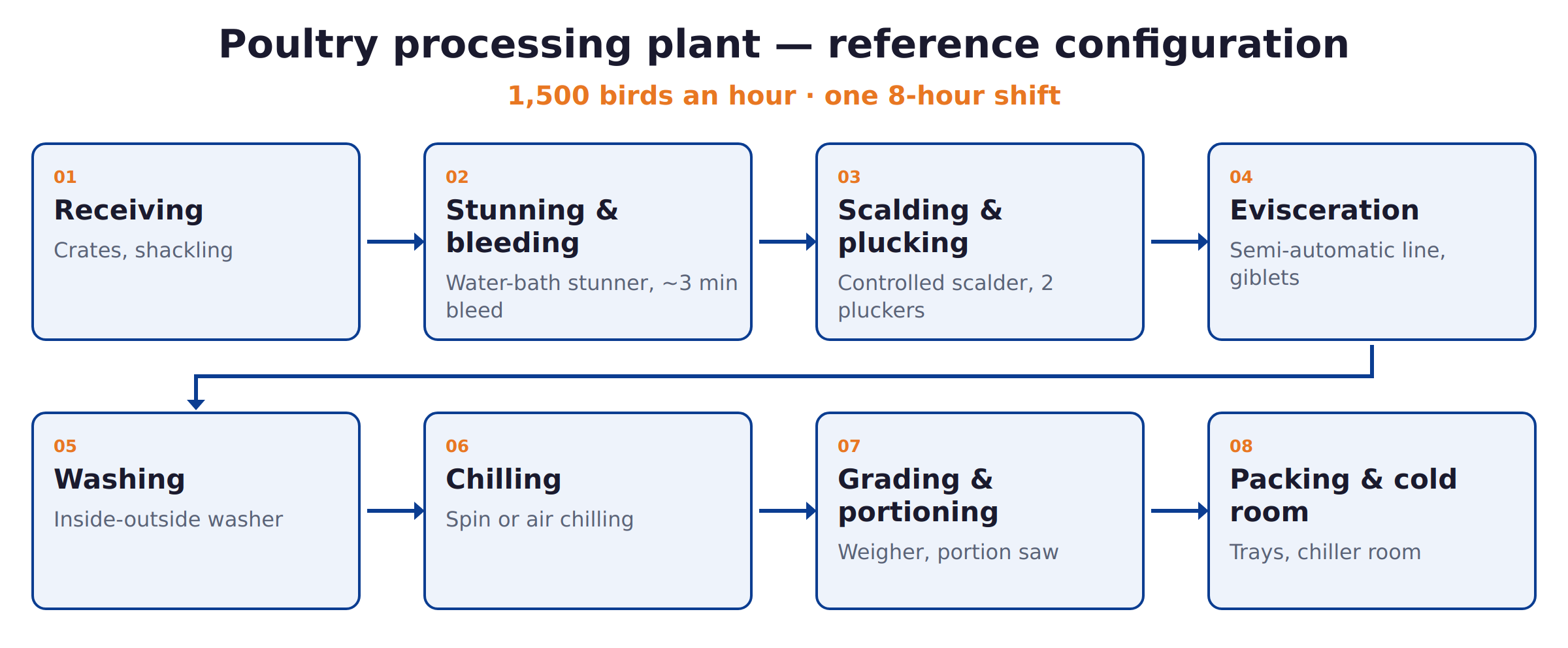
A group of broiler growers in North West sells live birds to traders at low prices. It plans a low-throughput poultry abattoir for about 1,000 birds an hour on one shift, with a slaughter-to-chill package, a portioning table, an air chiller, two chiller rooms, a blast freezer and a bagging line for frozen portions. It applies for approval and registration before construction, designs the building with the provincial veterinary services, adds a fat trap and screening for effluent, and agrees a slaughter schedule with its growers. Sales go to butchers and wholesalers in nearby towns. The figures are illustrative.
Common mistakes
- Building before approval: the design must meet the regulations for your category.
- Underestimating water and effluent.
- No livestock supply agreements.
- Too few chiller rooms for the daily kill.
- No by-product plan.
- A plant too large for the throughput you can fill.
Where CISH fits
We supply complete poultry abattoirs and meat processing lines, slaughter, evisceration, chilling, portioning, packing and cold storage, from audited factories in China, sized to your throughput. CISH ships, clears, installs and commissions the plant with your team, and trains operators. Approval, registration and meat inspection arrangements are applied for by the abattoir owner with the veterinary authorities.
Frequently asked questions
How much does it cost to start an abattoir in South Africa?
It depends on species and throughput. As an indication for 2026, a complete poultry plant for 1,000–2,000 birds an hour costs about US$250,000–800,000 for the equipment; red meat abattoirs are quoted per configuration. Building, water, effluent and cold rooms add to this.
Do I need a licence to slaughter animals and sell the meat?
Yes. Under the Meat Safety Act, animals for sale may only be slaughtered at an approved and registered abattoir.
How long is abattoir registration valid?
The registration certificate states its validity, which may not exceed five years.
What are the abattoir categories?
The regulations set requirements for rural, low-throughput and high-throughput abattoirs, with daily limits for each.
Can I sell meat from animals I slaughter on the farm?
No. Slaughter for own use or cultural purposes is allowed, but that meat may not be sold.
Does CISH help with registration?
No. We supply the plant and technical documents; the owner applies for approval and registration.