Extra moulds for 200, 250 or 300 mm panels, film lamination, hot stamping or printing for wood and marble finishes, and a hot-cold mixer for the dry blend add to that and are priced per configuration. Wide WPC or PVC board lines for 1,220 mm boards are a different, larger investment. Landed and installed in South Africa, budget about 1.25–1.45 times the ex-works price. Extruders enter duty-free under 8477.20. CISH supplies, installs and commissions complete PVC ceiling panel lines.
PVC ceiling panel machine prices, 2026
| What you buy | Typical specification | Indicative price (2026) | Notes |
|---|---|---|---|
| Complete 600 mm panel extrusion line | Conical twin-screw SJSZ 51–65 class, mould, vacuum calibration, haul-off, cutter, stacker | About US$25,000–60,000 ex-works | Seven factory listings in this range |
| Extra panel moulds | 200, 250, 300 or 400 mm widths, other profiles | Priced per mould | Each width needs its own mould and often calibrators |
| Hot-cold mixer for dry blend | Batch mixing of resin, filler, stabiliser | Priced per configuration | Needed unless you buy compound |
| Film lamination or hot stamping | Wood grain, marble, colour finishes | Priced per configuration | Adds a finish customers pay more for |
| Printing (transfer or UV) | Decorative patterns | Priced per configuration | |
| Wide WPC or PVC board line | About 1,220 mm boards, high output | Quoted per configuration | Different market and investment |
Prices are ex-works listings, not quotes. Landed and installed through Durban is typically about 1.25–1.45 times ex-works, more for inland sites far from the port.
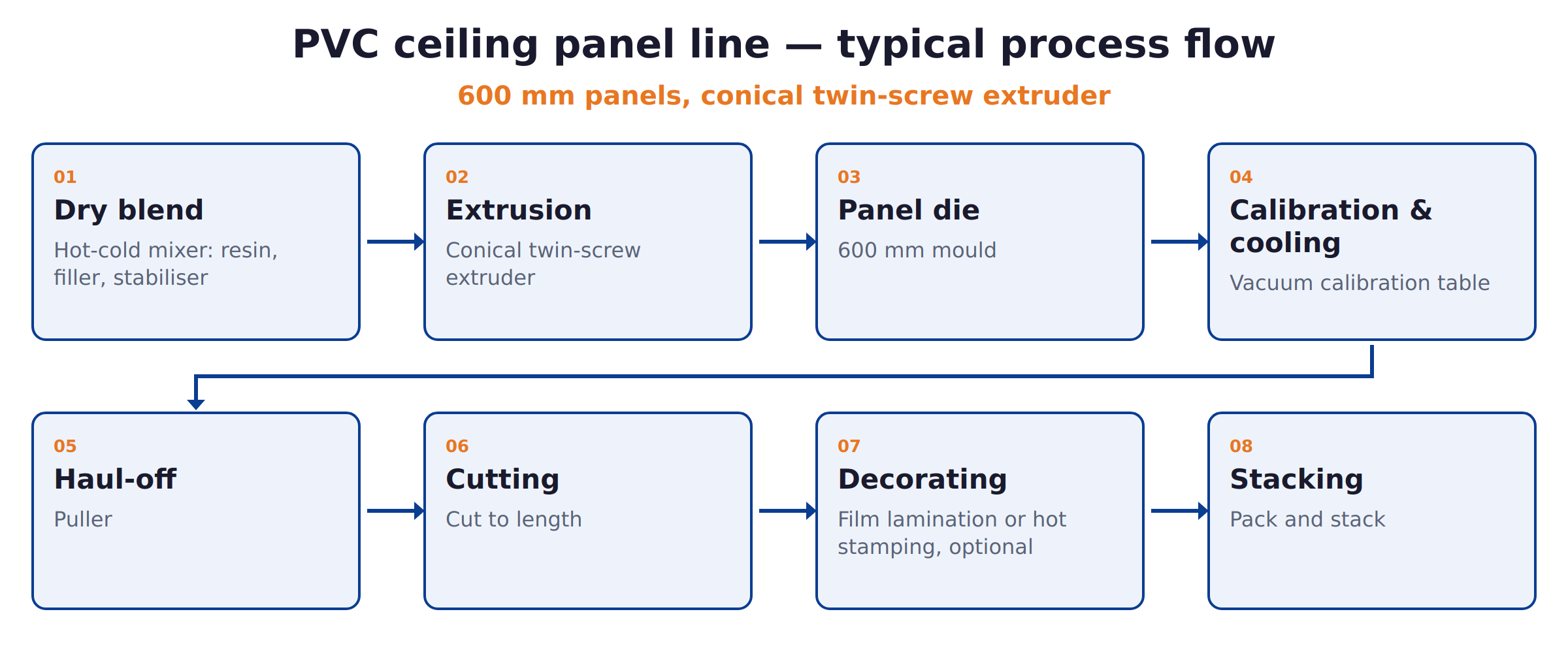
How the line works
- Mixing: PVC resin, calcium carbonate, a calcium-zinc stabiliser, lubricants and processing aids are blended hot, then cooled, into a dry blend.
- Extrusion: a conical twin-screw extruder melts the blend and pushes it through the panel mould.
- Calibration: a vacuum table with water cooling holds the panel shape while it sets.
- Haul-off: caterpillar or belt pullers draw the panel at constant speed.
- Cutting: a saw or knife cutter cuts panels to length.
- Stacking and finishing: panels are stacked, then laminated, hot-stamped or printed if required, and packed.
Output and power
A 600 mm line with an SJSZ 65 class extruder typically runs at roughly 150–300 kg/h, depending on panel weight per metre and formulation. Lighter panels run more metres per hour; heavier, stronger panels fewer. Extruder motors, heaters and vacuum pumps make the line a steady power user. Eskom's standard tariff rose 8.76% for 2026/27, so ask for connected load and typical consumption per kilogram.
Formulation decides cost and quality
Most of the cost of a panel is material. More calcium carbonate filler lowers cost but makes panels heavier and more brittle; more resin makes them tougher and more expensive. A good supplier will help set a starting formulation and run your materials during commissioning. Buy resin and stabiliser from reliable sources and test each delivery. Keep the formulation consistent: panels that change colour or brittleness from batch to batch lose customers.
Who buys PVC ceilings
PVC ceiling panels compete with gypsum board, fibre cement and timber in homes, extensions, bathrooms, kitchens, shops and low-cost housing. They are light, moisture-resistant and easy to clean. Buyers judge them by thickness, rigidity, surface finish, colour stability and joint fit. Ask your building control officer about fire performance requirements for your target buildings, and keep test data for your product.
How to compare quotes
- Extruder model and screw diameter, with motor power.
- Output in kg/h on a stated panel weight per metre.
- Moulds included: widths and profiles.
- Calibration table length and cooling.
- Haul-off and cutter type.
- Mixer included or not.
- Finishing: lamination, hot stamping or printing included or not.
- Controls: temperature controllers, inverter, PLC.
- Installation, commissioning on your formulation, and training.
- Spares: heater bands, thermocouples, saw blades, belts.
Choose by situation
- Hardware store and builders' supply in one region: one 600 mm line with two or three moulds and a laminator.
- Growing brand: a second line for different widths, plus hot stamping and printing.
- Housing contracts: consistent product, test data and delivery capacity matter more than finishes.
- Wide boards for furniture or cladding: a WPC or PVC board line, quoted separately.
Worked example: a ceiling panel start-up in Gauteng
A building materials trader in Gauteng sells imported PVC ceilings and wants to make its own. It installs a 600 mm line with an SJSZ 65 class extruder, moulds for 600 and 250 mm panels, a hot-cold mixer and a film laminator for wood grain finishes, in a 600 m² unit with three-phase power. In the first months it adjusts filler content to balance cost and rigidity and sells plain white panels first, then laminated panels. The figures are illustrative.
What separates a good line
The extruder screws and barrel decide output and how long the line lasts: ask for the screw material and surface treatment, and the motor and gearbox sizes. The mould decides panel quality: polished, chrome-plated flow channels and a precise lip give an even wall and a smooth surface. A long enough calibration table with good vacuum and cooling keeps panels flat and straight. The haul-off must pull evenly without marking the surface, and the cutter must cut square without cracking the panel. Ask the factory to run your panel profile with a formulation close to yours and send you samples, and measure their weight per metre, wall thickness and flatness before you sign.
Space, staff and utilities
A 600 mm line is roughly 25–30 m long including the stacker, so plan a building of about 40 m in length with space for raw material storage, mixing and finished panels. Panels are bulky: a week of production can fill a large part of the floor. Typical staffing is one or two operators per shift on the line, one person on mixing and one or two on finishing and packing. The line needs three-phase power, cooling water for the calibration table, often a small chiller or cooling tower, and compressed air for the cutter and stacker.
Mistakes we see
- Buying only one mould: customers want several widths and finishes.
- No mixer: inconsistent dry blend and panel quality.
- Too much filler: brittle panels and complaints.
- No space for stock: long panels need racks and floor space.
- Imported used lines without a permit: second-hand equipment needs an ITAC import permit before shipment.
What we see in South Africa
- PVC ceilings are widely sold in hardware stores and builders' merchants.
- Laminated and printed finishes sell at higher prices than plain white.
- Imports compete on price, so local makers win on availability and finishes.
- Extruders enter duty-free under 8477.20; VAT applies.
- Electricity is a real cost for extrusion lines.
- Housing and extension work drive demand.
Where CISH fits
We supply complete PVC ceiling panel lines, mixing, extrusion, calibration, cutting, stacking and finishing, from audited factories in China, sized to your panels and output. CISH ships them to Durban, clears and delivers them, installs and commissions the line on your formulation, and trains your operators. For a single used extruder, a local seller is usually the better choice.
Frequently asked questions
How much is a PVC ceiling machine in South Africa?
As an indication for 2026, a complete 600 mm PVC ceiling panel extrusion line costs about US$25,000–60,000 ex-works, before moulds for other widths, finishing machines, freight and installation.
What machines do I need to make PVC ceilings?
A hot-cold mixer, a conical twin-screw extruder, a panel mould, a vacuum calibration table, a haul-off, a cutter and a stacker, plus lamination or hot stamping for finishes.
What raw materials are used for PVC ceiling panels?
PVC resin, calcium carbonate filler, a calcium-zinc stabiliser, lubricants and processing aids.
How much does a PVC ceiling line produce?
A 600 mm line typically runs at roughly 150–300 kg an hour, depending on panel weight and formulation.
Is there import duty on PVC extrusion lines?
Extruders under 8477.20 enter South Africa duty-free; VAT applies.
Does CISH supply PVC ceiling lines?
Yes, complete lines with mixing, finishing, commissioning and training.