PVC and HDPE pipe extrusion lines in South Africa are sold by local agents of European and Asian extruder makers, dealers of used lines, Chinese factories selling complete lines direct, and turnkey companies that set up a pipe plant with mixing, extrusion, testing and stacking. Choose the supplier who commits to kilograms per hour of pipe that passes those tests, not just an extruder speed.
Who sells pipe extrusion lines
Irrigation suppliers, plumbing merchants, contractors and plastics converters look for pipe lines. Four supplier types make the offers.
| Supplier type | What they sell | Price | Who answers for output | Best fit |
|---|---|---|---|---|
| Agent of European or Asian extruder maker | Extruders, dies, vacuum tanks, haul-offs, cutters | High | The maker, through the agent | Established pipe makers adding capacity |
| Used line dealer | Second-hand extruders and downstream equipment | Low to moderate | Usually nobody, after sale | Buyers with experienced extrusion staff |
| Chinese line maker, direct | Complete PVC and HDPE pipe lines, mixers, belling machines | Lowest on the quote | You, after delivery | Buyers with process engineers |
| Turnkey pipe plant company | Compounding to stacked pipe, with testing lab, commissioned | Between direct and European | The turnkey company, at agreed kg per hour and test results | New pipe plants |
Pass the pressure test, not just the speed test
A pipe line is judged by pipe that passes its standard at the right wall thickness, not by how fast the extruder runs. Thin walls save material but fail tests; thick walls pass but waste money. The die, vacuum calibration, cooling length and haul-off control all decide wall thickness.
Ask any supplier three things:
- Which pipes: PVC-U pressure, PVC-U non-pressure, HDPE or PPR, with diameter range and pressure classes.
- Kilograms per hour at each size, with wall thickness tolerance.
- What testing the plant needs to prove compliance batch by batch.
PVC-U or HDPE: which line first?
| PVC-U pipe line | HDPE pipe line | |
|---|---|---|
| Typical buyers | Municipal water and sewer, building plumbing, irrigation mains | Water supply, irrigation, mining, rural schemes |
| Raw material | PVC resin plus stabilisers, fillers and lubricants, blended on site | Ready-compounded PE pellets |
| Extruder | Usually twin-screw, fed with dry blend | Usually single-screw |
| Jointing | Belled or socketed ends, made on the line | Butt or electrofusion welding on site |
| Coils | Rigid lengths only | Small diameters can be coiled |
| Key quality risk | Poor dry blend, uneven gelation | Wall thickness and ovality on large sizes |
Many new pipe makers start with the product their nearest buyers order most. A second line for the other material often shares the building, testing lab and stacking yard.
What to check in the supplier
Extruder type
PVC-U pipe usually runs on conical or parallel twin-screw extruders fed with a dry blend; HDPE and PPR run on single-screw extruders. Ask why the offered extruder suits your material.
Mixing for PVC
PVC needs a hot and cold mixer to prepare the dry blend with stabilisers and fillers. Ask whether mixing is included and at what batch size.
Downstream equipment
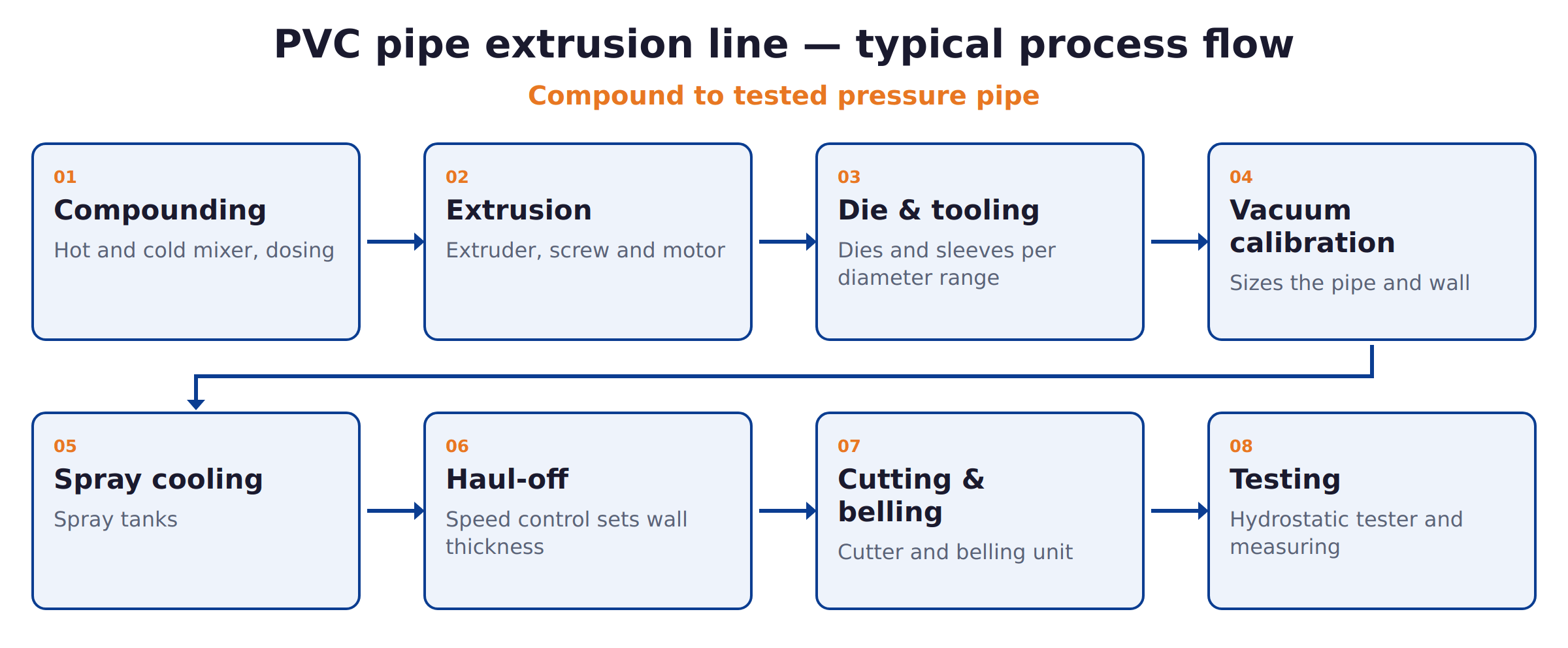
Vacuum calibration tanks, spray cooling, haul-off, cutter and belling or socketing decide pipe quality and productivity. Ask for cooling length at your largest diameter.
Where to find pipe line suppliers
- The Southern African Plastic Pipe Manufacturers Association (SAPPMA) sets audits for members and publishes procurement guidance.
- Plastics trade shows bring extruder makers and agents together; check dates with the organisers.
- Working plants: visit a line making your diameters and material.
- China: a large share of pipe lines sold in Africa are made in China. Our supplier audit checklist explains what to inspect.
Pipe line suppliers stay unnamed on this page.
How to choose: a 10-point checklist
- Pipes and standards listed: material, diameters, pressure classes.
- Kilograms per hour at each size, with wall tolerance.
- Extruder type matched to the material.
- Mixing for PVC dry blend.
- Dies and calibration sleeves for each diameter.
- Cooling, haul-off, cutting and belling.
- Testing lab: hydrostatic pressure, dimensions, impact.
- Power and cooling water for the line.
- Installation, commissioning on your compound, and training.
- Support for screws, barrels, heaters and dies.
Ten questions to ask
- Which pipe sizes and pressure classes can this line make?
- What kg per hour at each size, and what wall tolerance?
- What extruder, screw design and motor power?
- Is the PVC mixer included?
- Which dies and calibration sleeves are included?
- How long is the cooling section at the largest diameter?
- What testing equipment is included?
- Is installation, commissioning and training included?
- How quickly can I get heaters, screws and die parts?
- Which pipe plant runs this line, and may I see test results from it?
Comparing pipe line quotes
| Section | What each quote should state |
|---|---|
| Compounding | Hot and cold mixer, dosing, batch size |
| Extrusion | Extruder type, screw, motor, output |
| Tooling | Dies, sleeves, diameter range |
| Calibration and cooling | Vacuum tank, spray tanks, lengths |
| Haul-off and cutting | Haul-off type, cutter, belling unit |
| Testing | Hydrostatic tester, measuring equipment |
| Utilities | Power, chiller, cooling water, air |
| Installation and training | Engineer days, trials on your compound |
| Owner's scope | Building, crane, power, certification |
Bring the scopes level before you compare totals. The same-scope comparison shows the method.
Common mistakes
- Buying an extruder without dies and sleeves for every size.
- No testing lab. You cannot prove compliance.
- Using bought-in recyclate in pressure pipe. Buyers reject it.
- Short cooling. Large pipes deform.
- Ignoring certification time. Tenders need the mark before the first order.
Pipe line prices in 2026
Indicative, in USD, from our bag, pipe and preform machine price guide:
| Purchase | Capacity | Indicative price (2026) |
|---|---|---|
| Single-screw pipe line | Small diameters, HDPE or PPR | From about US$20,000 ex-works |
| PVC-U twin-screw pipe line | Pressure and non-pressure pipe | Higher, by diameter range |
| Large or multilayer pipe line | Large diameters, co-extrusion | About US$200,000 and up |
| Complete pipe plant, landed | Mixing, extrusion, testing, stacking | Quoted per configuration |
Standards, buyers and duty in South Africa
- Pressure pipe standards. Industry procurement guidance names SANS 966-1 for PVC-U and SANS ISO 4427-2 for HDPE as the certifications buyers should check.
- Virgin material. The same guidance asks for evidence that only virgin raw materials, and no bought-in recycled material, are used, with full batch traceability.
- The SAPPMA mark. SAPPMA urges municipalities to specify its mark in tenders and audits member factories.
- Independent tests. Buyers are advised to ask for independent lab results for each supplied batch.
- Worker safety. Extruders, cutters and haul-offs are driven machinery under the OHS Act.
- Duty. Extruders (8477.20) carry no general duty. Import VAT of 15% is reclaimable by VAT vendors; see our import duty guide.
Where CISH fits
CISH is a turnkey pipe plant company. We specify PVC and HDPE pipe lines from audited factories in China against your pipe sizes and standards, with mixing, tooling and testing, ship and clear them, and install and commission the line with kilograms per hour of compliant pipe demonstrated, and your operators trained. For a single used extruder or a spare die, a local dealer is often the better choice.
Frequently asked questions
Who sells PVC pipe machines in South Africa?
Agents of European and Asian extruder makers, used line dealers, Chinese line makers selling direct, and turnkey companies that set up complete pipe plants.
How much does a PVC pipe extrusion line cost?
As an indication for 2026, single-screw lines start at about US$20,000 ex-works, and large or multilayer lines run to about US$200,000 and more.
Which standard applies to PVC pressure pipe?
SANS 966-1 for PVC-U pressure pipe, and SANS ISO 4427 for HDPE water pipe. Many municipal buyers also ask for the SAPPMA mark.
Can I use recycled PVC in pipes?
Not bought-in recyclate in pressure pipe; procurement guidance calls for virgin material. Your own clean in-house scrap is a different matter.
Is pipe extrusion machinery duty-free?
Extruders (8477.20) carry no general duty in SARS's 2026 tariff. Import VAT of 15% applies.
Does CISH sell single extruders?
No. We supply complete pipe extrusion lines, installed and commissioned. For a single used extruder, a local dealer is usually the better route.