Many refuse bag makers in South Africa use a high share of recycled polyethylene, so a third stage, a recycling and pelletising line, is often part of the plan. A pelletising line adds about US$80,000–120,000; complete plants are quoted per configuration. Imported polyethylene bags carry 15% general duty, which supports local makers.
Refuse bag machine prices in 2026
| Machine | Capacity | What it does | Indicative price (2026) |
|---|---|---|---|
| Blown film machine (single layer or ABA) | About 30–130 kg/h of film | Extrudes HDPE or LDPE film tube | About US$7,000–50,000 ex-works |
| Roll-type refuse bag machine | Dozens to about 200 bags/min per lane, often two lanes | Star seal, flat seal or drawstring bags, perforated and wound on rolls, cored or coreless | About US$10,000–40,000 ex-works |
| Pelletising line for recycled film | Per output | Shreds, washes or densifies and pelletises film | About US$80,000–120,000 more |
| Three-layer co-extrusion and complete plants | 300 kg/h and up | Higher output, mixed recycled and virgin layers | Quoted per configuration |
Ex-works listing prices; freight, installation, power, a building, cooling, compressed air and working capital come on top. The extruder and bag machine are usually around 35–55% of the money a bag plant needs.
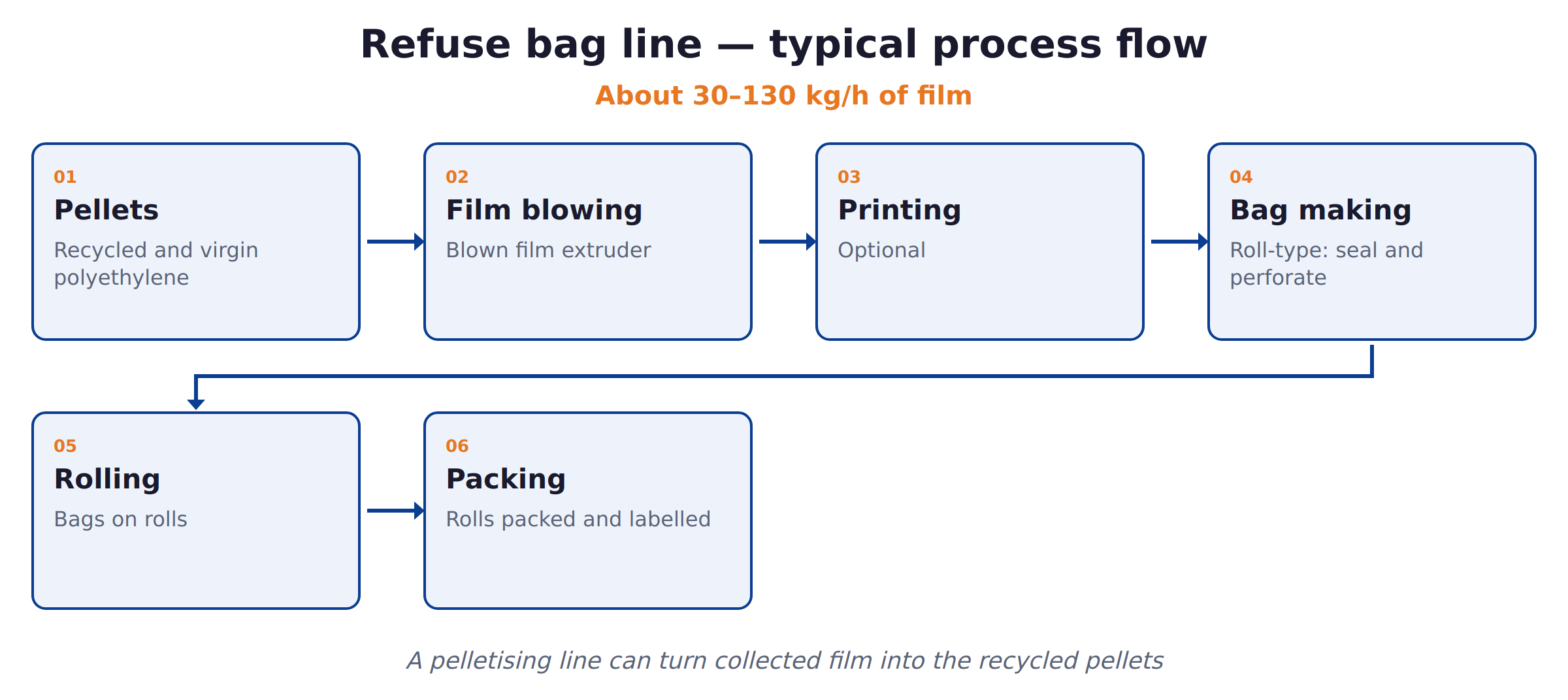
How a refuse bag line works
- Film blowing. Pellets, often a blend of recycled and virgin polyethylene with colour masterbatch, are melted in an extruder and pushed through a ring die. Air inflates the tube into a bubble, which is cooled, collapsed and wound. The blow-up ratio and haul-off speed set the width and thickness.
- Bag making. The film roll is unwound, sealed across at each bag length, perforated, and either wound into rolls of bags or cut into flat bags. Star-seal bags have a folded bottom that spreads the load; drawstring bags add a tie.
- Packing. Rolls are counted, sleeved or boxed and labelled.
- Recycling (optional). Edge trim and rejects, plus bought-in recycled film, are pelletised and fed back to the extruder.
What drives the price
- Film output in kg per hour, set by screw size and die.
- Single layer or co-extrusion. ABA and three-layer lines let you bury recycled material in the middle layer.
- Bag machine lanes and speed.
- Seal type: flat, star or drawstring.
- Cored or coreless rolls.
- Automation: automatic roll change, counting and packing.
- Recycling capacity if you make your own pellets.
Recycled content: the economics of refuse bags
Refuse bags are one of the main uses of recycled polyethylene film in South Africa. Plastics SA reported that 485,000 tonnes of plastic were recycled in 2025. Recycled pellets are usually cheaper than virgin polymer, but their quality varies, so most makers blend recycled and virgin material and adjust thickness to keep strength. A line that can run a high share of recycled material reliably is worth more than one that is cheaper to buy but needs virgin polymer to perform.
The recycled-content rules in South Africa's plastic bag regulations are written for carrier bags and flat bags. Check with the regulator or a specialist whether your product falls under them before you design packaging claims. Producers of packaging also fall under the Extended Producer Responsibility Regulations of 2020.
Who buys refuse bags
| Buyer | What they want |
|---|---|
| Municipalities and waste contractors | Large volumes, set sizes and thickness, tenders |
| Retailers and wholesalers | Branded rolls, consistent quality, barcodes, promotional packs |
| Cleaning companies, offices, hospitals | Heavy-duty and coloured bags, regular delivery |
| Spazas and small shops | Affordable small rolls |
Choosing by scenario
- New bag business: one blown film machine and one two-lane roll bag machine, running recycled pellets bought in.
- Recycler adding a product: a film line and bag machine fed by your own pellets, so you sell finished bags rather than pellets.
- Existing bag maker: an ABA or three-layer line for better strength from recycled material, and automatic packing.
How to compare quotes
- Film output at your thickness and width, using your material blend.
- Screw and die sizes, and whether the line is single layer or co-extrusion.
- Bag machine speed, lanes, seal types and roll format.
- Recycled content the line is designed to run.
- Power and starting load; extruders draw heavy loads.
- Cooling: chiller and air ring.
- Installation, commissioning on your material, and training.
- Spares: heaters, screens, sealing knives, perforation blades.
- References of plants making similar bags.
- Delivery and payment milestones.
Duty and rules
- Import duty on bags. Polyethylene refuse bags fall under "other" bags (3923.21.90), which carry 15% general duty, with exemptions for the EU and UK, EFTA and SADC. The tariff's own definition of flat bags excludes household bags, including refuse bags and bin liners.
- Machinery. Extruders (8477.20) and other plastics machinery (8477.80) carry no general duty; 15% import VAT applies.
- Plastic bag regulations. Carrier and flat bags must meet thickness and recycled-content rules; confirm how they apply to your products.
- EPR. Packaging producers fund collection and recycling through EPR schemes.
Worked example: a recycler moving into bags
Picture a business that already washes and pelletises post-consumer film and sells pellets to converters. Pellet prices swing, and converters pay slowly, so the owner decides to make refuse bags from part of the output. The plan is one blown film machine of around 100 kg an hour that can run a high share of the company's own pellets, blended with a little virgin polymer and black masterbatch, and a two-lane roll bag machine making star-seal bin liners on rolls of 20.
The trials show that film made from recycled pellets alone has holes when the melt filter is not changed often enough, so the operators change screens on a schedule and test film strength each shift. The bag machine keeps up with the film line at standard sizes, but heavy-duty bags slow it down, so the business adds a second bag machine later. Selling finished bags to cleaning companies and municipalities brings a steadier margin than selling pellets, and trim from bag making goes straight back into the pelletiser.
Common mistakes
- Buying a film line that cannot run recycled material well.
- No melt filtration on recycled pellets: holes and weak film.
- Bag machine too slow for the film line.
- Ignoring trim recycling.
- Undersized power supply.
Where CISH fits
We supply complete refuse bag lines, film blowing, bag making, packing and, where needed, recycling and pelletising, from audited factories in China, sized to your bags and output. CISH ships and clears the line, installs and commissions it on your material blend, and trains your operators. For a single bag machine to add to an existing film line, a local dealer is often the better choice.
Frequently asked questions
How much does a refuse bag making machine cost in South Africa?
As an indication for 2026, a blown film machine for about 30–130 kg an hour costs about US$7,000–50,000 ex-works, and a roll-type refuse bag machine about US$10,000–40,000.
What machines do I need to make refuse bags?
A blown film extruder, a bag making machine that seals, perforates and winds or cuts bags, and packing. Many makers add a recycling and pelletising line.
Can refuse bags be made from recycled plastic?
Yes. Many refuse bags use a high share of recycled polyethylene, blended with virgin material for strength.
Is there import duty on plastic bags in South Africa?
Polyethylene bags carry 15% general duty, with exemptions for the EU and UK, EFTA and SADC.
Do the plastic bag regulations apply to refuse bags?
The recycled-content rules are written for carrier and flat bags. Check how they apply to your product before making claims.
Does CISH supply single bag machines?
We supply complete refuse bag lines. For a single bag machine, a local dealer is often better.